Why wind farm stops its turbines for vultures to pass
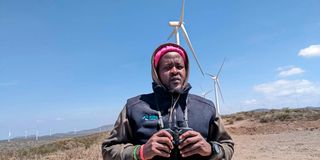
Matayo Ezekiel, a bird watcher at Kipeto Wind Farm

What you need to know:
- Raptors are birds of prey. A recent study done by Kenyan scientists published by Biological Conservation last year found out that there has been a sharp decline of raptors in the country in the last four decades.
- Among the biggest threats to raptors globally are habitat destruction through logging and agricultural expansion, persecution (such as shooting, poisoning and trapping), electrocution and collision with energy infrastructure, contamination (primarily from lead, pesticides or veterinary drugs), and illegal harvesting for belief-based use.
A few years ago, Esilanke area in Kajiado County would effortlessly pass as a sleepy village. Once in a while, it roared when wild animals invaded their territory, sparking the frightful human-wildlife conflict.
Little did the villagers know that atop the hills located at the back of beyond the village about 80 kilometres from Nairobi, a naturally occurring asset, the wind, could give their town a new form of pride. Esilanke now hosts the country's second largest wind farm whose 60 turbines go all the way to a distance of 70 square kilometres with a capacity of producing about 100 megawatts of electricity.
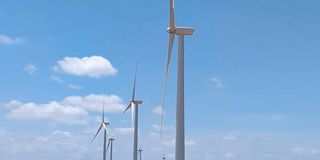
Wind turbines at Kipeto Wind Farm.
Driving a few kilometres past Isinya town, the spinning blades of the wind turbines of Kipeto Wind Power Plant show bits and pieces of their beauty from afar. They appear symmetrical, gyrating like a fan at a low speed. Moving closer, the turbines become enormous, with the wind whooshing in between the blades, one rotation at a time. It becomes uncomfortable to stand too close to just one turbine. While the wind cannot easily kill someone, birds can barely survive a turbine blade accident. They die.
Kipeto wind farm is located about 15 kilometres from an important breeding ground for endangered vultures called the Kwenia colony. Kwenia is one of the few sites globally where Ruppell’s vulture breeds. Within the wind farm is a migratory flight path through which the birds have over the years used as a route to get to their colony. Setting up the wind farm therefore meant that it would have been a distraction for the birds that could end up declining. Already, the International Union for Conservation of Nature (IUCN) lists the Ruppell’s vulture as one of the critically endangered species.
Studies have shown that apart from poisoning and climate change, wind farm collisions of birds are also great contributors to a decline in bird species. A study conducted by British scientists in three breeding colonies in the United Kingdom showed that turbine blade accidents greatly contribute to that decline. The scientists published their findings in the Journal of Applied Ecology of the British Ecological Society.
“Individuals (birds) were not only vulnerable to collision during the breeding season from wind farms in the proximity of breeding colonies, but may also be vulnerable during non-breeding periods from wind turbines located far away from breeding colonies,” revealed the study.
“Sensitivity and vulnerability to collision was high during breeding when adults are restricted to a central place foraging, and movements are concentrated into a relatively small area,” they added.
In Esilanke, before the wind farm brought life and changed livelihoods, the locals could poison birds as well as other land wildlife like leopards and cheetahs.

British High Commissioner Jane Marriott (left) being briefed on what happens at the vantage point by Mary Kirui, an ornithologist. Looking on is Matayo Ezekiel, a bird watcher.
When the wind farm was proposed to be put up, some ground rules by conservationists were set and one of those was to ensure that the biodiversity in Esilanke was not going to be affected.
This necessitated the creation of a Biodiversity Action Plan by the Kipeto Energy Limited that since June 2021 was officially connected to the national grid. This was in consultation with other organisations such as Peregrine Fund, Kenya Bird of Prey Trust and Nature Kenya and Bird Life International.
Dr Mary Warui, an ornithologist (scientists who specialises in birds) working for Kipeto Energy Limited explained to Healthy Nation that Kipeto’s Biodiversity Action Plan is adhering to the International Finance Corporation (IFC) performance standards, number six.
“This IFC's clause is on biodiversity conservation. The document we have now has mitigation measures that should be implemented to conserve all kinds of biodiversity here. What Kipeto is focusing on is on conservation of vultures and other raptors,” she explained.
Raptors are birds of prey. A recent study done by Kenyan scientists published by Biological Conservation last year found out that there has been a sharp decline of raptors in the country in the last four decades.
"Among the biggest threats to raptors globally are habitat destruction through logging and agricultural expansion, persecution (such as shooting, poisoning and trapping), electrocution and collision with energy infrastructure, contamination (primarily from lead, pesticides or veterinary drugs), and illegal harvesting for belief-based use," said the researchers.
Dr Mary and her team had to come up with a solution to help in restoring lost numbers as well as ensuring the available raptors are not killed by the turbines. “We now use an approach called shut-down on demand where our teams monitor birds flying in and when they spot our priority species, they call for the shutdown of the turbines and once the bird passes, the turbines are put on.
Dr Mary explains that the process of shutting a turbine for a bird to fly away takes about 44 seconds and that the power lost is negligible compared to what is lost during turbine maintenance.
“So far, we have been able to save vultures and many of them are encouraged to breed because the measures we have put in place enhance their survival and protect their habitats,” she explained.
The ongoing drought, especially during the last quarter of the year, exacerbated the rate of carcasses in the area because most animals died for lack of food and water. “Last year we had a number of shutdowns on demand because there were so many carcasses but if you compare the energy we lose because of the shutdowns on demand with respect to the energy we produce, then it is quite minimal,” explained Mr Patrick Maingi, Kipeto Energy Limited’s operations lead.
“Our shutdowns on demand coincides with our wind pattern, which shows that during the day our wind speeds are low and pick up in the evening around 6pm,” he said.
The Healthy Nation team meets Matayo Ezekiel, one of the observers from the local Maasai community. He has binoculars and despite it being sunny, he is wearing a cardigan to avoid getting health complications from the wind.
Matayo is part of the bird watching team, but there is another team that looks out for carcasses near the turbine and bury them just to avoid accidents from the vultures.
“I start working at nine in the morning and end by six. Our work is to observe and monitor the movement of raptors within the wind farm. We normally have vultures in the morning flying from the western side to the eastern side. They scout for carcasses and also train their young ones how to fly and feed,” he explains.
Matayo tells Healthy Nation that they also create awareness in the community and thus cases of poisoning have been plummeting.
“In the evening , the vultures start flying back from the east heading to the Kwenia colony. When the wind is very strong in the morning, we notice that they struggle to face the wind towards the east and sometimes they have to change their route to escape the turbines,” he said.
Despite having the shutdown on demand technique, the wind farm has however experienced a few hitches and lost about three birds; one of which was a vulture.
“We tried our best but we lost three, but I am happy that we have had about 1,000 shutdowns on demand that saved many birds from dying last year,” explained Mary.
British High Commissioner Jane Marriott lauded the biodiversity efforts at the wind farm during her recent visit to the farm.
“I have been amazed standing next to these towers, especially how big they are. Standing next to them makes you feel very small and insignificant. I am happy that this project powers about 250,000 Kenyan homes with renewable energy but at the same time it takes care of the area’s biodiversity,” she told Healthy Nation in an interview.
“I have been impressed by the Biodiversity Action Plan that has been put up by the Kipeto Wind Farm. We are pleased by this because it is a major investment by Actis, a UK investment company done locally in collaboration with Kenyan companies,” she added.