We will not sign: Hospitals reject SHA payout
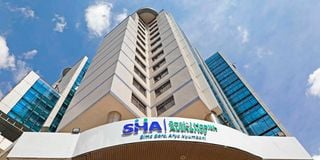
The Social Health Authority building in Nairobi.
Hospitals across the country say they will not sign off on Social Health Authority (SHA) payment forms until they are paid in full, as a dispute over unsettled claims from the defunct National Health Insurance Fund (NHIF) heads to court.
The owner of a private facility in Western Kenya told Nation she is owed Sh4.5 million but has only been offered Sh2 million. She has been in healthcare for over a decade and had kept her own records precisely.
"When NHIF was wound up and SHA took over, the NHIF system was switched off. No transition period. No printed records handed to facilities. No official communication telling hospitals to preserve their data before the portal closed. The system that held years of verified claims simply went dark," she said.
Her own records, covering every claim, patient and service rendered, show Sh4.5 million in outstanding NHIF claims. The SHA form she was given put the figure at Sh2 million. She said she asked for an explanation and a breakdown of which claims had been adjusted, but neither was given. When she asked to photograph the form to compare it against her own records, she was told photographs were not allowed and to simply sign and leave.
She did not sign.
"I will not put my signature on a document that says my claims have been fully settled when I am owed Sh4.5 million and you are showing me Sh2 million," she told the Nation. "Where is the Sh2.5 million? Which of my patients did you decide did not exist? I have their files. I have the DHIS records. I know what I am owed."
She is preparing to go to court and says she is willing to wait as long as it takes to get her full payment.
A Level Three facility owner in the Nyanza region tells a similar story. His patients are not wealthy, and many chose his facility specifically because he accepted NHIF cover. By the time the fund was discontinued, he had Sh870,000 in verified claims. SHA's offer came to Sh370,000, less than half.
"What made it worse was the silence surrounding the figure," he said. "When the NHIF system was switched off to make way for SHA, it took the claims history with it. There is no portal a hospital can log into today to verify what NHIF recorded against their facility. The government's own system, the one that should be the reference point for any dispute, is gone."
"They switched off the system, and now they are using figures that I cannot verify against anything because the platform no longer exists," he said.
"What am I supposed to do? Accept a number they have produced from a process I was never part of, for an amount I cannot cross-check, on a form I was not allowed to photograph?"
He refused to sign and instead produced his own printed records, kept because he never trusted the transition would be clean. His files show every claim submitted to NHIF, every approval and every pending payment.
"I treated Kenyans. I have the documentation. SHA has given me half of what I am owed and called it verified. I am calling it something else entirely, and I will say so in court."
A third case involves a private facility on the outskirts of Nairobi, owed Sh7.9 million but offered just Sh2.89 million. The owner said he had expanded his services and taken on more staff on the understanding that NHIF would honour its obligations.
"When I arrived at the sign-off session, the room was structured to move quickly. Facilities were called in, handed forms, and expected to sign. There was no table at which to sit and compare figures. No official could explain the discrepancy."
Faced with Sh2.89 million on the form against his own records showing Sh7.9 million, he refused to sign.
"I will not sign," he said. "Not because I do not need the money, I need it desperately. But because signing that form means I am agreeing that Sh2.89 million is what I am owed. And that is a lie I am not willing to put my name to."
"That is exactly why I kept my own copies," he added. "Because I knew this day would come. The day when someone would hand me a number and tell me to be grateful for it. I am not grateful. I am going to court. And I am taking everything I have."
SHA maintains that the claims were verified. The hospitals say they were never part of that verification process. All three facility owners are refusing to sign and are heading to court.
"Why would you owe me Sh7.9 million and offer me Sh2.89 million?" the Nairobi facility owner asked. "What happened to the rest? Which patients did you decide were not real? Which services did you decide were not rendered? Tell me. Because I have the records. And I will bring every single one of them to a judge."
Hospitals that borrowed money to keep their wards running while waiting years for reimbursement are now being asked to absorb losses of between 50 and 90 percent.
On July 4, 2026, SHA issued a public notice announcing that Sh4 billion had been released to settle outstanding hospital claims of Sh10 million and below inherited from NHIF, covering 3,527 eligible healthcare facilities nationwide. For hospitals that had waited up to five years, the announcement was framed as relief. Many hoped it marked the end of a long wait. Instead, it has proved to be the start of a different kind of dispute.
SHA has deployed officers to county offices across eight regions, running a sign-off exercise from July 6 to 24. Facility owners are being asked to attend on their scheduled dates, review the claims SHA says it owes them, and sign an agreement confirming the debt has been fully settled. The message hospitals say they are getting is simple: sign for what is being offered, or get nothing.
Explaining the discrepancy between the amounts facilities say they are owed and what SHA is offering, SHA CEO Dr Mercy Mwangangi told Nation that outstanding claims were not simply transferred from NHIF's records onto a payment list. "They were subjected to a verification exercise conducted jointly by SHA and the National Treasury, facility by facility, claim by claim."
According to SHA, each claim was checked against five criteria: whether it related to an eligible patient; whether it was supported by the required medical records and approvals; whether it fell within the facility's contract and level of care; whether it complied with approved NHIF tariffs; and whether the claim had been duplicated, previously paid, exaggerated, or found to be irregular in any way.
"The amount originally claimed may therefore differ from the amount approved for payment," SHA's statement reads, "as some claims were verified while others were adjusted or rejected."
SHA says the sign-off exercise serves two purposes: confirming the verified amount, and collecting current bank and institutional details before payment is released, since the claims are roughly two years old and some facility information may have changed.
Follow our WhatsApp channel for breaking news updates and more stories like this.