The devastating cost of cervical cancer: What patients still pay despite SHA
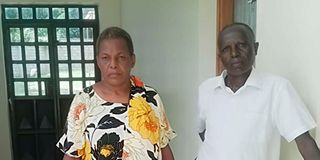
Kimanyi Kisangau and his wife Elizabeth Nduku at Coat General Hospital, in Mombasa on July 2, where he had accompanied her for treatment.

What you need to know:
- Dr Omar Abdihamid, a consultant clinical oncologist at Garissa Regional Cancer Centre, explains that the treatment path is decided by stage.
- A patient diagnosed early may need nothing more than surgery to remove the cervix followed by a week of recovery and no further treatment.
- Once the disease has spread into surrounding tissue, surgery is no longer an option, and patients move on to chemotherapy and radiotherapy for about six weeks, followed by three more weeks of brachytherapy.
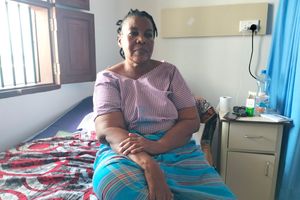
At the age of 34, Consolata Awuor’s body started giving her warning signs, but she had no money to find out what they meant. Her periods stopped for six months.
When foul-smelling bleeding started in the seventh month and later stopped on its own, she went back to work. She could not afford a hospital visit, so she convinced herself it had passed.
It had not.
By May 2025, the pain had spread to her ribs and chest, becoming unbearable. One day, as she hung laundry, she collapsed and was rushed to a hospital in Kisumu, where doctors diagnosed fibroids, benign growths that can mimic more serious bleeding. It had been growing inside her for over a year.
“I didn’t believe it was just fibroids. I, however, had no money for further tests, so I let it stand and went back to work,” she says.
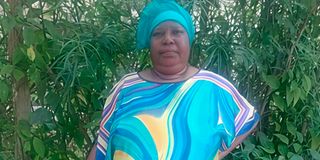
Jane Musyoka, a cervical cancer patient living in Mombasa.
Weeks later, the bleeding returned, lasting more than a day, and she fainted. By the time she reached intensive care, her haemoglobin had dropped to five, and she needed eight pints of blood before surgeons could operate. A biopsy confirmed she had Stage 2 cervical cancer.
For a month, she moved between wards, watching her savings dwindle. Over two months, she received a single round of chemotherapy that cost Sh19,000 before the money ran out.
By then, she had spent Sh300,000.
She moved to Nairobi in search of better care. There, the bleeding returned. She slipped into a coma three times, received 23 pints of blood from 45 donors, and lost more than half her body weight, dropping from 74 kilograms to 32. Further tests at Kenyatta National Hospital (KNH) confirmed the cancer had progressed to Stage 3.
Because the Kisumu facility does not accept Social Health Authority (SHA) cover, she had paid Sh9,000 out of pocket there for ultrasounds, labs and consultations.
At Kenyatta, SHA has covered far more, about Sh635,000 across two MRIs, a CT scan, a PET scan, a beta-hCG test and drug-reaction screening, though she has separately spent roughly Sh75,000 on medicine the scheme excluded.
Her SHA membership expires on August 8. She does not have the Sh6,000 to renew it. Her imaging alone requires regular top-ups: Sh5,000 on a Sh11,000 MRI and Sh12,100 on a Sh6,900 CT scan.
“I am an orphan. None of my four siblings has a stable job,” she says.
She now owes friends Sh69,000, has sold most of her household belongings, and has exhausted her chama savings. Even without counting food, she spends about Sh3,000 a month
just to get by.
A carpenter’s savings, gone in months
For Kimanyi Kisangau and his wife, Elizabeth Nduku, they had more cushion when their ordeal began, though they lost it just as fast.
Kimanyi is a 54-year-old carpenter in Malindi while his wife Elizabeth is 52. Until February this year, the family’s biggest expenses were ordinary: school fees, rent and the occasional clinic visit.
“I sold three of my cattle, a piece of land, and the water generator I had bought to start my vegetable farming,” Kimanyi says. Within months of Elizabeth falling ill, the proceeds from that venture had been swallowed up by her treatment.
Elizabeth was first tested in Kitui, the couple’s home county, then joined Kimanyi in Malindi to wait for the results. The wait lasted a month. The results, which arrived through WhatsApp, confirmed she had cervical cancer. Kimanyi visited a hospital in Malindi with the results and was referred to Mombasa, where Elizabeth’s treatment began in May.
By then, costs had stacked up.
“Two biopsies in Malindi cost me Sh3,600 and Sh3,000. The CT scan at Coast General was Sh19,000; SHA covered Sh13,800 of it. The HCG test was Sh8,000. Every week, I paid Sh650 for blood tests at a private facility,” Kimanyi says. Even before Elizabeth was admitted, the couple had spent nearly Sh30,000 on transport between the two towns alone.
Almost all of that went towards diagnosing the illness before treatment even began. Once it did, SHA picked up much of the cost, covering 35 sessions of radiotherapy at Sh3,600 each and chemotherapy medicine priced at Sh20,300.

Dr Omar Abdihamid, a consultant clinical oncologist at Garisa Cancer Centre. He explains that cervical cancer treatment path is decided by stage.
“The money from the cattle and the land went to consultations, referrals and admissions along the way,” Kimanyi says. Because the public system could not provide blood fast enough, the family turned to private facilities, where each transfusion cost Sh3,500.
Elizabeth receives treatment as an outpatient, meaning the family needs accommodation between sessions. With rooms costing up to Sh7,000 in the city centre and about Sh4,000 on the outskirts, they have at times resorted to sleeping on the floor.
“I stopped working as a carpenter to care for her. My income now comes from relatives in the village, sometimes as little as Sh500,” Kimanyi says. “Both my children, one in high school and another in college, are at home. There is no money left for school fees once medicine, transport and food are accounted for.”
“I have never missed a dose of her medicine,” he says. The treatment, he adds, is working, though Elizabeth needs fruits and vegetables regularly on top of everything else the illness demands. He remains hopeful.
“I should not have been bleeding at all”
For Jane Musyoka, it was not poverty or distance that ate into her care, but the collapse of the safety net she thought she had.
Jane, 54, first felt a sharp pain in her abdomen in June 2025. “I thought it was ulcers, and so did my doctors. I was treated for that, and the pain never went away,” she says. Then came bleeding, which she initially mistook for a period, though, as she puts it, “I had already gone through menopause. I should not have been bleeding at all.”
By December, the pain was unbearable, and she sought treatment at Bomu Hospital in Mombasa. Doctors took a tissue sample from her cervix and sent it to a lab in Nairobi.
Three weeks later, the diagnosis came back: Stage 2B cervical cancer.
“SHA and my husband’s insurance catered for the biopsy,” she says. From Bomu, she was referred to Mombasa Hospital for a CT scan. “That cost Sh5,600, again covered.”
She was referred to Makadara Hospital for chemotherapy but, faced with long queues, opted to continue her treatment at Premier Hospital instead. “I completed 12 sessions there. I finished last week. SHA and my husband’s cover paid for that, too.”
But it is the costs that fall outside that cover that have taken the greatest toll. “Every week, I spend Sh1,500 on lab tests and Sh670 on blood work before each round. My radiation costs Sh3,600 a session. A follow-up scan cost me Sh8,000. Transport costs about Sh500 a day, and pain medication runs me Sh700 to Sh1,200,” Jane says.
Before her diagnosis, she sold vegetables from a roadside stall. “I closed the business. My condition doesn’t allow me to stand and work a full day.” She also cares for her 22-year-old child, who lives with a disability. “My husband has since left. He took not just a second income but the insurance policy that has paid for most of my treatment.
That policy lapses on the 10th.”
“For now, friends and well-wishers bring me food, fruits and the basics I can no longer buy myself,” she says.
Why the bills differ
So, why does one family’s cancer cost a few hundred thousand shillings, while another’s runs into millions? The answer comes down almost entirely to timing: how early the cancer is caught, and how far it has travelled by the time a patient reaches a doctor.
Dr Omar Abdihamid, a consultant clinical oncologist at Garissa Regional Cancer Centre, explains that the treatment path is decided by stage.
A patient diagnosed early may need nothing more than surgery to remove the cervix, he explains, followed by a week of recovery and no further treatment. Once the disease has spread into surrounding tissue, surgery is no longer an option, and patients move on to chemotherapy and radiotherapy for about six weeks, followed by three more weeks of brachytherapy — nine weeks in total. If the cancer reaches the lungs or elsewhere, surgery and radiotherapy are abandoned for chemotherapy alone, and treatment can stretch to 10 or 12 weeks.
“The percentage of early-stage diagnosis now is very low in Kenya,” Abdihamid adds. “Most of our cervical cancer patients come in the advanced stage.”
An advanced stage means more scans, more sessions, months of treatment, and more of the indirect costs (transport, food and lodging) that no scheme touches.
In his view, SHA prevents cancer treatment costs from becoming completely unaffordable. “SHA really plays a big role in diagnosis, treatment, and even follow-up,” he says.
It absorbs the largest single costs: radiotherapy, chemotherapy, and CT and PET scans. At public facilities such as Kenyatta University Hospital, a PET scan costing more than Sh50,000 is typically covered in full. At a private hospital, where the same scan might cost Sh55,000 to Sh56,000 out of pocket, SHA still absorbs the bulk, leaving a top-up of roughly Sh5,000 to Sh6,000. Biopsies are covered only in public hospitals, one reason patients without means gravitate there.
What SHA does not reliably cover, he notes, are the routine labs that shadow every week of treatment.
“Some laboratories accept SHA, but it’s not uniform, it’s not standard like the scans,” he says. Blood counts and kidney function tests, needed weekly during chemotherapy, run around Sh6,000 a round (roughly Sh30,000 over a full course) found outside any scheme.
Then there is the cost of medicines that patients must buy themselves when they are unavailable at the treating facility or their SHA cover has been exhausted.
Dr David Wata, a pharmacy oncologist at KNH, explains that the true cost of cervical cancer treatment depends on more than the price tag of a single drug. It comes down to how many vials a patient needs, which varies with their weight, body surface area, kidney function and prescribed dose.
Paclitaxel costs around Sh3,000 a vial, and a typical dose needs two to four vials, working out to Sh6,000 to Sh12,000. Carboplatin, at about Sh4,000 a vial, usually requires one to three vials, or Sh4,000 to Sh12,000. Gemcitabine costs roughly Sh3,000 a vial, with one to two vials needed per treatment, coming to Sh3,000 to Sh6,000. Topotecan is pricier at Sh15,000 a vial, and a standard three-day course can call for two to four vials, pushing the cost to between Sh30,000 and Sh60,000.
Pembrolizumab, a newer immunotherapy drug, costs about Sh260,000 for a 200mg vial, with one vial typically used per cycle, more than many patients spend on scans across an entire course of treatment. Bevacizumab costs between Sh100,000 and Sh300,000 per vial, and most patients need one to two vials depending on their weight and dose.
Put together, a single treatment cycle that includes both Pembrolizumab and Bevacizumab can cost anywhere from roughly Sh403,000 to Sh950,000 in medicine alone, though the final figure depends on the drugs prescribed, the number of vials needed and the patient’s individual profile. Most patients go through around six cycles, spaced three weeks apart, with targeted therapies sometimes continuing even after chemotherapy ends.
For a patient whose SHA balance is exhausted, that kind of bill is less a treatment option than an imaginary one.
Beyond the hospital bill, Dr Abdihamid points to costs that never appear on an invoice but decide whether treatment is finished: accommodation, food and transport.
“Those who do not have insurance will have to pay out of pocket, and that’s a big challenge,” he says. His prescription is twofold: “Increase the uptake of insurance, SHA, and other private insurance,” first, then “improve early detection.”
The first means expanding SHA enrolment through county registration drives. The second means catching cancer at Stage 1, when surgery, largely covered, can be the end of the story. He also points to regional cancer centres in Mombasa, Garissa and Nakuru, sparing patients the cost of travelling to Nairobi.
What tariff schedule reveals
A gazetted amendment to the SHA tariff schedule, signed by Health Cabinet Secretary Aden Duale on April 30, 2026, sets out exactly what the scheme pays for oncology care. The figures line up with what Elizabeth and Jane were charged: a CT scan tariffed at Sh6,900, close to Jane’s Sh5,600 bill; an MRI at Sh11,000; and a PET scan at Sh53,500.
Radiotherapy is set at Sh3,600 per session, the exact figure both cite, capped at 30 sessions per policy period, and brachytherapy at Sh40,000, capped at three. Chemotherapy administration is tariffed at up to Sh5,500 per session, with up to Sh15,000 for the chemo port.
The tariff also covers weekly blood tests at between Sh500 and Sh1,000 each. But patients can only claim for four tests per policy period, far fewer than a standard course of chemotherapy requires.
The tariff also covers cervical screening. A Pap smear, used to detect cervical cancer early, is priced at Sh1,500. Early detection can mean the difference between an operation and weeks of chemotherapy and radiotherapy. A holistic care consultation, which includes an oncologist, a nutritionist and mental health support, is capped at
Sh2,500, with up to four visits a year covered. The chronic illness fund limit has also increased from Sh150,000 to Sh400,000.
For Elizabeth, who underwent 35 radiotherapy sessions, the tariff helps explain why she had to pay for treatment beyond the 30 sessions covered under her policy.
Can an ordinary Kenyan really afford this?
Dr Jackson Otieno, a senior research and policy analyst studying healthcare financing in Kenya, situates cancer within a decades-long shift in the country’s disease burden: non-communicable diseases have climbed steadily up the rankings since the 1990s, and cancer has become expensive precisely because it is rarely caught early.
“Most cancer cases are diagnosed at later stages,” he says. “Because of late detection, the cost always gets so high.”
“When you talk of out-of-pocket in cancer, you are talking around 60 per cent of household income on average going to treatment,” Otieno says, “but there are cases where you can even get 90 per cent.”
That figure only captures lost income, not the caregiving or farm work a family also gives up. The benefit package has moved from a cap of Sh500,000 per case to Sh800,000, but the medic is blunt: “That is not enough for the conditions.”
His prescription echoes Dr Abdihamid’s: fold cancer into primary healthcare and invest in screening, so fewer cases reach the expensive end of the system. Community health promoters, already trained for immunisation and maternal care, could flag early warning signs at a fraction of the cost of an advanced case, he argues.
Chemotherapy, not screening, consumes the largest share of spending, which is why underinvestment in screening is such a costly economy: SHA funds only a limited number of sessions before a patient pays out of pocket, so the more advanced the disease, the faster that limit is reached.
Dr Otieno has no directly comparable cost data for Kenya’s neighbours, but offers a hypothesis: given Kenya’s more developed health system, he expects its treatment costs to run lower than Tanzania’s, Uganda’s, Burundi’s or Rwanda’s. The burden does not fall evenly. Rural and peri-urban Kenyans face higher effective costs through the difficulty of reaching care, and over 83 per cent of the working population sits in the informal sector, where regular SHA contributions are rare, even among the more than 30 million people registered.
“If you’re not contributing to the fund, the cost of treatment, in the event you have a case, is very high,” he says. Layered on poverty and informality, in his account, is gender: women facing cancer are, more often than not, disproportionately disadvantaged compared with men.
How Kenya compares with its neighbours
So, how does Kenya’s bill compare elsewhere on the continent? Kenya is not the worst-off country to be diagnosed in, but the shape of the problem, a scheme covering the expensive core of treatment while leaving diagnostics, drugs and survival costs to the patient, repeats itself across sub-Saharan Africa.
In Nigeria, there is close to no equivalent of SHA’s cancer coverage. A chemotherapy cycle costs 600,000 (Ksh56,600) to 1.5 million (Ksh141,100) Naira, while radiotherapy costs 600,000 (Ksh56,600) to 1 million (Ksh94,300) Naira.
A scoping review in Surgical Oncology Insight found that only a small share of Nigerian cervical cancer patients could afford radiotherapy, with roughly four in five unable to do so for financial reasons. A study in the Journal of Cancer Policy, using breast cancer patients as a proxy, found the average cost of care around $5,193 (Ksh671,000) against a household’s yearly capacity to pay of just $2,867 (Ksh370,500), with nearly all patients facing catastrophic spending.
Meanwhile, a new Cancer Health Fund offers up to two million Naira towards breast, cervical and prostate cancer, but operates in only six hospitals nationwide as of late 2024.
In South Africa, care is technically free, and cancer is a benefit medical schemes must cover, but a South African Medical Journal analysis found the public sector badly under-equipped, with 0.4 linear accelerators per million people against a World Health Organisation minimum of one, meaning long radiotherapy waits. Private chemotherapy runs 25,000 (Ksh199,300) to 100,000 (Ksh797,300) rand per cycle, and even comprehensive medical aid typically caps cancer cover at 200,000 (Ksh1.6 million) to 400,000 (Ksh3.2
million) rand — a ceiling that newer drugs, like immunotherapy, can exceed in one course, at nearly a million rand.
Uganda’s system is built, in principle, around free cancer care. Researchers at the Uganda Cancer Institute found it now gets over 80 per cent of patients through a full course free and on schedule, credited to negotiating directly with manufacturers. But a Makerere University study found patients spent an average of 300,000 Ugandan shillings (Sh10,600) a visit, some up to 800,000 (Sh28,300), on blood tests, medication, transport and accommodation outside the free package, with half facing catastrophic expenditure. When stocks run short, patients turn to private facilities, where treatment can run into the millions.
Lastly, Ghana takes the narrowest but most deliberate approach: its National Health Insurance Scheme singles out cervical and breast cancer for coverage, excluding nearly every other cancer type. An assessment by the City Cancer Challenge coalition found the benefits fairly comprehensive but excluding screening, psychosocial support and rehabilitative care, with hospital staff often unaware of the scheme’s full extent, leaving patients to pay out of pocket for services technically covered.