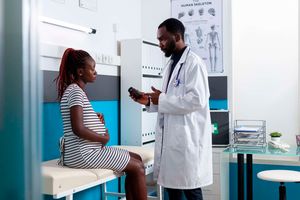
Wellness centre mending broken mothers after losing their unborn babies
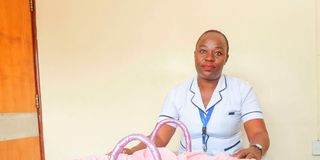
Jaramogi Oginga Odinga Teaching and Referral Hospital maternity Nurse in Charge Faith Odhiambo poses with a Moses basket from the biblical Moses story during the interview.

What you need to know:
- At the referral facility, doctors diagnosed preeclampsia—a high blood pressure disorder that develops after 20 weeks of pregnancy.
- According to the World Health Organization, this condition presents serious risks to both mother and baby.
- Early detection and management are crucial to prevent progression to eclampsia, which involves seizures.
The cemetery is quiet this morning, save for the soft rustle of leaves and the distant hum of traffic. Here, among rows of weathered headstones, lies the tiny grave that holds both Mercy’s* deepest sorrow and her greatest love. Today, like many days before, tears flow freely down her cheeks—not from blame or anger, but from the profound ache of losing a piece of herself.
“I visited my late son’s graveyard today and broke down. I cried, not because I felt like myself or anyone was responsible for his untimely death. It was the pain of losing part of me. I have since accepted his loss, but the pain remains with me,” the young mother shares, her voice carrying the weight of a journey no parent should have to walk.
In that small grave rests the remains of a baby she had longed to have for years. After the successful conception and birth of her firstborn son seven years ago, what should have been joyful news became a recurring nightmare: four miscarriages and one terminated pregnancy followed her second conception.
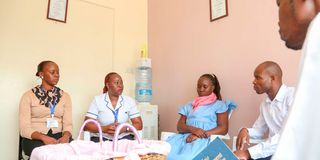
From left: Sonia Akinyi, a psychologist at the Jaramogi Oginga Odinga Teaching and Referral Hospital’s maternity section, maternity Nurse in Charge Faith Odhiambo, Ruth Prisca Ochieng (acting bereaved mother), Nahum Ochieng (acting bereaved father) and Sylvester Okello, who assumed the role of a pastor, during a demonstration on how the wellness centre attends to a family after a case of miscarriage or stillbirth.
“I am still hopeful that one day I will gift my son a sibling, perhaps twins,” she says, revealing that her only child will turn eight in just a few weeks.
A room where healing begins
When we catch up with Mercy, she has just arrived at the Jaramogi Oginga Odinga Teaching and Referral Hospital (JOOTRH) maternity section for her bimonthly counselling sessions. The young woman, all smiles and radiating life despite her pain, is ushered to the facility’s counselling section.
Adjacent to the bustling maternity ward sits the Wellness Centre—a simple room that bears the profound burden of broken mothers and their families. A framed quote on the wall greets visitors with bold lettering: “God grant me the serenity to accept things I cannot change, the courage to change the things I can and the wisdom to know the difference.”
Inside this sanctuary of healing, seats are arranged in a welcoming U-shape around a central table. At its heart sits a woven basket—what the staff calls a Moses basket—cradling a doll wrapped tenderly in baby blankets. A water container with disposable glasses and serviettes occupies a corner, small touches that speak to the care woven into every detail.
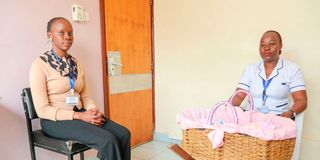
Sonia Akinyi, a psychologist at Jaramogi Oginga Odinga Teaching and Referral Hospital’s maternity section and maternity Nurse in Charge Faith Odhiambo during the interview at the facility’s wellness centre.
“We drew the idea of a Moses basket from the biblical Moses story, a lightweight carrier, woven with papyrus reeds where baby Moses was placed to save him from King Pharaoh’s decree that all new-born Israelite boys had to be killed,” explains Faith Odhiambo, the maternity nurse in charge.
The innovation emerged from the collaborative efforts of Ms Odhiambo, Dr Leah Okiri (an obstetrician and head of the labour ward), deputy director of nursing Rosabella Apollo, and then nurse-in-charge Mulusa Elizabeth. Since its inception, this simple yet profound concept has played a major role in the recovery of grieving mothers.
When care falls short
Having worked as a maternity nurse for 14 years, Ms Odhiambo recognised a troubling gap in how healthcare facilities treated women who suffered miscarriages or stillbirths.
“Once health experts learned that the unborn baby was already deceased, they would immediately shift attention to the women whose babies were still alive,”she recalls. This abandonment left grieving mothers feeling invisible at their most vulnerable moment. After delivery, deceased new-borns were placed in boxes and transported to mortuaries awaiting burial. Women who underwent caesarean sections often never saw their babies, who were buried long before they recovered.
“Back in the wards, the situation was not any better; the new mothers would not allow the grieving women to get close or even touch their babies, leaving them isolated,” the nurse explains.
The devastating impact was predictable: women left the hospital shattered, drowning in self-blame and family recrimination over their pregnancy loss. In her years of practice, one case particularly haunts the veteran nurse—a woman who endured 16 miscarriages.
“When she left the facility after the 16th miscarriage, the woman had been shattered and broken. When we took her for counselling, she was inconsolable for four hours. She kept crying while cursing her creator,” Ms Odhiambo remembers.
“I am, however, glad to say that in our wellness centre, she found a home and is currently recuperating.”
A different approach
The wellness centre operates on a radically different philosophy. When staff establish that an expectant mother has miscarried or suffered a stillbirth, a psychologist attached to the centre immediately begins counselling to prepare the mother for the loss. Once the deceased baby is delivered, something remarkable happens. The nursing staff wash and dress the infant in clothes provided by the mother. She is allowed to spend precious hours with her child before being moved to the wellness centre.
“We have blue and pink Moses baskets to hold a deceased baby boy or girl, respectively,” Ms Odhiambo explains, adding that mothers are also encouraged to name their deceased babies.
The centre accommodates not just the grieving couple, but their extended family and church members as well. These support networks receive sessions explaining the cause of death, how to care for the mother, and detailed guidance on the healing process.
“The thought of bringing together the lady’s family, spouse and church to prepare them to receive the broken couple,” she says, emphasising that these relationships play the largest role in a mother’s healing journey. “Having the couple on board also helps them to heal while limiting blame games. It is also a way of including men in the healing journey. They also feel the pain of child loss.” Since its establishment early this year, the facility has attended to over 50 women, including Mercy.
A pattern of loss
After the birth of her first child in 2017, the young mother had eagerly anticipated expanding her family. When she conceived a year later, hope filled her heart. The pregnancy test at a local health centre confirmed her joy—positive results that seemed to promise everything she wanted. That joy lasted barely a month. One morning, after noticing spotting, Mercy sought immediate medical attention. By the time she reached the nearest health facility, heavy bleeding had begun. Medical tests delivered the devastating news: she had lost the pregnancy.
“I was never given any explanation for the cause of the miscarriage. The health worker attending to me casually said that I was still young and could still conceive,” she remembers.
Returning home with a head full of unanswered questions, Mercy couldn’t understand what had gone wrong. She had done everything right—checking into a health facility immediately after missing her period, religiously taking prescribed iron and folic acid supplements.
A couple of months later, hope returned with another positive pregnancy test. Again, she scheduled antenatal appointments with renewed optimism. “I once again started spotting one month after conception and quickly sought medical care,” she recalls. Again, the pregnancy was lost.
Her third and fourth pregnancies followed the same heart-breaking pattern; all lost before the second month. Each time, doctors offered no explanation for the pregnancy loss.
“I kept conceiving with the hope that I would heal once I had a successful birth. Each failed trial, however, left me shattered,” she explains. A friend eventually suggested she might be struggling with secondary infertility.
The fifth attempt
Toward the end of 2024, desperation mixed with hope as Mercy discovered she was pregnant again. Following her established routine, she began antenatal care (ANC) just two days after missing her period.
Given her history of miscarriages, healthcare providers identified her as a high-risk client and advised weekly check-ups. The first trimester passed smoothly—for the first time in six years, she felt convinced she would carry the pregnancy to term.
Trouble emerged at five months. At 22 weeks, her feet became swollen and painful, symptoms she initially dismissed as normal pregnancy changes. A week later, while working at her computer, her vision suddenly became blurry. Alarmed, she excused herself from work and headed to her ANC clinic. “At the hospital, a test revealed my blood pressure was extremely high,” she recalls. Despite medication, her condition showed no improvement.
The following day brought a referral letter. The attending medics explained they might need to induce labour but lacked the proper equipment to care for a premature baby.
On April 11 this year, she was referred to JOOTRH for advanced medical care.
A life-threatening diagnosis
At the referral facility, doctors diagnosed preeclampsia—a high blood pressure disorder that develops after 20 weeks of pregnancy. According to the World Health Organization (WHO), this condition presents serious risks to both mother and baby.
Early detection and management are crucial to prevent progression to eclampsia, which involves seizures. Both conditions can be life-threatening. “Severe pre-eclampsia may include symptoms such as severe headaches, visual disturbances and upper abdominal pain,” WHO states.
Without timely detection, the condition can result in seizures, organ damage, placental abruption, foetal growth restriction, and even maternal and foetal death.
During our interview, Ms Odhiambo reveals that preeclampsia, alongside anaemia, remains one of the leading causes of maternal deaths and pregnancy loss at the regional facility. “Being a referral hospital, we receive many pregnant women with complications on a referral basis,” she notes. “At times, both mother and child are lost to the condition due to late referral.” Two days after her referral, both Mercy and her unborn child’s health were deteriorating rapidly. Doctors placed her on medication to facilitate the development of the foetus’s lungs, hoping to deliver the premature baby at 28 weeks.
Time was running out. While the foetus was only 23 weeks old, doctors explained that waiting longer was putting both lives at risk. The only option was to terminate the pregnancy and save the mother’s life.
“When I checked into the facility, my main goal was to save the life of my unborn child. Surviving through the second trimester had felt like a miracle. I was so close to having a baby I had so much desired,” she shares. Initially, she refused to undergo the medical procedure.
The hardest decision
A counsellor took time to explain the risks of carrying the pregnancy to term. Similar sessions were held with her close family members. By this time, she was showing signs of organ damage. “All this time, I was in denial and upset. My thoughts were with my son, whom I had informed that we were expecting a child,” she remembers. She had already purchased baby items in anticipation of the delivery.
After multiple counselling sessions, she finally agreed to the procedure. Her change of heart was partly inspired by the realisation that her surviving child also needed her.
On April 16, she delivered after a successful induction, but the baby was already deceased. His organs had not fully developed.
A different kind of goodbye
What happened next transformed her experience of loss. To her surprise, nurses cleaned the new-born, dressed him in the clothes she had brought to the hospital, and allowed her to stay with her baby from 6:30am until around 9am the following morning.
“A couple of minutes later, the nurses who had picked the baby guided me to a room just next to the maternity section. Inside, my close family members and our pastor were seated around a Moses basket,” she recalls.
The deceased baby had been placed inside the woven basket, covered with blue blankets like any other new-born. Her pastor led the room in prayer before a nurse took time to explain preeclampsia in detail.
A psychologist guided the family through counselling, including specific instruction on how to support both Mercy and her spouse through their grief. The pastor conducted final funeral rites while offering condolences to the family. “I was later handed the baby to have my final moments with him before handing him over to the mortician,” she says.
That afternoon, as she returned to the wards for continued medical care, her family headed home to arrange the burial. She found herself in a ward specifically for women who had suffered miscarriages, stillbirths, or pregnancy termination.
The women, while receiving medical care, participated in counselling sessions before discharge.
“Although I am still healing, I am grateful for the fact that this time, I got to know why I lost my baby. The fact that I was also able to see my baby even without participating in the burial gave me closure,” she reflects.
She adds, “The nurses have also promised to walk with me whenever I want to conceive all the way to delivery to ensure good pregnancy outcomes.”
Understanding the medical reality
Dr Onyango Ndong’a, an obstetric gynaecologist at the Kisumu County referral hospital, provides clinical context for these experiences. He defines a stillbirth as a birth at 28 weeks of gestation or more with no sign of life, while miscarriage is a non-viable intrauterine pregnancy up to 28 weeks of gestation or less than 500 grams. Stillbirths can result from congenital birth abnormalities, foetal growth restriction, infections, genetic abnormalities, and placental and umbilical cord abnormalities.
“Causes of miscarriages can range from chromosomal abnormalities, maternal anatomic abnormalities including fibroids, polyps, septum and trauma of the abdomen,” Dr Ndong’a explains.
He adds, “In the second trimester, infections, chronic stress, uterine malformations and a weak cervix can also result in a miscarriage.”
Recent WHO statistics reveal that nearly two million babies are stillborn annually, with a majority being preventable deaths. However, the agency notes that miscarriages and stillbirths are not systematically recorded even in developed countries, suggesting the numbers could be higher. In Kenya, the latest reports show a stillbirth rate of 19 per 1,000 live births.
The ripple effects
According to Dr Ndong’a, miscarriages and stillbirths create impacts ranging from psychological and financial to spiritual and social effects.
“Preparation for pregnancy is an emotional journey accompanied by physical changes. When a loss occurs, the response is always traumatic,” he explains. “Some losses also result in strained romantic relationships, leading to divorce or separation. Society also tends to shun women or couples, making the healing process more challenging.” Mercy experienced this social stigma first-hand. After learning of her predicament, neighbours avoided associating with her. She was forbidden from crossing paths with pregnant women or those with new-borns.
“The society has been harsh on women. Some are not allowed to interact, cook or even eat with those around them,” Ms Odhiambo observes. These myths and misconceptions around stillbirths prevent some women from planning for childbirth.
“Many times, we have attended to women who deliver without a single baby item only to learn that society made them believe buying baby items could expose them to witchcraft, resulting in miscarriages and stillbirths.”
The psychology of healing
Sonia Akinyi, a psychologist at the JOOTRH maternity section, explains that counselling extends beyond women who suffer pregnancy loss to include mothers experiencing postpartum depression. Once she identifies her client, the next step involves determining which stage of grief they’re experiencing. While grief stages don’t follow a particular order, they include denial, bargaining, anger, depression, and acceptance.
The Moses basket proves particularly valuable during the denial stage.
“Allowing the mothers to see, hold and name the deceased babies while explaining the cause of death allows them to come to terms with the loss,” Akinyi explains. During the bargaining stage, they help mothers understand the deaths were never their fault. The healing process duration varies for every mother, with some grieving for months. The counselling sessions also provide opportunities for mothers to discuss struggles they may face at family or societal levels.
Often, mothers reveal how pregnancy loss exposes them to divorce, separation, and stigma. The facility has embraced group counselling sessions where mothers can share their feelings without judgment, helping them realise they’re not alone.
“There are women who will open up about battling family and societal pressure to conceive while questioning their abilities to be called a mother,” she notes. She emphasises,
“The society should allow women to grieve. Let us create a safe space for them without being judgmental.”
Looking forward
Dr Ndong’a warns that early conception after pregnancy loss may lead to repeat loss. Couples should allow adequate time for reproductive organs to return to normal anatomy before conceiving. “If there are identified causes of the losses, they should be corrected. On average, a woman should wait between six to 12 months before the next conception,” he advises.
Back in the quiet wellness centre, where soft light filters through windows and the Moses basket sits ready for the next family that will need it, hope mingles with sorrow.
For mothers like Mercy, the journey continues—marked by loss but not defined by it, shadowed by grief but illuminated by the possibility that healing, like love, can grow from the smallest gestures of human compassion.