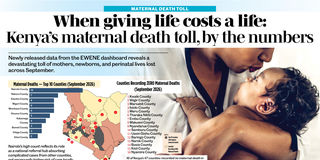
When giving life costs a life: Kenya’s maternal death toll, by the numbers

Newly released data from the EWENE dashboard reveals a devastating toll of mothers, newborns, and perinatal lives lost across September. As the government rolls out a multi-billion-shilling emergency plan, the numbers expose where the healthcare referral chain is holding, and where it is quietly failing.

What you need to know:
- New data maps exactly where the health system is holding, and where it is failing women and children.
Somewhere in Kenya this week, a woman went into labour believing she would walk out of that hospital holding her baby. Nine times in the final week of September alone, that belief was wrong. Nine families rearranged a nursery into a memorial. Nine husbands learned how to explain to other children that their mother was not coming home. The week before, it happened 29 times.
These are not merely numbers on the EWENE (Every Woman, Every Newborn, Every Where) surveillance dashboard run by the Digital Health Agency. They are women who carried a child for nine months, felt that first kick, picked out a name, and believed they had done everything right, only to bleed to death, or to be failed by a system that should have caught the danger in time.
Across September, Kenya lost 84 mothers, 188 newborns, and recorded 690 perinatal deaths, according to data from the EWENE dashboard. That is a combined toll of 962 deaths logged in a single month: 962 families who will mark an empty chair this year where a child or a mother should have been sitting.
In the last quarter alone; July, August, and September, Kenya lost 163 women to childbirth-related causes along with 262 neonatal deaths and 1,152 perinatal deaths. Over the last nine months, the cumulative toll stands at 663 maternal deaths, 1,056 neonatal deaths, and 4,552 perinatal deaths nationwide, according to EWENE.
The data on the EWENE dashboard is live. All 47 counties key in information every second, every minute and every hour, each time a mother or a child dies, and each time a child is born. What appears on the screen is not a monthly summary written after the fact. It is a running record of lives gained and lives lost, as they happen.
Behind every one of those figures is a woman who trusted that giving life would not cost her her own. Kenya is still breaking that trust, month after month.
A neonatal death refers to any infant death occurring within the first 28 days of life. A perinatal death includes late foetal deaths and stillbirths at 28 weeks’ gestation or beyond.
Kenya is losing the most in the journey from labour to a child’s first month of life.
Where maternal deaths happened
Kenyatta National Hospital recorded the highest number of maternal deaths in September, with eight, according to EWENE. Coast General Teaching and Referral Hospital followed with six; Nakuru, Jaramogi Oginga Odinga Teaching and Referral Hospital, and Migori each recorded three; and Kakamega recorded 2.
By county, Nairobi recorded the highest toll in September, with 13 deaths. Nakuru followed with seven. Kiambu, Migori, and Mombasa each logged six deaths, while Kisumu recorded five.
That concentration in Nairobi and at facilities such as Kenyatta and Coast General is not necessarily a sign that those institutions are more dangerous to give birth in. Both are national or regional referral hospitals that absorb the most complicated obstetric cases transferred from smaller facilities across the country, a pattern reflected clearly in EWENE’s level-of-care breakdown.
County referral hospitals accounted for 40 of the month’s 84 maternal deaths, sub-county hospitals for 20, and national teaching and referral hospitals for 11. The sickest, most complicated cases end up at the top of the referral chain, and so, often, does the death.
For neonatal deaths, Mandera led with 21 deaths recorded in September. Kisumu and Mombasa recorded 15 deaths each; Kirinyaga and Nyeri recorded 10 each; and Bungoma recorded eight.
However, Nyamira, Narok, Isiolo, Embu, Kisii, and Tharaka Nithi did not record any case of a woman dying while giving birth in September. For neonatal deaths, Nyamira, Machakos, Laikipia, Embu, and Kisii did not record a single case.
What is killing mothers
Complications during delivery were the single leading recorded cause of maternal death in September, accounting for 16 cases, according to EWENE data. Obstetric haemorrhage followed closely at 14 cases, with a further 12 deaths logged simply as “not specified.” Hypertensive disorders in pregnancy, childbirth, or the puerperium accounted for 11, and complications predominantly related to the puerperium rounded out the leading causes. Other causes accounted for the remaining deaths.
More deaths occurred among women aged 20 to 29 than in any other age group: 38 cases in that bracket, compared with 15 among women aged 30 to 34, 13 among those aged 35 to 39, and 9 among those aged 40 to 49. The smallest number, 8 cases, occurred among adolescents aged 15 to 19, with one case recorded as unknown age.
That the 20-to-29 bracket carries the heaviest burden is not surprising, given that it is also the age range in which the largest share of Kenyan women give birth. But it is a reminder that maternal mortality in Kenya is overwhelmingly a crisis facing young women in the prime of their reproductive years.
September’s neonatal deaths followed a different geographic pattern from the maternal toll. Mandera County led the country by a wide margin with 21 neonatal deaths, according to EWENE, far ahead of every other county. Coast General recorded nine, Makueni eight, Jaramogi seven, and Kericho six.
Nationally, respiratory disorders were the leading recorded cause of death, accounting for 51 of the 188 cases, followed by disorders related to length of gestation or fetal growth at 35, and infections of the neonate contributing a further 31.
Notably, most of the babies who died in September were born at or near term: 97 deaths occurred among infants born at 37 to 41 weeks’ gestation, compared with just 13 among those born before 28 weeks.
This suggests that prematurity alone does not explain the bulk of September’s neonatal deaths; intrapartum and immediate newborn care failures, the handling of birth itself and the hours immediately after, likely play a significant role.
Level 4 and Level 5 facilities, Kenya’s county and sub-county referral tier, accounted for 92 and 69 deaths respectively, the tier of the health system that handles the bulk of the country’s deliveries.
Perinatal deaths: The largest and least understood category
The perinatal category, spanning stillbirths and deaths in the earliest days of life, overshadowed the other two categories in volume. Nakuru County recorded 97 perinatal deaths in September, far ahead of Kirinyaga, Kakamega, and Kisumu, which each logged 55.
Respiratory disorders again dominated the recorded causes, accounting for 194 of 690 cases, followed by disorders of foetal growth and gestation length at 108. Seventy-seven deaths were recorded with no specified cause at all, and 304 of the 690, nearly 44 per cent, occurred on what EWENE records as “Day 0,” meaning intrapartum, during labour and delivery itself.
Nine months into EWENE’s reporting cycle for 2026, the cumulative picture, 663 maternal deaths, 1,056 neonatal deaths, and 4,552 perinatal deaths, is not simply a running tally. It is, according to the dashboard’s own data, a map of exactly where Kenya’s maternal and newborn health system is holding, and where it is quietly failing the women and children passing through it.
The data on the EWENE dashboard is live. All 47 counties key in information every second, every minute and every hour, each time a mother or a child dies, and each time a child is born. What appears on the screen is not a monthly summary written after the fact. It is a running record of lives gained and lives lost, as they happen.
Mombasa Governor Abdulswamad Nassir, who chairs the Council of Governors Committee on Health, said that with the platform, governors are able to access and monitor the challenges that exist and the issues they need to work on.
“The statistics of women who lose their lives on an annual basis, the statistics of the tens of thousands of children who actually lose their lives on an annual basis; these are human lives; these are statistics that are there.” He said there are many factors that add to and compound the deaths.
“Where governors see a situation, they try to avoid it through peer learning, by learning from mistakes made previously and seeing how we can improve. We’re already seeing great improvement,” he said.
Governor Nassir noted that Kiambu, Homa Bay, and Murang’a are among counties that have not recorded any deaths.
“A number of counties are actually doing extremely well, but with this in place, what it is now telling us is: What are the main causes of these deaths? Is it non-availability of personnel? Is it non-availability of the right medicine? Is it the non-availability of the different practices that need to be done?”
He added: “Many counties are now reporting deaths to the platform. We have collectively agreed as governors to learn from each other and overcome these challenges together.
It is not a platform to blame and point fingers at each other.”
President William Ruto, during the launch of EWENE in May at State House, said he was travelling outside the country when a woman approached him with a simple, devastating statement: “Mr President, so many women are dying in Kenya due to childbirth, and this is alarming.”
The statement, he said, became a turning point, not because he didn’t already know the statistics. Kenya’s maternal mortality rate is 355 deaths for every 100,000 live births, a figure that translates to approximately 6,000 preventable deaths every year. Sixteen women. Every single day.
“That was a wake-up call for me,” Dr Ruto said. “Something needed to be done moving forward.”
The EWENE Acceleration Plan for 2026–2028 is a global initiative adopted by Kenya, led by the Ministry of Health and partners, to accelerate the reduction of maternal and newborn deaths.
“We must cut down the number of maternal deaths by half. And we must drive it to the point where we account for every mother,” said the President during the launch.
He said the country must account for every mother, not just reduce deaths, not just improve statistics, but know, by name and by circumstance, every single woman who dies.
Make that death matter. Ensure it is investigated, learned from, and prevented.
According to the Ministry of Health, maternal mortality in Kenya claims the lives of approximately 16 women every day, with postpartum haemorrhage (PPH): severe bleeding after childbirth as the leading cause of death, accounting for 40 pe rcent of maternal deaths. Other major causes include high blood pressure during pregnancy, infections, unsafe abortions, and delays in accessing emergency medical care, particularly in rural and underserved areas.
Twenty-six counties were identified as high-burden areas for maternal and newborn mortality: Garissa, Mombasa, Kisumu, Kisii, Kitui, Nairobi, Machakos, Nakuru, Trans Nzoia, Bungoma, Homa Bay, Kwale, Siaya, Kilifi, Kakamega, Kajiado, Uasin Gishu, Meru, Samburu, Elgeyo Marakwet, West Pokot, Tana River, Turkana, Mandera, and Wajir.
These are the counties where, if EWENE works, lives will be saved.
The government has allocated an additional Sh4 billion to the Social Health Authority (SHA) to cover healthcare premiums for pregnant women, meaning no expectant mother will be turned away because she cannot pay. She will walk into a health facility and deliver, with SHA covering costs between Sh10,000 and Sh12,000.
The government has committed to recruiting 5,000 nurses and midwives to strengthen frontline healthcare services, addressing one of Kenya’s critical gaps in maternal care provision.
A six-month Maternal and Newborn Health Rapid Results Initiative will run until November, focusing on improving emergency maternal care, increasing skilled birth attendance, and strengthening healthcare systems at both national and county levels.
Equipment will be flagged off to 630 health facilities across the 20 highest-burden counties, including maternity theatres, neonatal ICU equipment, oxygen concentrators, phototherapy lights, bilirubinometers, and blood transfusion units.
The EWENE programme acknowledges that maternal death is not just a woman’s tragedy. It is a family tragedy. It is a community tragedy. It is a national tragedy.
Kenya now joins 40 other countries across sub-Saharan Africa and South Asia in implementing EWENE. But implementation is where commitment becomes real, or falls apart.
Health Cabinet Secretary Aden Duale said: “Most maternal deaths are preventable. The challenge before us is not a lack of knowledge of what works, but ensuring that the right interventions reach every mother.”
“Every mother and every newborn has the right to survive, thrive, and transform. Yet too many lives continue to be lost to causes that are both preventable and treatable.
This Plan represents our renewed commitment to addressing these challenges head-on by scaling up proven, cost-effective, high-impact interventions and strengthening the systems that deliver them,” Duale said.
He said EWENE is aligned with the Sustainable Development Goals; the Plan prioritizes high-impact interventions, strong partnerships, and enhanced accountability to ensure that all women and newborns in Kenya have equitable access to quality care.
For the Acceleration Plan to succeed, Kenya will implement five game-changing delivery mechanisms designed to ensure speed, consistency, and accountability: a National EWENE Delivery Unit within the Ministry of Health; a ring-fenced last-mile fund for commodity security and infrastructure; encouraging and embedding a readiness and drill culture for high-risk events; promoting interventions for premature babies; and utilizing information from the live Maternal and Neonatal Hospitals scorecard to sustain political and community accountability.
Kenya has five years to meet its Sustainable Development Goals (SDGs) and Kenya Health Policy targets for maternal and newborn health.
“This Acceleration Plan serves as both a technical blueprint and a delivery contract, anchored in WHO guidance, EWENE scorecard priorities, and Kenya’s health policy framework. With political will, social accountability, and disciplined execution, it can save thousands of mothers and newborns each year, securing a healthier future for the next generation,” Duale said.