WHO issues new Mpox guidelines targeting high-risk groups
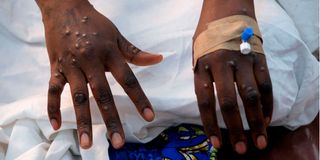
The hands of a patient with skin rashes caused by the mpox virus are pictured in Kinshasa.

The World Health Organization has released updated clinical guidelines for mpox management, with new emphasis on routine HIV testing for all mpox patients.
The revised recommendations, issued this week, respond to mounting evidence that people living with HIV face significantly higher risks of severe mpox complications and death.
"Children, pregnant people and people with weak immune systems, including people living with HIV that is not well controlled, are at higher risk for serious illness and death due to complications from mpox," the WHO stated in its updated guidance.
In the report, titled "Clinical management and infection prevention and control for mpox," the WHO strongly advises that people who have been diagnosed with mpox, and who test positive for HIV, must immediately begin antiretroviral therapy (ART).
WHO also states that early HIV testing should be conducted when patients present with suspected or confirmed mpox infection.
“Anyone showing symptoms of mpox should get medical help and an HIV test early. This step is crucial for reducing their risk of developing a severe case of mpox,” says the WHO.
Mpox is a viral illness that spreads primarily through close contact between people. The disease causes painful skin lesions and is typically accompanied by fever, headache, muscle aches, back pain, fatigue, and swollen lymph nodes.
While many patients recover without specialised treatment, the WHO's new guidelines recognise that certain populations, particularly those with compromised immune systems, require enhanced monitoring and care.
The emphasis on routine HIV testing for mpox patients represents a significant shift, recognising the overlap between populations affected by both conditions and the need for coordinated treatment strategies.
According to the WHO, the creation of the guidelines was necessitated by "the spread of the current global outbreak (since 2022 to present)”, which is sustained by human-to-human transmission occurring during close contact including sexual contact.
As of March 10, 2025, a total of 129,172 confirmed cases, including 283 deaths, have been reported to WHO from 130 member states and territories across all six WHO regions.
Five different studies with more than 2,000 people showed that those who started ART later were about four times more likely to be hospitalised.
The international health agency clarifies that quick ART initiation was based on several points: there's no really effective proven treatment for mpox itself, the mpox virus continues to multiply and worsen in people with weak immune systems (like those with untreated HIV), and quickly starting ART helps manage other opportunistic infections that often occur alongside mpox in people with HIV.
"Restoration of the immune function through ART is considered an important intervention in the management of opportunistic infections, especially if effective treatment is unavailable," says WHO.
The revised guidelines also provide recommendations for breastfeeding mothers infected with mpox, it suggests that breastfeeding mothers with mpox avoid direct skin-to-skin contact, especially if lesions are present on the breast or body.
“Mothers who had to temporarily pause breastfeeding during their infection are encouraged to restart once clinically recovered, while maintaining strict hygiene and ensuring physical capability.”
The WHO has called on countries, including Kenya's Ministry of Health, to integrate these new protocols into their local response strategies particularly among high-risk groups such as people with HIV and infants.
According to WHO Director-General, Dr Tedros Ghebreyesus, more than 37,000 confirmed mpox cases and 125 deaths have been reported to the WHO from 25 countries since the beginning of 2024. More deaths are being recorded in people with compromised immunity, including HIV infected patients.
Mpox symptoms typically develop within one week of exposure, though they can appear anywhere from 1 to 21 days after contact with the virus. Most patients experience symptoms for two to four weeks, but those with weakened immune systems may face prolonged illness.
Early symptoms mirror many viral infections and include fever, sore throat, headache, muscle aches, back pain, fatigue, and swollen lymph nodes. A distinctive rash usually follows these initial symptoms.
The symptoms commonly affect the palms and soles, areas rarely involved in other viral rashes, and can appear wherever contact with infected material occurred, including genital areas.
Beyond the characteristic rash, some patients experience more serious symptoms including painful rectal inflammation (proctitis), difficulty urinating, or pain when swallowing.