Why Africa's medicinal plant industry struggles to upscale
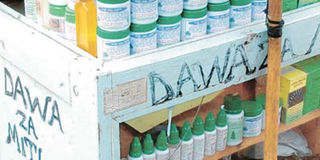
Herbal medicine on display on a street in Nyeri town.

What you need to know:
- Many medicinal plants are still harvested from the wild, which is not sustainable in the long term.
You have probably seen them: individuals walking around the streets, often balancing a large, sun-worn container. Inside, a concoction that they claim comes from specific herbs and is an answer to most modern ailments.
Or, you have had a more personal experience. A time you felt weak and then someone handed you a few leaves, telling you to steep them, breathe in their steam, or press them against your skin. Did it work?
Africa is home to a rich biodiversity of medicinal plants, experts say. “Traditional healers have passed down knowledge about these plants from one generation to another and when you look at the range of wild animals we have in the continent, there is a lot that we have learned from them; from how they soothe their pain, to the plants that work and don’t,” said Prof Bassirou Bonfohis, a Cote’dviore-based epidemiologist who has co-authored research on antimicrobial potential of 27 plants consumed by Chimpanzee.
He was speaking at the sidelines of the Global Bioeconomy Summit—held for the first time in Africa, and which Dr Andrew Karanja, CS Ministry of Agriculture and Livestock Development, said “opens opportunities for Africa to forge partnerships with other regions of the world to solve pressing global challenges of climate, biodiversity, food insecurity and jobs for the youth in a sustainable way.”
The struggles to harness to move from local, small-scale production of medicinal plants to large-scale, economically viable businesses are multifaceted.
“One of the critical issues hindering the growth of Africa’s medicinal plant industry is the lack of research facilities capable of isolating and identifying bioactive compounds. In many cases, the means to further analyse these compounds and develop them into scalable pharmaceutical products are simply not available locally. Instead, African researchers often have to send their samples to expensive labs in other continents, which increases costs and delays progress,” said Prof Bassirou.
This, instead, creates a bottleneck where valuable knowledge about medicinal plants remains untapped or underdeveloped.
“If Africa had more local research facilities, the industry could move from merely cataloguing plants and their uses to developing scientifically validated, commercially viable products,” he added.
The Covid-19 pandemic highlighted the urgency of this need as governments began to realise the importance of medical research and indigenous plant-based solutions.
Another barrier to scaling the medicinal plant industry in Africa is the challenge of cultivating these plants in a controlled environment.
“Many medicinal plants are still harvested from the wild, which is not sustainable in the long term,” remarked the researcher.
In countries such as Germany, the domestication process has begun, where researchers are experimenting with cultivating medicinal plants under controlled conditions.
Sebastian Guenther, a professor at the Institute of Pharmacy, University of Greifswald in Germany, explained how the process works. “The goal is to select plants that produce the highest concentrations of beneficial compounds and provide these plants to farmers for cultivation. However, there is often resistance to cultivation as some argue that farmed plants do not have the same efficacy as wild ones. Ensuring that the right phenotypes are selected for cultivation is crucial, as these cultivated plants need to maintain the same medicinal properties as their wild counterparts.”
Market demand also plays a significant role in the production of medicinal plants. In Africa, awareness about the potential of medicinal plants beyond local markets is still limited. As a result, small-scale producers often struggle to find a consistent market for their products.
“Additionally, there is a perception issue. Many consumers, both locally and globally, are not fully aware of the value of sustainably harvested or cultivated medicinal plants. In some cases, there is scepticism about the efficacy of cultivated plants compared to those harvested from the wild,” remarked Nguyen Huong, who leads a Vietnam-based International Centre for medicinal plants.
Despite these challenges, researchers say there are promising signs of change. “For example, the Vietnamese government introduced policies to support the regulation and cultivation of medicinal plants. Similar initiatives could be implemented across Africa to provide financial and technical support to local farmers and small-scale producers. Training farmers on sustainable harvesting methods and providing them with the knowledge to grow medicinal plants in controlled environments can go a long way toward ensuring the long-term viability of the industry,” she said.
Additionally, fostering collaboration between traditional healers and modern scientists can bridge the gap between indigenous knowledge and modern pharmaceutical development, they said.
Recently, the Kenya Medical Research Institute (Kemri) announced that it would start piloting the use of traditional medicines in health facilities across the country to treat various diseases including non-communicable diseases, whose drugs are rarely available.
“With the right infrastructure in place, Africa could move from being a supplier of raw materials to a producer of high-value pharmaceutical products, keeping more of the economic benefits within the continent,” said Prof Bassirou.