Why bamboo can solve Kenya's forest cover problem faster than any other tree
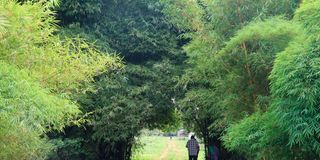
Bamboos at Mbidondo village, North East Bunyore in Vihiga county.
As the country races against time to meet its constitutional mandate of 10 percent forest cover by 2030, a fast-growing solution sits largely ignored on farms like David Muruli's five-hectare plot in Vihiga County.
The retired teacher has 20,000 bamboo seedlings lying idle, a small mirror of a national paradox where the country pours billions into flood control while overlooking the plant that could solve multiple crises at once.
"Kenyans have developed an interest in planting eucalyptus on riparian lands, and this is detrimental to the environment," says Muruli, who has turned his retirement into a mission to promote bamboo farming. "The eucalyptus absorbs a lot of water daily, leading to a reduction in water quantity and speed."
According to the conservationist, while ordinary trees take 15 to 25 years to mature, bamboo reaches harvestable size in just three to five years, and, for a country that needs to add 1.2 million hectares of forest cover in six years, the speed advantage should not be ignored.
The environmental multiplier effect
Bamboo's appeal extends beyond its growth rate. According to Lydia Atiti, an agronomist and agricultural county officer from Vihiga, the plant improves soil structure and prevents erosion that causes siltation in the lake basin. More critically, it produces 35 percent more oxygen than an equivalent stand of trees while absorbing significantly more carbon dioxide.
"The river streams across the nation are like canals with no life in them, but once bamboo plants are planted, rejuvenation and environmental aesthetics are conserved," Muruli explains. "The speed of the river is reduced, erosion is stopped, and water quantity increases."
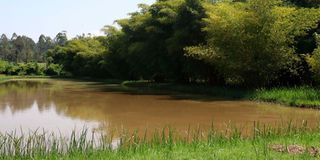
Bamboos planted along the Ezawa River that pours its water to Yala River in Vihiga County to conserve erosion.
This water management capacity carries particular weight in places like Budalangi, where residents have endured flash floods for 63 years. Government spending tells the story of repeated failure. In 2007 alone, Sh11 billion went into dam construction.
Between August and September that year, Ksh 22 million was spent on river dredging and drainage channels in Budalangi, according to then-minister John Munyes. This January, the president channelled another Ksh 130 million for dyke construction in the same area.
"The government should take the initiative of planting bamboo dykes along the lake basin in Budalangi and the lake region to control flooding and siltation," Muruli argues. "It will be a permanent solution instead of spending public money constructing dykes and drainage channels that are easily destroyed by floods."
The value chain that could transform rural economies
Betty Mulianga, Chief Officer in Vihiga County, acknowledges that most citizens fear bamboo's colonisation nature, how it can cover large areas with forest. But she sees this as precisely why it works for degraded wetlands.
"People should be sensitised on the economic gain of bamboo," Mulianga says. "The government has to entrench and enforce policies into laws to govern wetlands since most are degraded by planting trees that absorb much water."
The economic case is strengthening. Victor Mwanga from Earth Lungs, who has championed green environment initiatives for nearly two decades, recently supported the Ministry of Environment's investment proposal with Eco-Doctor, a Chinese investor, for bamboo processing plants in western Kenya and across the nation.
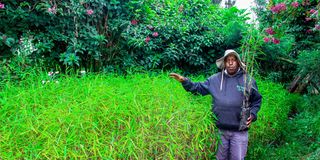
Daniel Waruathe stands next to his bamboo seedlings at his home in Kinale, Kiambu County.
The bamboo value chain in Kenya is expansive but largely untapped:
Construction industry: Bamboo's strength and hardness make it ideal for structural applications and the production of Medium Density Fiberboard (MDF), which is essential for modern construction and furniture.
Consumer products: The plant is processed into furniture, matchsticks, brooms, toothpicks, and utensils including cooking sticks and drinking cups.
Food and feed: Bamboo shoots, particularly from giant bamboo varieties, serve as vegetables for human consumption. The leaves provide nutritious animal and fish feed.
Energy and paper: Bamboo serves as a fuel source and raw material for paper production.
Medicinal applications: In countries like Indonesia, bamboo shoots are extracted for medicines treating kidney ailments. The plant is also processed into fabric.
Ecological services: Bamboo provides habitat for bees, supporting apiculture. "I am going to use the money earned to venture into apiculture as the bamboo plant provides a moderate temperature favourable for bees," Muruli says.
The challenge of implementation
Atiti points to a crucial factor that determines success. "The higher the rate of water retention by the soil, the higher the chances of bamboo survival and growth rate," she notes. This makes wetlands and riparian areas ideal, precisely where flood control and erosion prevention matter most.
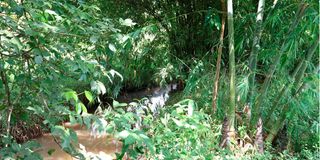
Bamboos planted along the Ezawa River that pours its water to Yala River in Vihiga County to conserve erosion.
Yet propagation remains challenging. "The survival rate is less than 50%, especially during the dry season, as more water is required for watering," Muruli admits.
More troubling is how government initiatives have faltered. An Auditor General's report from January 2025 flagged the Kaptagat Forest bamboo project as potentially ghost, with Sh147.7 million spent between 2017/18 and 2021/22 on a national bamboo demonstration centre that showed minimal activity. Accounting officials in the Ministry of Environment and Kenya Water Towers Agency could not explain how the money was spent.
"The government should follow due process when putting up any demonstration centres for bamboo to ensure public monies are used proactively," Muruli urges. "For the government to solve the Budalangi and lake region flash floods, local residents should be involved for public participation and enough sensitisation done."
A policy framework still catching up
The Attorney General's office concluded in a 2007 report on floods that the government has not put adequate measures in place to respond to humanitarian emergencies during flash floods. The report noted delays in early warning and inadequate evacuation of victims, leading to loss of life and trauma in relief camps.
Recommendations included coordinating the State Department for Internal Security with the department for Arid and Semi-Arid Lands to enact national disaster risk management policy and law. The development of a National Relief Assistance Policy was also urged to restore efficiencies in the relief process through clear, legally binding guidance.
None of this addresses the root cause that bamboo could help solve: preventing the floods in the first place.

A neglected bamboo nursery project at Kaptagat Forest National Bamboo demonstration site in Elgeyo-Marakwet County on October 11, 2024.
Mulianga emphasises the need for stronger policy action. "The government has to entrench and enforce the policies into laws to govern wetlands," she says, noting that agro-ecology and environmental conservation policies are essential but lack teeth.
Kenya's forest cover by numbers
Current forest cover: 8.8% (2024)
Constitutional target: 10% by 2030
Gap to close: Approximately 1.2 million hectares
Bamboo growth rate: Matures in 3-5 years
Tree growth rate: Matures in 15-25 years
Bamboo oxygen production: 35% more than equivalent tree stands
Government spending on Budalangi floods (2007-2025): Over Sh11.2 billion
Kaptagat bamboo project loss: Sh147.7 million (2017-2022)