Nairobi traffic: Why more electric vehicles will be good for our health

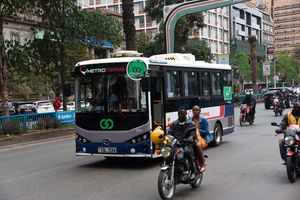
Rembo Classic Sacco electric bus in this photo taken on December 8, 2024. Many saccos in the capital are investing in electric vehicles.

Mary Njoki prefers the village to the city for many reasons. Top of her list is her health. As someone who was born and bred in Nairobi, the village gives her a sense of calm that only her body appreciates the most. Njoki is asthmatic. She lives in Mathare, one of the country’s slum areas full of crammed houses with poor air quality. She works as a community health promoter.
“Anytime I pass by a place that has any form of smoke, it affects me,” she says.
She gets an asthmatic attack at the slightest inconvenience. In traffic for instance, she always has her mask on just in case she sits next to someone who has worn a perfume. She starts wheezing at the slightest whiff of a perfume.
“I once got an asthmatic attack inside a bus because of the perfume,” says Njoki.
Njoki hates mornings because of the fumes that cars emit when she is waiting to catch a bus. She resorted to always having a mask on and sitting on a side that is less likely to emit any smoke.
“My route (Mathare) has no electric buses. We mostly use the old ones so I haven’t experienced the joy of riding in an electric bus yet.”
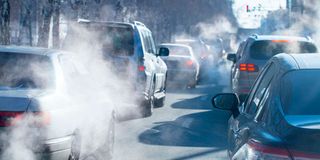
Nairobi’s air quality is heavily affected by vehicle emissions.
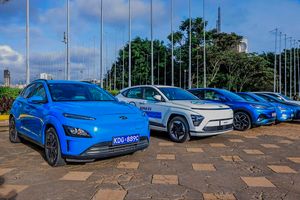
In most routes in the capital city, there is at least one electric bus plying. Data from the Electric Mobility Association of Kenya (EMAK) shows that the number of registered electric vehicles (EVs) has risen in the last six years to over 9,000 EVs. Electric motorcycles take the largest share of registered EVs in the country.
Habib Lukaya, Roam’s Country Manager, explained to the Nation that the biggest benefit of EVs to human health comes from reduced air pollution.
“Nairobi’s air quality is heavily affected by vehicle emissions, particularly PM2.5 particles, nitrogen oxides, and carbon monoxide from petrol and diesel engines. Electric vehicles produce zero tailpipe emissions, which means less smog, fewer respiratory diseases, and improved public health across the city,” he explained.
If you have taken a ride in an electric bus, you notice the calmness that you get in it. Habib explains that it is designed to reduce noise pollution. He says that electric vehicles operate much more quietly than internal combustion engine vehicles.
“Reduced noise levels can lower stress, improve mental well-being, and even enhance sleep quality for people living along busy roads,” he explains.
Another indirect health benefit that he alludes to is the reduction of the dependency on fossil fuels, which helps in cutting down oil spills and contamination, leading to cleaner water sources and healthier ecosystems — all of which indirectly support human health.

The number of registered electric vehicles has risen in the last six years to over 9,000 EVs.
Riding an electric vehicle, apart from the noise, is usually generally cooler. Habib explains that for vehicles, during heavy traffic, thousands of idling engines release heat into the air, which contributes to a rise in local temperatures. He says that electric vehicles don’t burn fuel, so they emit significantly less heat into their surroundings, which is why their microclimate is cooler.
“Because EVs produce no exhaust fumes, passengers are not exposed to pollutants from their own car or those idling around them. With advanced air filtration systems, the result is cleaner and cooler air inside the cabin,” says Habib.
A new report from the Global Climate and Health Alliance dubbed from the Cradle to the Grave, explains that while EVs reduce tailpipe emissions, they do not address inequality or non-exhaust pollution such as tyre and brake wear.
Their analysis shows that almost 2,000 times more particle pollution is produced by tyre wear than is pumped out of the exhausts of modern cars, polluting air, water and soil with a wide range of toxic organic compounds, including known carcinogens (cancer-causing compounds).
They, however, agree that fossil fuel transport policies are often costlier to public health systems.
Their report suggests that countries should invest in active and public transport, including safer non-vehicle options like separated bike lanes and improved walking and biking infrastructure, to reduce overall car dependence and address equity, physical inactivity, and air pollution.
Martin Muchangi, Director of Population and Health at Amref Health Africa, explains to the Nation that fossil fuels are an accumulation of organic compounds that abide below the earth surface and once burned, they give energy.
“It is the source of energy for most internal combustion engines, including the vehicles that we drive on,” he explains. “We mostly feel the impact of fossil fuel burning through polluted air.”
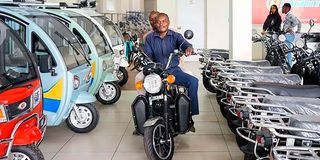
Customers try out an electric motorcycle at Hanlin Africa New Energy Technology Company Limited in Nairobi on May 2, 2024.
He explains that the prevalence of asthma cases are increasing because of the concentration of particles that come out as a result of burning fossil fuels such as PM 2.5 (particulate matter with a diameter of 2.5).
As a result of fossil fuels, he says that we are experiencing climate change which also contributes to changing disease patterns.
Maurice Kavai, Deputy Director Air Quality in Nairobi County, explains that exposure to emissions from vehicles cause a number of health complications such as heart attacks, stroke, cancers, neurological (relating to the brain) deficit and eye issues.
“Sometimes you could be walking in the Central Business District (CBD) and realise that your eyes keep on shedding tears. That is because of a direct exposure to particulate matter,” he says.
Mr Kavai adds that shedding tears is a natural way of getting rid of the particulate matter and dust. When it is very hot, it is sometimes difficult for some people to see far because of the dense particles, mostly emitted from vehicles.
He explains that exposure to these particles by vulnerable populations such as children, pregnant women and the elderly makes them more susceptible to negative health effects.