Women fishers demand equal support in Kenya’s blue economy push
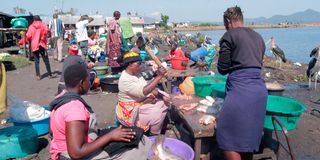
Women scaling fish at Kogina Beach in Homa Bay town in this 2022 picture. Homa Bay women have turned to aquaculture as fish stocks dwindle, demanding equal support in Kenya's blue economy push.

What you need to know:
- While men dominate traditional fishing in Kenya, 600 women in Homa Bay are revolutionising the industry through cage fish farming in Lake Victoria.
- Homa Bay Woman Rep Joyce Osogo is calling on the government to include women equally in President Ruto's blue economy plans, which aim to boost the sector's annual contribution.
While men cast their nets from boats, women in Homa Bay are quietly revolutionising Kenya's fishing industry—one cage at a time. Now, they want equal recognition for their efforts.
Homa Bay Woman Representative Joyce Osogo, popularly known as Bensuda, is calling on the Ministry of Blue Economy to ensure women are included in President William Ruto's plans to revitalise Kenya's fisheries sector.
The legislator argues that women play a crucial role in sustaining fish production, particularly through their involvement in sales and distribution. Despite fishing being predominantly male-dominated across the country, a growing number of women are carving out space in fish production, primarily through cage farming in Lake Victoria.


"Women should be supported equally, just like men," Ms Osogo said, highlighting how female fish farmers are taking advantage of dwindling fish stocks in the lake to help bridge supply shortages.
These women have turned to aquaculture as an innovative solution to address the challenge of reduced fish supply in Lake Victoria, with many adopting cage farming techniques to boost production.
"Women have proven their capability to produce fish through aquaculture in Lake Victoria. They are taking the lead as people who are coming up with solutions for addressing the dwindling fish population in the lake," the legislator explained.
Suba's success story
A prime example of this female-led initiative is the Suba South Women Enterprise, a group comprising 600 women operating fish cages at Rasira Beach. The group undertakes aquaculture in Lake Victoria with support from Rio Fish Limited, an aquaculture company also led by women.
The enterprise uses cages to grow fish, which are harvested upon maturity and sold in various towns across the region. This model demonstrates the potential for scaling up women's participation in the sector.
"Lake Victoria can transform the lives of many women in counties surrounding it through aquaculture. More women should, therefore, be empowered to enable the acquisition of fish cages," she said.
The Woman Rep emphasised that such groups need support in the form of fingerlings and funding for fish feed purchases.
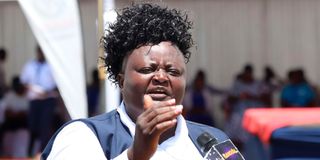
Homa Bay Woman Representative Joyce Osogo at an event in the county on April 14, 2023. She is calling for women to be equally included in President Ruto's blue economy plans.
Bensouda appealed to Blue Economy Cabinet Secretary Hassan Joho to establish a program specifically supporting women in aquaculture.
"The successful aquaculture undertaken by these women is a clear demonstration that women have the ability to produce fish through cage fish farming," she said.
Her call comes after President Ruto's visit to Homa Bay, where he announced his administration's commitment to revitalising the fisheries sector to boost the economy.
According to the President, Kenya's blue economy currently contributes just 0.4 per cent of the country's Gross Domestic Product (GDP), representing between £20-27 million annually. However, he believes the fisheries sector has the potential to contribute up to ten times more, generating between £200-270 million annually.
"We are far from achieving our target. We are, however, taking steps to reach our potential," President Ruto said during his visit.
Part of his plans includes helping fishermen form cooperatives to generate income for personal growth.
The Woman Rep believes empowering women in the blue economy will have far-reaching benefits beyond individual households.
"Many women are the breadwinners in their families, hence empowering them will improve the lives of many people in society. The blue economy is an emerging sector that will transform the economy of Kenya, especially in Homa Bay, which owns the largest share of Lake Victoria," she said.
Private sector partnership
Rio Fish Limited CEO Angela Odero and Project Lead Mercy Chepkirui explained their company's role in supporting the 600 women to improve their livelihoods through fish production.
The company provides technical training in modern fish production methods and guarantees to purchase the fish upon maturity.
"After maturity, we buy the fish from them," Angela confirmed.
Mercy outlined their three-year project timeline, emphasising sustainability beyond their involvement.
"We are implementing it in a manner that the project can continue even after our exit," she said.
Transforming lives
Millicent Okeyo, chairperson of Suba South Women Enterprise, testified to the project's impact on participants' lives.
"The income we get from this project has greatly improved our lives. We have also gained valuable skills on how to rear fish in cages," Millicent said.


