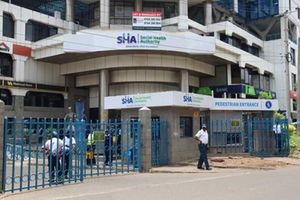
World Cancer Day: Patients stranded as SHA system fails at KNH
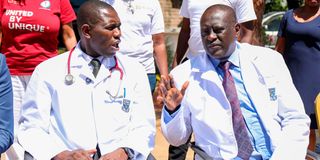
Medical Services Principal Secretary Dr. Ouma Oluga (left) engages with Kenyatta National Hospital CEO, Dr Richard Lesiyampe, during the marking of World Cancer Day under the theme “United by Unique: Focusing on Patient-Centred Cancer Care” at Kenyatta National Hospital on February 4, 2026.

Cancer patients at the Kenyatta National Hospital Oncology Centre have decried Social Health Authority (SHA) approval delays, leading to treatment delays and interruptions.
On a day the world marks World Cancer Day, a day intended to spark hope and advocate for better care, the halls of the Cancer Centre were instead filled with the quiet desperation of over 20 patients caught in a bureaucratic deadlock. For many, the transition from the defunct NHIF to the new SHA has become a barrier to the very medicine that keeps them alive.
For patients like 60-year-old Dishon Munase, who journeyed from Kakamega, the delay is more than an inconvenience; it is a threat to his recovery.
Munase was diagnosed with refractive Hodgkin's lymphoma in June 2025 and has been undergoing chemotherapy. He described a confusing cycle where medicine is available but remains locked away because of a failure to generate an invoice through the SHA system.
"I am supposed to be undergoing chemotherapy every three weeks. My doctor has already prescribed the drugs I need to take. However, since Monday, the system has been so slow I am yet to get an approval. This system serves about five patients only in a day," Munase complained.
"This has messed up my treatment because I was supposed to get it on Monday, then rest as I wait for the next session. But I cannot get the chemotherapy without a SHA invoice of authorisation. Any more delays will lead to a drop in my blood levels, and I will have to undergo other separate treatments to increase them before I resume chemotherapy. Those treatments also require tests, which require money. There are many critically ill patients who also have to wait until the system picks up for them to get treatment," he lamented.
He explained that due to chemotherapy, he cannot travel back upcountry because of a weakened immune system and has to keep visiting the facility until the system picks up.
The delay has also aggrieved caregivers like Betty Odero, who arrived at the facility at 9 am on Wednesday seeking authorisation for her mother's treatment. However, she was met with a crisis that left vulnerable patients stranded on hard wooden benches for hours. Odero noted that the delay is not just a matter of lost time but of physical and emotional agony for those undergoing chemotherapy.
"Remember, these are patients who are on chemotherapy. Some of them cannot even sit for long. The disease is already pushing them down, and now you are mentally and emotionally trying to disturb them," she said.
"System is down"
The recurring excuse, according to Odero, is the digital system.
"They say the system is down, and yet when they send you to private facilities like Texas Cancer Centre nearby, they do it in 20 minutes. It's a system problem inside here. Can they fix it? We can't do this," she said.
In response, Principal Secretary (PS) for Medical Services in Kenya's Ministry of Health, Dr Ouma Oluga, explained that the delay is likely caused by patient loss of fingerprints as a result of cancer, making it impossible to log into the SHA biometric system.
"Often for patients who are taking chemotherapy, we have a challenge with the loss of fingerprints. Because of that, we have to have mechanisms for identification. I think it's just about a delay that may need to be sorted, and it must be somehow unique because we are trying to make sure that as much as possible we have the correct patients getting the correct treatment," Dr Oluga said.
"In the morning, the Cabinet Secretary chaired a meeting. It is something that is going to be sorted, and it's something that shouldn't be an alarm. We assure all our patients that they will get the right care and at the right time for all those chemo patients," the PS said.
In an address marking World Cancer Day, PS Oluga outlined a comprehensive national strategy to reignite Kenya's response to the cancer crisis, moving from a culture of late diagnosis to one of prevention and financial protection. Centred on detection, improved care systems, and aggressive prevention, he explained that the Ministry of Health seeks to transform cancer from a death sentence into a manageable condition that does not bankrupt Kenyan families.
At the heart of the government's prevention strategy is the elimination of cervical cancer. The PS noted that while current HPV vaccination coverage for girls aged between nine and 15 stands at 30 percent, the government is aggressively pursuing a 90 percent target.
Beyond vaccines, the ministry is expanding its diagnostic footprint through the National Equipment Service Programme. This includes the deployment of mammograms to over 84 hospitals and the rollout of specialised laboratory services capable of detecting early indicators of colorectal and gastric cancers. Furthermore, endoscopy services have been deployed to address the high burden of oesophageal cancer, ensuring that even difficult-to-detect cases are caught at the onset.
The PS highlighted the growth of six comprehensive public cancer centres, including the advanced molecular imaging centre at Kenyatta University Teaching and Referral Hospital and regional hubs in Garissa, Mombasa, and Nakuru. To further decentralise care, the government is finalising two additional centres in Kisii and Kisumu (JOOTRH) to address the high burden of cancer in the Lake region, where thousands of cases are diagnosed annually.
Addressing the financial strain on patients, the PS confirmed that under the Social Health Authority, the government has officially increased the oncology benefit package from Sh550,000 to Sh800,000.
"Hospitals must utilise the provider portal to notify SHA once a patient nears their initial limit. No hospital that has notified SHA has been denied. To further protect patients from wiping out their cover on expensive drugs, the ministry is developing a standardised pharmaceutical catalogue by the end of March. This will guide doctors towards cost-effective prescriptions, preventing cases where a single tablet costs Sh140,000 when a Sh20,000 alternative is just as effective," PS Oluga said.
Follow our WhatsApp channel for breaking news updates and more stories like this.