Your flooded home and empty field are climate issues, not bad luck
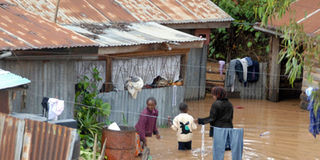
A family's flooded home in Dagoretti, Nairobi in the past.

When floods destroy your home, when droughts empty your fields, when heat waves claim lives in your community, climate change stops being a distant policy debate and becomes devastatingly personal.
For Dr Xavier Musonye, a PhD researcher specialising in energy systems modelling and sustainability studies, the question isn't whether Africans should care about climate change. The continent is already living its consequences daily. The real question, he argues, is whether Africa will seize this moment to leapfrog into green industrialisation and become a global leader in sustainable solutions or continue bearing the brunt of a crisis it barely caused.
In this conversation, Dr Musonye explains why the shift from climate aid to investment isn't just realistic but necessary, how young Africans can drive this transformation, and why the continent cannot afford to repeat the West's environmental mistakes.
Many people view climate change as abstract compared to pressing daily struggles like food, jobs, or housing. How do you explain its direct connection to these everyday concerns?
Climate change affects everyone in very practical ways. The impacts directly affect daily struggles, including access to food, housing, health, and jobs. Increased rainfall causes floods, destroys houses, and displaces people from their homes. With flooding comes the spread of waterborne diseases and the attendant cost of medication, and in some instances, death.
On the other hand, extreme drought conditions destroy harvests, causing food shortages that result in famine and starvation. Animals, especially for pastoralists, are also affected, leading to conflicts over scarce water and grass resources. This is highly experienced here in Africa.
Wildfires, fueled by extreme high temperatures, are consuming vast lands, destroying crops, forests, and national parks in the Western world and Oceania. Heat waves and their accompanying health conditions, like heat stroke and dehydration, have caused deaths in Asia. The destruction of farmlands in wildfires, as well as damage to facilities and infrastructure caused by storms and flooding, results in significant job losses.
Why should ordinary citizens, beyond policymakers and scientists, take climate change as a personal issue rather than a distant global debate?
Climate change has been and continues to be the cause of extreme weather conditions witnessed across the world. These extreme weather conditions directly impact everyone's livelihood, with the less privileged in society bearing the highest brunt. Food scarcity, rising food costs, and dry grazing fields for pastoral communities due to droughts, increased flooding, storms that destroy homes, and deaths caused by heat waves, all of these directly impact all of us.
At the Addis Ababa climate summit, African leaders emphasised investment over aid. From your perspective, how realistic is this shift in ensuring the continent meets its climate goals?
The shift from aid to investment is not only realistic but necessary. However, this is only possible with tangible financing, transparency, accountability, and deliberate commitment from African leaders.
The continent can leverage its abundant wind, solar, geothermal, and hydropower energy potential, along with its industrial and critical mineral endowment, and its young, educated labour force, to attract an industrial shift from Asia and Europe to Africa. This is what leapfrogged China. But unlike China, Africa could industrialise without fossil fuels, becoming a reference model of such an undertaking, only if the world can come together to support this.
African-led initiatives like the Africa Green Industrialisation Initiative (AGII) and the Africa Climate Innovation Compact (ACIC) are a good start for the continent, if they are followed with tangible and executable plans.
The Paris Agreement and subsequent commitments like the Nairobi Declaration set clear targets. Why is it critical for African countries not only to sign these agreements but to actually keep them?
The Nairobi Declaration emphasises the need for significant polluters to allocate more resources to assist poorer nations. Conversely, the Paris Agreement requires African countries to demonstrate commitment through planning and implementing practical adaptation measures, as well as updating and reporting on their progress and needs. The Agreement also obliges African nations to allocate resources towards achieving their goals.
Given that Africa has contributed only 5 percent to the historical emissions responsible for climate change, it should not be burdened with fulfilling these commitments using its own resources. Moreover, the continent continues to struggle with providing basic needs, causing most resources to be diverted to this priority and leaving limited funds for climate change mitigation efforts. Developed nations should be intentional in supporting the continent to realise the climate-related agreements and commitments.
President Ruto has accused Western nations of breaking a 'climate blood pact' by failing to deliver on financing. In your view, how can Africa balance holding the West accountable while still driving its own solutions?
Africa must persist in demanding that historical emitters honour their pledges. Sometimes, you use your strength to negotiate for your needs. Therefore, the continent can utilise its abundant resources, such as minerals and timber, as leverage.
Still, the continent can also aim for self-reliance by pursuing African-led initiatives, like the African Carbon Markets Initiative and regional green bonds, as well as mobilising domestic resources, all while leveraging these resources.
Sustainable energy is often positioned as the backbone of climate action. What practical steps should African governments and communities prioritise to accelerate this transition?
Governments should focus on expanding our understanding of "energy access" beyond simple household connections. They must establish clear, stable, and attractive policies and regulations to promote both domestic and international investment in renewable energy projects.
They should invest in and upgrade the electrical grid to effectively incorporate diverse renewable energy sources such as solar and wind, ensuring a reliable and stable power supply. Promoting cross-border energy development can help expand markets, reduce development costs, and increase efficiency.
The community should encourage and adopt energy-saving behaviours in everyday life. They should also participate in collective initiatives, such as community-owned solar farms or energy cooperatives, to promote local ownership and benefit from clean energy.
At the community level, raising awareness and promoting the use of clean technologies, solar home systems, efficient stoves, and electric mobility must be backed by financing models that make them affordable.
Industrialisation in Africa is key to economic growth. How can the continent pursue green industrialisation without repeating the environmental mistakes of the developed world?
We must leapfrog. That means employing renewable energy to power industries, prioritising circular economy practices, and implementing environmental standards early.
Africa can harness its plentiful hydropower and geothermal energy resources for industrial power, while utilising intermittent solar and wind, combined with storage systems, for commercial and domestic use. Since Africa is yet to industrialise, it can integrate sustainability into its industrial development. By incorporating sustainability from the outset, Africa can industrialise competitively without inheriting the pollution burdens of the past.
However, this must be supported by resources from developed nations, as such an industrialisation pathway will be costly, given the high expense of developing renewable energy sources and their storage systems compared to fossil fuels.
Skepticism and misinformation about climate issues remain widespread. What strategies can be used to ensure people understand both the urgency and the benefits of climate action?
Communication should move from technical jargon to relatable storytelling. Demonstrate how climate action reduces electricity bills, creates jobs, and enhances health. Schools, faith leaders, and local media can play influential roles in spreading accurate information.
Empowering trusted community voices to lead discussions helps dismantle myths and emphasise real benefits.
The Africa Green Industrialisation Initiative and similar frameworks sound ambitious. What markers of success should citizens look out for to know these initiatives are truly working?
Citizens should watch for tangible changes: new green industries generating jobs and growth in local green employment. They should assess whether Africa is increasingly processing its natural resources to develop value-added products.
Look for affordable clean energy reaching homes and businesses. Monitor the development of African-led innovation in green solutions, from electric mobility to clean cooking, and the growth of local manufacturing capacity for these technologies and related components. Watch for reduced air and water pollution in cities.
Looking ahead, what role do you see for young Africans in ensuring the continent not only adapts to climate change but also becomes a global leader in sustainable energy and climate solutions?
Young Africans are the drivers of innovation and advocacy across the African continent. The younger generation can lead the continent towards global leadership by demanding accountability from leaders, as they are already doing, spearheading startups in clean energy and climate technology, and shaping global narratives so that Africa is recognised not as a victim but as a leader.
With their creativity, energy, and digital fluency, young Africans, when supported by suitable policies, can steer the continent towards a sustainable future and global leadership through innovation, while contributing to global solutions originating in Africa. Additionally, many young Africans are entering job markets in developed countries, allowing them to learn from diverse social landscapes and work cultures, knowledge that can be applied back home for the benefit of our continent.