Youth set the pace in fight against forest degradation
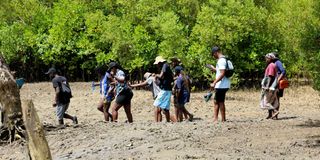
Youth plant mangroves around Jomvu Creek in Mombasa on June 13, 2025.

What you need to know:
- The initiative targets 50 youth across five countries: Kenya, Uganda, Ghana, Zambia, and Peru, who are trained and mentored to become leaders in forest monitoring and climate resilience.
Young people are emerging as the new face of forest conservation in Kenya, taking the lead in restoring degraded mangrove ecosystems in Mombasa as part of a multi-country initiative to address the climate crisis from the grassroots.
Armed with technology, indigenous knowledge, and a passion for environmental justice, a group of 10 winners of Young Forest Champions competition is working with local communities to replant mangroves, monitor forest cover, and educate the public on sustainable restoration practices.
They are part of the AIM4Forests (Accelerating Innovative Monitoring for Forests) programme, a five-year project funded by the UK government and led by the Food and Agriculture Organisation (FAO), in collaboration with the Kenya Forest Service (KFS) and local youth organisations such as SERIOP.
The initiative targets 50 youth across five countries: Kenya, Uganda, Ghana, Zambia, and Peru, who are trained and mentored to become leaders in forest monitoring and climate resilience.
“In Kenya, the 10 champions aged 30 and below have already mobilised over 10,500 community members and planted more than 150,000 trees since January this year,” said Ms Ivana Tara, FAO’s facilitator for the youth programme.
Brenda Kajuju, a forest champion and student of Kenyatta University pursuing a Bachelor’s Degree in Environmental Planning and Management, was attracted to conservation by the communities’ efforts to restore Meru forest.
She now uses Geographic Information Systems (GIS) and remote sensing to amplify the conservation efforts through monitoring of forests, green spaces, land quality and land surface air quality.
“This year, I was selected to become a Young Forest Champion under the AIM4Forest through FAO. The training has empowered me—I’ve grown through courses and field excursions,”,” stated Kajuju.
She called on youth to join the fight against environment degradation. She believes youth have the ability to reverse the effects of climate change through forest restoration.
Another champion, Anthony Alovale from Vihiga County, is focused on combating the rising threat of wildfires, which are being fueled by prolonged dry spells and increasing temperatures.
“The biggest threat that we are facing with the increase in temperatures is that the vegetation dries up and wildfires are on the rise,” he stated, adding that he is in the process of developing a fire detection system to have real-time monitoring of the fires when they occur for a quick response, thus reducing the impact.
Restoration practices
Alovale said unlike before youth, are now more willing to engage in environmental restoration practices.
"The government should invest in these efforts so we can have a good environment," he said, advising youth to pursue environment-related courses.
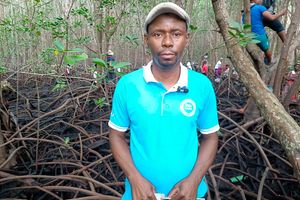
Levis Rikwa, a marine ecologist, has been working with the community to rehabilitate the degraded mangrove forest in Jomvu.
He said studies show that Mombasa’s mangroves are declining at five per cent per year—the only gazetted forest in the coastal city.
“We’re not just planting trees; we’re teaching alternative livelihoods like beekeeping and agroforestry so locals don’t rely on cutting trees,” Rikwa said.
The project builds on the earlier INFOForest programme, which successfully supported forest restoration in more than 20 countries.
In Kenya, it supports the government’s ambitious plan to plant 15 billion trees by 2032.
Last week, the champions planted 5,000 mangrove seedlings along Tudor Creek—a critical step in reversing degradation.
“This initiative gives youth practical knowledge on how to restore forests - not just planting trees, but understanding what species to grow, where and when to plant, and how to ensure survival using local knowledge,” Ms Tara explained.
According to KFS County Conservator Bernard Wahome, around 40 per cent of Mombasa’s 3,771 hectares of mangrove forest is already degraded due to pollution, urban expansion, and sea level rise.
“These young people are key to reversing the damage. Their energy and tech skills bring new momentum to our efforts,” said Mr Wahome.
The AIM4Forests initiative received over 1,500 global applications, with 519 from Kenya alone. The final 10 champions, all under 30, are undergoing mentorship and technical training to become the next generation of climate leaders.
“This is not just about trees. It is about building a movement that equips youth with the tools to protect our future,” said Ms Tara.