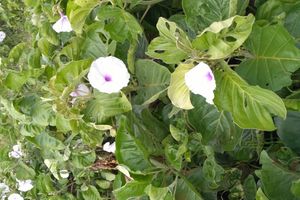
Youth wage war on invasive weed swallowing Kajiado’s grazing lands
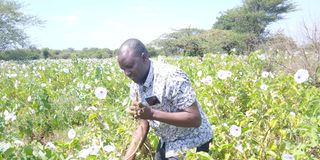
Mr Wilson Mayion, a herder from Kajiado East, uproots Ipomoea plants at a grazing field on May 30, 2024.

What you need to know:
- In Kajiado County alone, the weed has spread to an estimated three million acres, devastating traditional grazing lands.
In the vast, wind-swept rangelands of Kajiado County, a silent ecological disaster has been unfolding for decades.
Ipomoea weed has been waging a relentless war against pastoralism, threatening the very way of life for communities that have depended on this land for generations.
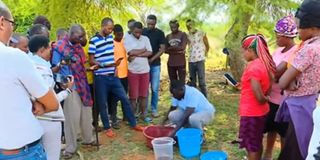
Elevate the Young members teach residents of Sajiloni in Kajiado County how to make paper and baskets from Ipomoea weed.
First detected in Kenya during the extreme El Niño rains of 1997-1998, this aggressive plant has since become a nightmare for herders across Kenya's arid and semi-arid lands.
What began as a seemingly innocuous flowering vine has transformed into an ecological monster, colonising millions of acres of critical grazing lands.
The plant's journey into Kenya's ecosystems is a cautionary tale of unintended consequences. Experts believe it was likely introduced accidentally, possibly through contaminated seed imports, or as an ornamental plant that escaped cultivation. Its remarkable adaptability quickly became apparent. With the ability to grow up to two metres tall and spread four metres in diameter, Ipomoea micrantha has an extraordinary capacity to outcompete native vegetation.
In Kajiado County alone, the weed has spread to an estimated three million acres, devastating traditional grazing lands. The plant's impact is multifaceted and devastating. Its dense foliage smothers native grasses, creating monoculture zones that render vast stretches of land unusable for livestock.
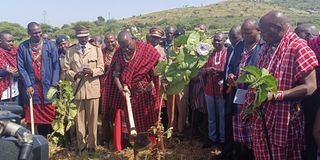
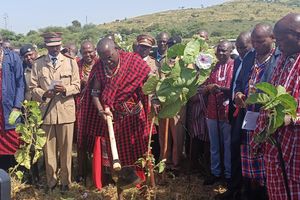
Kajiado Governor Joseph Lenku displays an uprooted Ipomea weed at Ibisil on 1 June 2024 as he launched the county-wide weed eradication exercise.
The roots are deep and persistent, making manual removal extremely challenging.
"This is more than just a plant," explains Halima Nenkari, the deputy director at State Department for Livestock Development.
She has dedicated most of her career studying the Ipomoea invasion. "It's an ecological disruptor that fundamentally changes landscape dynamics. Each plant can produce thousands of seeds, and they can remain viable in the soil for years, making complete eradication nearly impossible."
The human cost has been enormous. Pastoralist communities, already vulnerable to climate change and increasing drought conditions, have watched helplessly as their grazing lands transform into purple-flowered wastelands. The economic impact is staggering - reduced livestock productivity, increased feed costs, and diminished land value have pushed many families to the brink of economic collapse.
In June 2024, Governor Joseph Lenku declared the plant a county disaster owing to its adverse effects.
"This weed has become a monster endangering our food security. The weed has flourished due to bad use of land, including overgrazing in a small portion of grazing land. The only possible means to eradicate this weed is by uprooting, "said Governor Lenku.
But all is not doom and gloom.
Enter Elevate the Young, a local youth organisation that is reimagining the fight against this invasive species. Founded by 33 young professionals, including 11 women aged between 25-35, the group has developed an innovative approach that transforms the ecological challenge into economic opportunity.
Instead of viewing Ipomoea as an unmanageable problem, they see it as a resource. The group is converting the plant into eco-friendly paper and baskets, creating a circular economy approach to weed management.
"During the Covid-19 pandemic and concurrent drought, we saw our parents' mental health deteriorate as they watched their livestock suffer," says Wayne Tiampati, the organisation's director. "The Ipomoea weed became a symbol of hopelessness. But we decided to change that narrative."
The group's production process is meticulously designed. They collect the plants, carefully uprooting them to prevent re-growth.
The plant is then chopped and mixed with recycled waste paper. Cassava is used as a natural binder, creating a unique pulp that can be formed into paper sheets and dried in the sun.
The resulting "Ecovine Press" paper can be used for writing and drawing, while the plant's flexible vines are woven into eco-friendly baskets.
The group is also collaborating with researchers to explore potential of producing natural dyes and renewable energy briquettes.
Local herders are taking notice.
John Olepapa, a 56, reflects on the transformation: "We've watched this weed destroy our land for years. To see young people turn it into something valuable - it's more than just an economic solution. It's a restoration of dignity."
The initiative is not just an isolated effort. It represents a broader movement of innovative ecological problem-solving emerging across Kenya's arid regions. Researchers from institutions like the University of Nairobi have been studying Ipomoea for years, but practical, community-driven solutions have been rare.
However, challenges remain. The group currently lacks the financial resources to scale up their operation. They're seeking support from both national and county governments to expand their approach across Kajiado's five sub-counties.
The environmental stakes are high. According to the State Department for Livestock Development, if the current spread continues unchecked, pastoralism in Kajiado could be severely compromised within a decade.
The Ipomoea challenge extends beyond grazing lands. The plant has begun to impact other agricultural activities, including beekeeping. Its nectar can produce potentially poisonous honey, further complicating local agricultural ecosystems.
“The colonisation of large pasture areas by the weed is adversely affecting pasture adequacy for livestock. This is leading to agricultural activities in former rangelands and heavy deforestation and charcoal burning for locals to earn livelihood,” said Ms Nenkari.
"We're not just fighting a weed," Tiampati emphasises. "We're fighting for the future of our community, our environment, and our way of life."