Former President Mwai Kibaki and ex-Prime Minister Raila Odinga overruled key provisions of the Constitution that would have created only 14 counties, National Assembly Speaker Moses Wetang’ula has said.
Instead, the number of counties was unilaterally increased to 47 based on the existing districts at the time, he said.
Mr Wetang’ula made the revelation during an interview with the Nation as the 2010 Constitution turns 15.
The Speaker said that in the original Bomas Draft, Kenyans wanted 14 regions. Western, Nyanza, and Central regions were each supposed to be divided into two administrative units, Rift Valley and Eastern (three), while the Coast was to remain as one.
Nairobi was categorised as extra-territorial; it was neither part of the devolved units nor the central government, it was to be the central neutral unit — the seat of the national government.
“Had that happened, it would have been very good. We would have strong regional authorities, politically and economically. But we argued a lot and mistrusted each other. Eventually, every MP wanted his or her constituency to become a county. It became completely unmanageable,” Mr Wetang’ula said.
“President Kibaki (now deceased) and then Prime Minister Raila Odinga arbitrarily agreed that anything that was a district in 1992 was going to become a county. That is how we got the 47 counties,” the Speaker added.
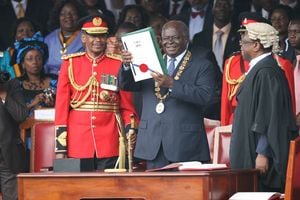
The late President Mwai Kibaki during the promulgation of the Constitution on August 27, 2010.
Photo credit: File | Nation Media Group
Mr Wetang’ula said that up to independence, Kenya had 42 districts, but former President Daniel arap Moi added five — Vihiga out of Kakamega, Bomet out of Kericho, Tharaka-Nithi out of Meru, Makueni out of Machakos, and another in the Coast region.
“That is how we got ourselves in this situation, with some counties having big and vibrant economies, like Kiambu and Narok, and others very small, like Isiolo and Lamu.
“Having been created under the new Constitution, a referendum will be required to change those numbers and boundaries. As to whether Kenyans will agree to that, I leave it to them.
“We have too many counties in a small country like Kenya. Some are not viable. If you look at a country like Canada, with a land mass almost half of Africa, it has about nine provinces. Australia, which is a continent on its own, has only six regions — and they are strong economically and politically. They work well.
“In Kenya we have some counties that for a long time have been unable to stand on their own, except by God’s miracle,” Mr Wetang’ula said.
The former Bungoma senator said the time is ripe for the country to have an honest discussion on parts of the Constitution. He said years is enough time to know areas that are working and those that are not.
Looking back, Mr Wetang’ula, who participated in giving Kenya the new Constitution at Bomas, said the country has made tremendous strides.
He said that the expansion of Parliament and delineating it from the Office of the President, an independent Judiciary and police service, increased public participation in governance, and the introduction of devolution was a result of the 2010 Constitution.
“When I first came to Parliament in 1992, the House was a department in the Office of the President. The Clerk of Parliament was an officer from the Office of the President. The Office of the President determined what happened in Parliament. That’s why House business could be going on and the President prorogues it — but that cannot be done now,” the Speaker said.
Mr Wetang’ula said the journey of getting a new Constitution was a long and protracted process. It started with clamour, glamour, and eventually the success in getting Kenya to become a multi-party democracy from a one-party State — a practice which was rampant in Africa.
“Many institutions felt oppressed and suppressed under the Executive. They wanted operational autonomy. In those days, even the Judiciary had no autonomy; judges were appointed by the President. Now it’s different — we have the Judicial Fund that helps the Judiciary to run on its own. The police was a department in the Office of the President; now it is an independent institution,” said Mr Wetang’ula.
The 2010 constitution of Kenya.
Photo credit: File | Nation Media Group
The Speaker said the first success story of the Constitution was the creation of three independent arms of government.
He also noted that before the new Constitution, budgeting was a top secret of the government, that no one dared to talk about in public.
“The new Constitution revolutionised budgeting, which previously was a top secret of the Executive. People used to be dismissed for leaking budget secrets. Now budgeting is open and is done through Parliament,” Mr Wetang’ula said.
On devolution, he said that “people now feel the presence of a government”.
“People in far-flung areas that were a long distance away from the seat of the national government usually made jokes. For instance, people from Turkana and Mandera joked that ‘sisi tunatoka Turkana tunaenda Kenya’, to mean that they were travelling to Nairobi. But as a result of devolution, that has changed,” Mr Wetang’ula said.
Despite the challenges, Mr Wetang’ula said that devolution is a key pillar of the success of the 2010 Constitution.
He said that increased public participation in decision-making is another milestone, noting that the Constitution gave authority back to the people. However, the Speaker said that the manner in which public participation should be done needs to be streamlined.
“We’ve not legislated on public participation — the depth of public participation, the extent of public participation, and how public participation impacts other processes,” Mr Wetang’ula said.
He also said that the matter of whether one House of the National Assembly has done public participation, the other should also do the same exercise, should be clarified. In addition, whether views collected from the public during the exercise override others as contained in a Bill; and whether public participation is binding, needs to be addressed.
“In many comparable jurisdictions, when you promulgate a new Constitution like we did, you give it five or so years and see how it works. Thereafter, you re-look at it and see if there is any excess material in that Constitution that needs to be weeded out and the areas that need improvement,” Mr Wetang’ula said.
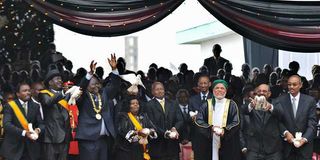
President Mwai Kibaki (centre), Prime Minister Raila Odinga and Vice President Kalonzo Musyoka hold the published draft constitution on May 6, 2010 at the KICC. Photo/FREDRICK ONYANGO
The Speaker gave an example of constitutional commissions, which he said need to be re-examined. However, he did not specify the commissions that he wants scrapped.
“A quick thinking will tell you that we created too many constitutional commissions that are duplicating what is already happening in government. Those constitutional commissions need to be reassessed to see whether some of them meet the requirements of the democratic system or not.
“You will find that there is a ministry doing this, and there is a commission with full-time commissioners doing the same thing. Some commissions are moribund; you hardly hear of them or see what they do,” he said.
Mr Wetang’ula also criticised the Judiciary over what he termed as overreach on certain issues passed by the National Assembly.
The Speaker pointed out instances where courts declare the entire law unconstitutional, yet a petitioner had issues with only specific sections of the legislation.
“You find that a citizen is challenging 16 sections of a law that has 63 sections, and a court declares the entire statute unconstitutional. It does not make sense to me. In Parliament, when we are passing a law at third reading, we vote on each and every clause of the Bill — including the title, short title, and long title. Now, when you declare the entire law unconstitutional, is the title also unconstitutional?” he posed.