In this first instalment of our exclusive series marking 15 years since the promulgation of the 2010 Constitution, John Kamau traces Kenya’s long quest for the people’s ‘perfect’ laws
London, January 1960 — A heavy winter mist lingered over St James’s Square as Sir Patrick Renison, the British Governor of Kenya, stepped out of his hotel. Just a few streets away, in the warm corridors of the Bedford Square Hotel, tensions were simmering. Kenya’s nationalist delegates who had gathered for the first Lancaster House Constitutional Conference were threatening a walkout.
Former Cabinet minister Mbiyu Koinange.
Photo credit: File | Nation Media Group
The spark? The exclusion of Mbiyu Koinange, a confidant and brother-in-law to the still-detained Jomo Kenyatta. The colonial government had deemed Koinange’s presence unfit due to a Mau Mau-related detention order. The response was swift and clear: “No Mbiyu, no talks.”
It was a defining moment. The colonial script in making a British-friendly post-independent Constitution had been disrupted. What followed was the start of Kenya’s constitutional odyssey—a 50-year journey of making and remaking the nation’s supreme law. From the polished halls of Britain’s imperial chambers, through the blood-stained landscapes of post-election violence, to the hopeful cheers at Nairobi’s Uhuru Park in 2010, the story of Kenya’s Constitution-making is as turbulent as it is compelling. It is an ongoing process.
That 1960 stand-off marked the beginning of a journey that would stretch across half a century as Kenyans experiment with Constitution-making. The Lancaster House conferences of 1960, 1962, and 1963 laid the constitutional scaffolding for independence.
Kenyatta, then still in detention, hovered over every discussion despite his physical absence. His proxies, James Gichuru and Tom Mboya, emerged as sharp, Western-aligned strategists, overshadowing Jaramogi Oginga Odinga, whose gaze turned eastward to the Soviet bloc.
At independence in 1963, Jomo Kenyatta reluctantly accepted a federalist structure — majimbo — a compromise pushed through under British pressure and championed by Kadu to safeguard minority and settler interests. But majimbo was a paper tiger. Mzee Kenyatta despised the system, favouring instead a strong central State. By 1965, it was gone. The Senate was abolished, Kenya had become a centralised republic, and its constitutional promises were folded into the hands of an increasingly powerful presidency. Kadu, the main opposition, was gone too.
The early years of independence witnessed the erosion of democratic guardrails. Power was drawn inward, to State House. The provincial administration became a mechanism of control. Land became both reward and weapon, dispensed as patronage and used to punish dissent.
Under Mzee Kenyatta, and later Daniel arap Moi, the presidency became imperial. The 1982 amendment to the Constitution declared Kenya a one-party state. Pluralism was buried; repression, refined. Detention without trial silenced opposition.
Ethnic favouritism structured State appointments and access to land. The unresolved land question—its ownership, its historical theft, its symbolic power—fed repeated conflict. Nowhere was this more viciously evident than in the Rift Valley, where politically orchestrated ethnic violence erupted in the 1990s. These clashes weren’t just about territory—they were about legitimacy.
With the Cold War’s end, African strongmen lost international protection, and donors began linking aid to political reform. In 1991, Section 2A was repealed, restoring multiparty politics, but the flawed 1992 and 1997 elections left the presidency’s dominance intact.
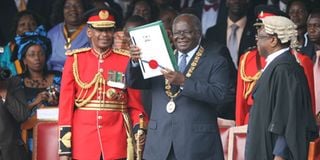
Then President Mwai Kibaki during the promulgation of the Constitution at the Uhuru Park grounds in Nairobi on August 27, 2010.
Photo credit: File | Nation Media Group
Calls grew for a new Constitution to reshape governance, not just expanding political competition. Civil society mobilised, leading to the creation of the CKRC in 2000 and the Bomas Conference, which produced a draft advocating devolution, a parliamentary government, and accountability. Then President Mwai Kibaki’s administration watered it down into the Wako Draft, removing key reforms.
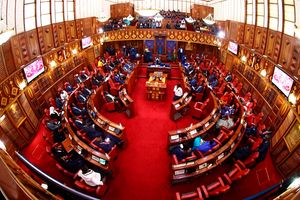
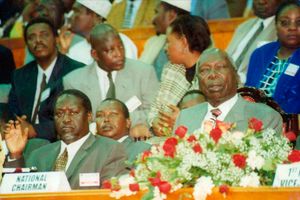
On April 28, 2003, the 629-member National Constitutional Conference convened in Bomas to review the draft Constitution prepared by the CKRC. Chaired by Yash Ghai, the conference included all 222 MPs, party representatives, civil society and religious groups, and 210 district delegates (three per district, recognising the district as the unit of representation regardless of size). The conference was marred by acrimony as delegates reviewed the draft Constitution line by line, often failing to reach consensus.
Although the Narc government officially backed a Constitution with a weak prime minister, internal divisions emerged by mid-2003. Kanu and the Liberal Democratic Party, allied with the original drafters, held a working majority at Bomas of Kenya. Justice Minister Kiraitu Murungi and others in National Alliance Party of Kenya (NAK) pushed for a national referendum rather than letting Parliament adopt the Constitution, especially as it became clear the draft would pass unaltered.
By December 2003, NAK figures including Chris Murungaru, Murungi, and Assistant Minister Kivutha Kibwana demanded the dissolution of the Bomas conference, accusing it of being dominated by "Kanu moles" advancing Odinga’s interests.
The final phase of the Bomas process began in January 2004. A last review kept the core structure: four levels of devolved government (national, regional, district, locational), abolition of the provincial administration, land ownership limits, a bicameral legislature with one-third female representation, and a division of executive power between a president and a strong prime minister. Delegates from LDP, Kanu, and civil society retained control, blocking efforts by centralist factions to alter the draft. However, Parliament posed a challenge—150 of the 222 MPs supported giving the House, not Bomas, the final say. Many NAK MPs boycotted the process entirely.
Tensions peaked in March 2004 when a last-ditch attempt by DP, Ford-Kenya, and NPK ministers to restore presidential powers was rejected. After intense lobbying failed, Vice President Moody Awori led a walk-out by NAK ministers, while Odinga and the LDP remained. Murungi publicly accused Odinga of betrayal. On March 15, 2004 the remaining delegates passed the Constitution unchanged, pushing the country toward a potential confrontation.
However, the High Court intervened. Ruling on a lawsuit filed by Bishop Timothy Njoya and other delegates, the court declared the entire constitutional review process unconstitutional. It found that neither Parliament nor the National Constitutional Conference had the authority to enact a new Constitution, requiring instead a constituent assembly or referendum. Prof Ghai denounced the ruling as "weakly reasoned, misapplied and a tragedy”. The decision opened a new window for compromise—or further delay.
For 18 months following the March 2004 crisis, the government remained divided and hesitant, with many seeking ways to revise the Bomas “Zero Draft” Constitution. Eventually, using Parliament, they succeeded in significantly modifying the draft—producing a new version dubbed the “Wako Constitution”. The outcome would prove disastrous.
According to the law, then Attorney-General Amos Wako was supposed to receive the Bomas draft and publish a Bill within 14 days to introduce it. However, a series of lawsuits derailed the process. Despite Kibaki’s assurances of a consensus-based approach, no such thing existed. Many within the government were determined to block the “Zero Draft” and now had the legal requirement of a referendum to lean on. Meanwhile, their opponents — more numerous and committed to structural change in State – citizen relations—refused to back down. The result was a stalemate.
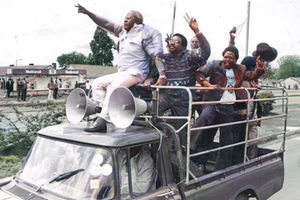
The CKRC adjourned, and Prof Yash Pal Ghai resigned in frustration. MPs debated endlessly as their self-imposed deadline of June 30, 2004 lapsed. Public frustration mounted, culminating in violent protests against the delays.
Under pressure, the Cabinet — including the increasingly isolated LDP ministers — instructed Wako to draft legislation allowing Parliament to amend the Bomas Draft. In August 2004, Parliament passed yet another Constitution of Kenya (Review) Act, handing control of the process to itself.
However, an amendment introduced by the new Parliamentary Select Committee (PSC) Chair Dr William Ruto, required a 65 per cent super majority for any changes. Kibaki refused to assent to the Bill and returned it for revision. With the Government of National Unity now holding a working majority, Parliament revised the threshold to a simple majority. Kibaki assented in January 2005, effectively regaining control over the constitutional process.
In November 2004, the PSC agreed on a compromise: Kenya would adopt only two levels of government — national and county — and executive power would be ambiguously shared between a president and a prime minister. The process dragged on into 2005, further alienating Bomas supporters as the PSC — now dominated by pro-government figures and chaired by Simeon Nyachae — pushed new amendments.
The 2010 constitution of Kenya.
Photo credit: File | Nation Media Group
At a conference in Kilifi, the PSC proposed further changes: devolution would be to the district level, the legislature would be unicameral, and the prime minister would be a presidential appointee with minimal authority — what Odinga derisively called an “errand boy.” On 21 July 2005, Parliament approved the revised draft by 102 votes to 61, sparking street protests.
The government had split. While most ministers supported the draft, Odinga, Anyang’ Nyong’o, Najib Balala, and George Ayacko voted against it, as did KANU bigwigs Uhuru Kenyatta and William Ruto. The LDP now found itself effectively in the opposition.
The new constitution, known as the Wako Draft, was published in August 2005 and was required by law to be subjected to a national referendum—Kenya’s first.
The Electoral Commission of Kenya (ECK) oversaw the referendum, assigning a banana symbol to the Yes campaign and an orange to the No camp—symbols ostensibly free of political meaning. The No campaign was spearheaded by Raila Odinga, Kalonzo Musyoka, and former civil society activists like Anyang’ Nyong’o and Linah Kilimo. Their stance was rooted more in defense of the Bomas process than in outright opposition to the government. They were joined by most KANU leaders—including Uhuru Kenyatta, William Ruto, Daniel arap Moi, and even the retired Charles Njonjo—as well as powerful institutions such as the Kenya National Union of Teachers (KNUT) and many religious groups.
On the other side, the Yes campaign was led by a majority of the 30-member Cabinet, NAK stalwarts such as Charity Ngilu, Musikari Kombo, Moody Awori, and George Saitoti, along with some KANU MPs, FORD-People leaders, and supportive church figures. President Kibaki initially adopted a neutral tone, encouraging voters to decide for themselves. Yet his administration actively sought support through a wave of development projects, salary increases for councillors, new districts, and land allotments to squatters. As the campaign progressed, Kibaki accused the No team of misleading the public and seeking power “through the back door.” In a national address on the eve of the poll, he urged Kenyans to vote Yes. However, the Orange side quickly outpaced its rivals in organisation, branding, and public enthusiasm, drawing inspiration from Ukraine’s Orange Revolution. With strong grassroots mobilisation and a growing momentum, the No campaign neutralised the efforts of pro-government figures like Kiraitu Murungi and Simeon Nyachae.
Narrow parliamentary majority
Although the Yes side still enjoyed a narrow parliamentary majority (118 MPs to 90, with 14 remaining neutral), public sentiment had shifted decisively. Key contentious issues — such as land reform, the role of Kadhi’s courts, and the Kibaki administration’s overall performance — fuelled opposition.
On 21 November 2005, Kenyans went to the polls. The Kibaki Yes campaign was defeated by 3.6 million votes (58 per centre) to 2.6 million (41 per cent) with only Central Province voting overwhelmingly in favor. It was a referendum on Kibaki, than the constitution.
Following the 2007 General Election — marred by disputed results and ethnic violence that left over 1,000 dead and hundreds of thousands displaced — a mediated truce led by Kofi Annan created a Grand Coalition Government and reignited the push for constitutional reform.
President Kibaki during an address to the nation at the Kenyatta International Conference Centre, Nairobi. He said the ushering in of a new Constitution dispensation will herald development August 5, 2010. On the left is Prime Minister Raila Odinga and his deputy Musalia Mudavadi. Photo/WILLIAM OERI
The Committee of Experts was appointed, tasked with merging public input, the ideals of the Bomas Draft, and the political realpolitik of the moment. They consulted widely, travelled extensively, listened deeply. In August 2010, Kenyans voted overwhelmingly in favour of the new Constitution. At Uhuru Park, President Kibaki and Prime Minister Raila Odinga stood side by side to promulgate the new supreme law. A new chapter had begun.
The 2010 Constitution was a landmark. It established 47 county governments, diffusing power away from Nairobi. It created a new Supreme Court, a Judicial Service Commission, and a process to vet judges, restoring confidence in the rule of law. The Bill of Rights was expansive, including social and economic rights rarely constitutionalised elsewhere. Chapter Six demanded integrity in public service. Article 10 enshrined public participation as a governance principle. The Senate was revived to protect devolution and offer regional balance.
But this celebrated document has not been immune to subversion. Its promise is daily tested by political inertia, elite manipulation, and a fatigued public. Chapter Six is more often cited than enforced. Corruption, ever adaptable, finds new forms. Courts are politicised. Devolution is popular but poorly funded. Citizens are often spectators rather than participants in governance.
Still, the 2010 Constitution remains a living text—a testament not just to what Kenya is, but to what it dares to become.