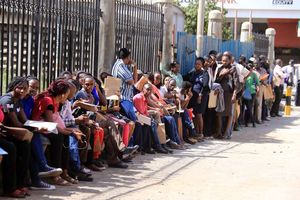
To the casual observer, they may look like idlers—groups of young men sprawled on benches, stretched across patches of grass or huddled under the shade of trees in parks across the city.
But among them are engineers, teachers, statisticians, and computer scientists.
They clutch brown envelopes and folders filled with certificates that once promised a bright future. Today, those papers lie mostly dormant as their holders spend endless days in the “jobless corners.”
The nation spent a day at Jeevanjee Gardens, Nairobi Cinema Park, KenCom and Uhuru Park, where dozens gather daily.
Beneath a jacaranda tree at Jeevanjee Gardens, 36-year-old Moses Mbugua lies on the grass, his head resting on a rolled-up bag. A faded green cap shades his weary eyes.
“I’m just tired,” he says softly. “Tired of hustling and hustling in this economy. I’ve sent CVs everywhere. Nothing. So I come here, sleep through the day, then head to Afya Centre or KPCU when buses are loading for Migori, Homabay or Kericho. If I’m lucky, I get a commission—maybe Sh100, maybe Sh200—by helping passengers find the right bus.”
Moses Mbugua, 36, a Mechanical Engineer from Nyahururu Polytechnic, at Jeevanjee Gardens, is jobless.
Photo credit: Cyprian Musila| Nation Media Group
He pauses before adding, “It’s not a job. Sometimes you walk all night and nobody pays. You stay hungry.” At night, if bus traffic thins out, he heads back to Jeevanjee. When city askaris chase him away, he finds refuge at Khoja or Globe Roundabout. Occasionally, he catches a matatu to Limuru, where he rents a small room if he can afford it.
Mr Mbugua studied mechanical engineering. He once ran a small business and dabbled in farming. Losing his job toppled both his career and his family.
“My wife left when I couldn’t provide,” he says, eyes fixed on the ground. “She went with the children. There are about 10 people I know here with college degrees.
Some were laid off, others never found work after graduation. Here, at least, you feel like you still belong in the city.” On rare days, opportunity comes in unusual form.
“A politician picked a few of us last month, took us to City Hall for a press conference. We were paid Sh500 just to clap behind him,” he recalls.
At another bench sits Willy Maina, 28, his brown envelope tucked tightly under his arm. Inside is a seven-page CV and data collection forms he fills in for local politicians.
He graduated with a Bachelor of Commerce degree from Zetech University in 2017. Once, he dreamed of a career in finance.
Today, he counts himself lucky to earn a few hundred shillings from short-term gigs offered by politicians.
He reckons he has applied for more than 100 jobs. “Every CV costs Sh70 to print. I’ve spent thousands and never been shortlisted. I’m tired,” he says with a weary shrug.
He dreams of raising just Sh10,000 to start an egg trolley business. “Even that feels impossible,” he admits. Still, Jeevanjee has become a haven for him.
“By early afternoon this place fills with people like me—men and women with degrees but no payslips. This place gives us peace. It’s free. It’s where we can breathe.”
Away from his job search, Mr Maina chairs the Nairobi Masafara Foundation, a grassroots group helping street families obtain IDs and access social programmes.
But even this has turned political. Inside his envelope are the foundation’s forms. He hopes to sell them to politicians for campaigns. “That’s the only way we survive now,” he says bluntly.
When asked when he last submitted a CV, his answer is sobering. “Three years ago. I wasn’t shortlisted. These days, if you don’t know someone inside, you don’t even get called.”
According to the Commission for University Education and the Economic Survey, 123,928 graduates joined the job market last year. Only 78,600 formal jobs were created.
A Tifa opinion poll released on September 11, 2025, paints a grimmer reality: one in four Kenyans is unemployed, and only a quarter are in full-time jobs.
Among them is Enoch Odhiambo, 25, a graduate in Applied Statistics and Mathematics from Rongo University. Two years ago, he arrived in Nairobi, hopeful that education would open doors.
“I apply for jobs day in, day out. The government has failed us,” he says. “If I stay home, I get depressed. We come here to cool our minds.”
For now, survival means leaning on relatives and friends. “You call them, you bother them because that is the only way to survive. Some pick the calls, some snub you, some give excuses.” His frustration is palpable. “To get a job, you must know somebody. I’m a son of nobody.”
Every day, Jeevanjee Gardens and other jobless corners around the city attract hundreds of young Kenyans whose dreams remain suspended between hope and despair.
For them, education has not guaranteed employment; determination has not secured opportunity. As the sun sets and the city lights come on, the men and women who spent the day on park benches drift into Nairobi’s streets—some to bus termini to hustle for commissions, others to cramped rooms in the city’s outskirts.