Premium
Scientists date Moon at 4.470 billion years
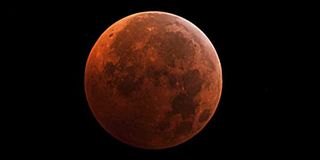
This file picture taken in Manassas, Virginia shows the moon during the peak of a total eclipse on December, 21, 2010. AFP PHOTO / FILES

What you need to know:
- Many earlier age estimates had been based on measuring the rate of radioactive decay of atomic nuclei found in rocks.
- For the new study published in the journal Nature, a team of planetary scientists from France, Germany and the United States created a computer model of how dust and rock accumulated in the early Solar System to form tiny planets called planetesimals.
- These grew into "planetary embryos" that ended up as the rocky planets we know today -- Mercury, Venus, Earth and Mars -- through a succession of giant impacts, according to the new model.
The Moon was formed about 95 million years after the birth of our Solar System, in a collision that also settled the structure of Earth as we know it, according to the latest attempt at dating that impact.
A study in the journal Nature said the crash between an early, proto-Earth and a Mars-sized object that dislodged what would become the Moon, happened some 4.470 billion years ago -- give or take 32 million years.




