Temidayo Oladehin is Burna Boy’s sound engineer, a music professional whose career has taken him from church choirs in Nigeria to international tours. He is also an Arsenal supporter who watches football with a sound engineer’s attention to detail.
Temidayo: I knew we would have problems against Brighton because, from the games I watched earlier in the season, they were scoring goals. Even when they lost to Chelsea, it was 4-3. But I didn't expect us (Arsenal) to lose 3-0.
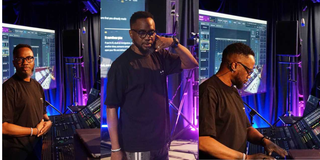
Temidayo Oladehin, the official Front-of-House (FOH) sound engineer and Production Lead for Grammy Award-winning Nigerian Afro-fusion artiste Burna Boy, is facilitating a masterclass on live event production on October 8 and 9, 2026, in conjunction with Xpose Limited, a full-service event planning, management, and production company headquartered in Karen, Nairobi, Kenya.
Photo credit: Thomas Rajula| Nation Media Group
I'm like a virtual coach. It's funny because when I discuss football with colleagues and friends, I often challenge their thinking. They watch to enjoy the game; I'm deep into it.
Have you ever thought about becoming a coach?
I used to train my son's primary school team when he was younger. He's 20 now. But training was at weekends, which is also when the music industry needs you, so it died a natural death. I'd love to return to it when I have more downtime, perhaps coaching children at grassroots level.
Did you ever play football?
I wanted to play. The two things I wanted to do were football and music, but my parents didn't want me doing either. Growing up in a Nigerian home, you're expected to become a doctor or lawyer. Choosing music and football was a travesty.
I also fell ill frequently as a child. A doctor even suggested testing me for sickle cell because I often became ill after playing football. My parents naturally told me to stop. It turned out I was suffering from childhood migraines caused by eye strain. Once I started wearing glasses, the headaches stopped.
I played midfield because I've always liked being in control. That's probably how I ended up as a production lead. (Laughs.)
You have a musical ear, which you say distinguishes your mixing. Did music come first or sound engineering?
Music came first. Sound engineering wasn't part of the plan. I started playing snare drum in primary school because my older brother and his friends played drums. I joined the Sunday school choir, then the youth choir, where I played local drums and a little drum set.
We had a keyboard in the choir, but nobody knew how to play it. At about 13, I started picking out notes by ear. I never learnt to read music. A friend who played saxophone told me to write down the tonic sol-fa notation for 100 hymns and memorise them. The idea was that once you understood the 12 notes, you could work out how songs were constructed.
Temidayo Oladehin, the official Front-of-House (FOH) sound engineer and Production Lead for Grammy Award-winning Nigerian Afro-fusion artiste Burna Boy.
Photo credit: Thomas Rajula| Nation Media Group
My mother had a small shop and, one Christmas, she bought a toy piano with eight notes. I took one and used it to learn songs, pressing the keys and writing down what I heard. Soon, I could recognise notes and transfer that knowledge to other instruments.
How did you end up in the UK?
In 2002, I was transferred to the UK to become my church's music director. I was 25 or 26 and ready to explore, but things became difficult when the church failed to make proper arrangements for my stay. The church later split, and I had to fend for myself.
I worked selling double-glazed windows, but I was tired of it and decided to return to what I knew. I started small, with two microphones, two speakers and a basic sound system, which I hired out. I gradually bought drums and mixers, and musicians I knew began calling me when they had gigs.
I reinvested whatever I earned. Everything grew through word of mouth, long before social media became what it is today.
How did you meet Burna Boy?
Temidayo: There was a jazz band who I helped with equipment and setup. One connection led to a Nigerian lecturer who wanted to promote gospel artistes.
Through that network, I began working at a church venue where promoters also held concerts.
Then, in October 2011, the jazz band got a gig supporting 2Baba at the O2 Indigo in London. I had been booked to supply the backline equipment. The venue already had its own sound system, but I volunteered to mix the show.
Ropo was in the audience. He came backstage looking for the person responsible for the sound, and I told him it was me. He said it was the best mix he'd heard at that venue after years of putting on Afrobeats shows.
Burna Boy performs onstage at the Coachella Valley Music & Arts Festival in Indio, California on April 21, 2023.
Photo credit: File | Reuters
I'd already mixed for gospel artistes such as Fred Hammond, Deitrick Haddon, and Tonya Baker, but that show opened another door.
What made your mix stand out?
I think it's the musical side of me. Many engineers are very technical, but understanding the genre matters. Mixing rock is different from mixing Afrobeats, where the kick, bass and treble are important.
My years as a music director also shaped my approach. When conducting a choir, you control the overall sound. With mixing, you're doing something similar mechanically rather than manually.
For me, balance comes first. While some engineers chase the perfect snare or kick drum, I focus on how everything works together.
After that show, other promoters began recognising me. I mixed for Tiwa Savage, who was the first Nigerian artiste to take me outside the UK and bring me to Kenya in 2018. I later returned with her for Walker Town.
When Burna Boy first came to the UK in 2016, Cokobar brought him over, and I mixed the show. I continued mixing whenever he returned, until it became a touring arrangement.
Temidayo Oladehin, the official Front-of-House (FOH) sound engineer and Production Lead for Grammy Award-winning Nigerian Afro-fusion artiste Burna Boy.
Photo credit: Thomas Rajula| Nation Media Group
What should Kenyan sound engineers focus on to improve their craft?
They need greater exposure to equipment and knowledge. The industry is constantly innovating. Social media helps you see new equipment, but watching a mixing desk on a screen isn't the same as having access to it and learning to operate it.
I've met excellent engineers in Nigeria who could go further with more exposure. I've watched one engineer, Samson, who now works as Davido's monitor engineer, develop significantly through touring. His experience changed his mentality and approach to work.
I'm not necessarily better than engineers here. I simply have access to opportunities they might not have. I can pick up the phone and call the head of DiGiCo, a major manufacturer of professional mixing consoles. That doesn't make me a better engineer; it gives me access.
Is that why you want to pass on your knowledge through masterclasses?
Looking back, I realise I wouldn't be where I am today if I hadn't broken barriers for myself. But I wish someone had helped me understand the mistakes to avoid.
If I hadn't left Nigeria, would I be where I am today? Probably not. But rather than everyone having to leave their country to find opportunities, I want to bring some of those opportunities to them.
I've seen experienced people afraid to share knowledge because they worry younger professionals might take their jobs. If you can take my job, take it. I'll find another one.
Did you formally study sound engineering?
No. I kept experimenting. You can learn about equalisation (EQ), but no textbook tells you exactly how to mix because balance is relative. Eventually, you develop your own methods.
My progress comes from wanting to learn more and remain relevant. I've seen engineers who were prominent disappear a few years later because others moved ahead. Even if you're still mixing at 60 or 65, your hearing might change. You need to keep developing other skills.
Whenever I take a break from touring, I want to return with something new I've learnt. I've also realised that adding too much equipment or complexity creates more points of failure. The goal is to create value every day. Mistakes will happen, but they shouldn't be the only things that drive your growth.
How much would you say your earnings changed over time?
Most of my early gigs were free. Sometimes, all I got was a meat pie and a Coke. I mixed Burna's first two shows for free because I wanted the visibility.
I don't have a fixed rate for Burna. For other artistes, it depends on their circumstances.
For independent artistes who aren't doing anything big yet, I charge £500 (Sh86,600) a day; every day I walk out of the door for the job.
Do you charge extra for the equipment you bring?
I don't, although they cover excess baggage fees when I fly my equipment racks. The equipment is for me, not them. It helps me deliver the quality of work I want, and I want clients to have a reason to call me again. The tools benefit me, too.
What do you enjoy most about the job?
Perhaps it's the Leo in me, but I like knowing that the audience's experience is partly in my hands. If people enjoy the show, the sound is a big part of that. (Laughs.)
I also enjoy creating. When you're mixing, you're creating something. You keep trying things. Sometimes, you break them, fix them and start again. I enjoy what I do.
Your parents initially opposed your interest in music. How do they feel about your career now?
My father has since passed away, but he lived to see what music did for me. It took me from Nigeria to the UK.
It began at a conference in Nigeria, where I helped lead a choir of about 400 people. Visitors from London later approached my bishop and asked for me to go help their choir there.
My father also saw me conduct the “Hallelujah Chorus” at a Christmas carol event attended by the Nigerian High Commissioner to the UK at the time. After the performance, the High Commissioner asked to take a picture with me. My father was so proud, saying, “That's my son!”
How do you balance touring with family life?
I'm intentional about making family time count. Initially, my wife struggled with the touring because I wasn't travelling so much when we got married. But the work has also brought financial security.
When I'm home, I prioritise quality time. Earlier this year, after finishing a tour in February, my wife and I spent the last three weeks of March travelling through four Asian countries.
There was also a time I was away for about three months, travelling through Australia, South Africa and the US. I asked her to choose where she'd like to meet me, and she came to the US for eight days.
The children are older now, and I stay in touch with them when I'm away. My eldest son has met Burna several times, and the children sometimes come to our house when the artistes are in London. They're not star-struck; I think they see their father as the star.
They do enjoy having access to concert tickets through my industry contacts, though.
Has working with secular artistes caused friction with the church?
The church has moved on. Many artistes, including Burna and Asake, have church backgrounds, so churches have to decide whether to lose them or continue engaging with them.
There was friction in Nigeria when I played keyboards for Shina Peters. I was threatened with suspension, but I continued attending Sunday service. Doing a gig never meant I had to stop going to church.
I've also built a company that supplies sound engineers to my church's branches. That way, I've created a system that can last beyond my own work.
What's next for Burna Boy? Can you share any details about the new album?
We have a few one-off shows, but we're not touring at the moment. We will probably tour next year when he releases the new album.
Will you return to Kenya for another masterclass?
Temidayo: Byron is organising something with DiGiCo in March, so I might be back then.