The first time I went to the August 7th Memorial Park in Nairobi was for a wedding reception. I remember thinking it was a strange place for such a celebration. It was only a few years after the 1998 bombing of the American Embassy in the middle of the city—and the place was then often called the Bomb Blast Park. But, as its current website says, though born out of tragedy, “it stands as a symbol of peace and hope amidst the challenges of our world today”.
Lut and I had decided to spend a quiet Easter in Nairobi, and on Good Friday, we visited the park. We started at the Peace Memorial Museum, where we had as a guide, George Oringo, who was working only a few hundred metres from the building when the bombing happened. He explained that the museum was created to honour all those who lost their lives that 7th August, almost 27 years ago, to tell the stories of those who survived, and to act as a stark reminder of the appalling consequences of terrorism.
The basic facts are that around mid-morning on Friday, August 7, 1998, al-Qaida terrorists detonated thousands of pounds of explosives in the parking lot of the United States Embassy in Nairobi. Minutes later, another truck bomb exploded outside the gate of the US Embassy in Dar es Salaam —killing 11 people and injuring 85.
In Nairobi, the explosion was so heavy that it brought down the adjacent Ufundi Cooperative House. Windows in several surrounding buildings were shattered. Some 218 people were instantly killed; 172 of them were in neighbouring buildings or passers-by. The blast injured more than 4,000 people—400 were severely disabled; 164 endured acute bone and muscle injuries; 38 adults and children were blinded; 15 were totally deafened; 75 suffered severely impaired vision; and 49 were left with hearing disabilities. Hundreds of businesses were destroyed or damaged.
In the museum, among the many graphic photographs is one of a scene I remember watching on TV that day—many Kenyans clambering over the huge pile of debris in their efforts to rescue people trapped in the rubble. Among the eye-witness accounts is a one by John Githongo: “... Kenyans, regardless of ethnicity at a time when ethnic tensions were high, jumped in with minimal concern for their own safety to help those who had been injured, and continued to do so even after the international rescue teams arrived later that day”.
There is a 15-minute film in the museum showing the aftermath of the bombing. It features Douglas Sidialo, who was left blinded by the blast. Somehow, he turned his anger into positive energy. He became an adventurer and an inspirational speaker. He is believed to be the first blind African to reach the Uhuru Peak of Kilimanjaro—5,895 metres above sea level.
On a tandem, he cycled the length of Africa from Cairo to Cape Town, through 10 countries, on the Tour d’Afrique, completing the 12,000 kilometres in 95 days, and becoming the first blind person and the first African to do this. Douglas has also travelled the world, giving talks on his sporting achievements and on how he battled against adversity, showing a remarkable resilience in refusing to let his blindness diminish his life.
The film is a powerful one, but I have one suggestion: given that many who view it will be foreign visitors who are not used to Kenyan accents, it would help if there were sub-titles.
The first floor of the museum is dedicated to two African Nobel Peace Prize winners. The Wangari Maathai Conference Centre, with its Nelson Mandela Boardroom, can be adapted for various uses, including lectures, workshops, committee meetings and receptions. The conference room seats 70 while the boardroom seats 15 people. They have a free Wi-Fi connection and projection equipment is available.
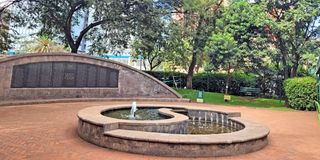
We moved outside to the Memorial Gardens. Its prominent feature is the granite Memorial Wall, on which are inscribed the names of all the 218 people who died. All the plants in the garden are indigenous, collected from across the country, as are all the stones that line the paths, signifying that all Kenyans were affected by the blast. The fountain in the centre of the garden has the shape of the Chinese Yin and Yang sign, which represents the duality of opposing but interconnected forces governing the universe and all that is within it. In one corner, is Joan Collis’ poignant Mind, Body and Spirit sculpture, made up of items from the blast’s debris.
Shelters have been erected in the garden, with seats and tables. A good number of people were enjoying the shade from the afternoon sun. Couples were chatting; some, I guess, were students, with their laptops and enjoying the free Wi-Fi. The entrance fees for the museum ranges from Sh50 to Sh150. And the park is open every day from 6am to 6pm.
It did look so peaceful, as the website promises —except for the raucous music of a matatu parked on Moi Avenue and the very loud voice of a preacher on the pavement. As for the Memorial Park being “a symbol of peace and hope amidst the challenges of our world today”, there is certainly less of the ethnic tensions in Kenya that Githongo’s message on the wall of the Peace Museum mentioned.
As for the challenges of our world today, things are surely much worse than they were at the time of the bomb blasts in Nairobi and Dar es Salaam —what with the unconscionable destruction in Gaza, the Russian invasion of Ukraine, the horrific civil war in Sudan and the chaos being caused across the world by the US President Donald Trump Administration. Perhaps the 7th August Memorial Park is a good place for thinking about such matters.