Blankets and Wines’ lead team address the shortcomings of the September show as they also highlight the growth of the festival ahead of ‘Kenyan Summer’ December edition, admitting some things were on them as organisers, while others were systemic issues beyond their control. Thomas Rajula
On the morning of October 29, 2025 till late afternoon, award-winning musician and the creative entrepreneur behind Blankets and Wine, Muthoni Ndonga aka Muthoni Drummer Queen and her all-female lead team sat down with brand partners, stakeholders, members of different media representations, influencers and content creators to talk about the festival’s progression over the last 16 years and its upcoming December edition.
The attention has been on Muthoni Ndonga, The Drummer Queen this was after a blogger made sensational claims alleging that flamboyant businessman Chris Kirubi killed her super successful brand, Blankets and Wine. PHOTO | FILE
Muthoni, the founder and creative director of Blankets and Wine was joined by the other GoodTimes Africa administrative heads Justine Mbugua – head of festivals, Diane Ywaya – communications manager, and Michelle Njeri – brand and marketing, in conversations Patricia Kihoro moderated at Nairobi Street Kitchen.
“On the day called Blankets and Wine, you are allowed to suspend reality and just be present to that thing and to feel the energy of 5,000 people jamming to a deejay song that you’ve never heard but even you’re in the vibe. Those things are spiritual; they’re the essence of being a person. Music spaces are very much owned by corporations and even some of your favourite artistes are owned by corporations, so somebody has got to make the space for music to be free. For imagination to be free. For human expression in its messiness, its clumsiness and in its totality to be free. And Blankets and Wines is that space,” mentioned during the start of the candid stock-taking conversations on the journey of the festival so far.
Justine added, “We do it for ourselves and for you. Essentially, as we’re building and we’re making these nice things, it’s also for us to express our own creativity and for you to experience that joy when you see that joy. And give systems for artistes and the audience. It’s very few times that you’ll be able to connect with your artistes so we’re trying to give a safe space for that to occur so that you have the right thing happening at the right time. In the 16 years, there has been a lot of learning. Unfortunately, we’ve been learning as we’re doing. So that’s the actual grace we hope the audience gives us. And they have been giving us. We’re making the thing that makes us happy. If it works out, if it looks great, we’re happy. If it doesn’t work out, we’re not happy. It’s our legacy, essentially. When everything ends and I’m not here, at least there’s something that I left… it’s really important to us that it works.”
Even David Mureithi, aka DJ D-Lite, who sits on the festival’s advisory board, later talked about how in 2008 Mutoni took him down to Tayiana Garden Spa in Garden Estate Ridgeways and later on wrote her vision of the festival on a napkin. What started out as a 100-person event to “put on” talented artistes who weren’t getting airplay due to the “gatekeeping and biases” of radio bosses, became a 400-person event by the third edition and moved to Mamba Village. It then soon after went to Carnivore, becoming a two-day festival that was bringing in different established acts from across Africa, before it went into Uganda and Kigali. Muthoni said at some point she was not happy with the product because she felt that its growth had made it turn into something different from her desired direction.
The festival returned to Kenya in 2022, and has grown in prominence with every edition since; currently attracting “tens of thousands” and had its first off-continent show at Bradford 2025 UK City of Culture, a partnership with British Council and Kenya Tourism Board.
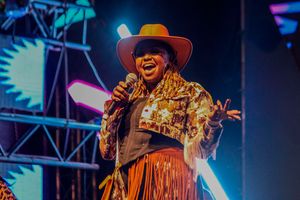
Musician Chimano performs during Blankets and Wine event held at Laureate Gardens in Nairobi on September 28, 2025.
However, the issues around the September edition, in which Nigerian superstar Tems, Chimano, Toxic Lyrikally, Joshua Baraka, Billy Black, Zeituni, among other artistes and deejays were also addressed by the management team. Patricia Kihoro had asked about the challenges Blankets and Wine has faced over the years.
Justine said that they take feedback and also learn from what they do every day. Things that they’ve tried or tested and haven’t worked are improved on to be better in subsequent editions.
“There are things we are trying to build for future editions and for this event industry. For example, the last edition we had very long bar queues, but this is because we are trying to develop a system that can help us keep digital account of our stock, faster processes of payment, and to enable you get your product quickly. Anything new has some where it’s like ‘Oh! I didn’t know..’ and learning to make it better for the next one. The challenges make us better,” she explained.
Jay Macharia at the Blankets and Wine event held at Laureate Gardens in Nairobi on September 28, 2025.
Photo credit: Bonface Bogita| Nation Media Group
Diane said accountability and being customer-centric is key to Blankets’ communications. To them, this includes the attendees, vendors or partners and what they feel or what they want to see. This puts them at a point of empathy that then calmly chat about the way forward.
“It’s a space that’s very fast-paced, but with comms (communications department) you have to be very level-headed and strategic with what you’re doing,” she said, adding that having a constant feedback loop (on social media and via newsletters) enables them to find out what they can do better and action that in future editions. “We are a brand that’s driven by community. Without our community we wouldn’t be here.”
Michelle said that it takes time between complaints made and the team responding with what works for everyone who has been involved: Blankets, attendees, partners and other brands involved in the whole ecosystem.
She added that it’s about internalising the feedback they’re receiving, taking time to process it, “because what has happened, it’s not just our brand at stake but the brands of all other stakeholders, so we really need to strike a balance and be truthful and honest about it.”
They stated that feedback has to be formally addressed, and that is why feedback forms are sent to all who purchase tickets. They will not go back and forth on social media.
“We need to rewire ourselves. As a team, we’ve really had to sit down and think, ‘Yes, people have their grievances. How are we going to respond to these grievances in a way that is offering resolution that they need or gives a response that backs who we are, what we’re able to do, what we’re not able to do, and what that means (going on from there).’ In terms of responding to feedback, we take time. We receive your feedback, we sift through it, seeing what is within our control and what isn’t, then how do we now package a response based off of what you have shared. We can’t do this in one day, we can’t do this in two weeks because we have thousands of people who come to the festival. By the time we review, finding out is this true, was it on our part or someone else’s part… and even if it wasn’t on our part, we can’t choma (put under the bus) other brands or partners,” Michelle puts it.
“The feedback forms were always going to go out on Tuesday, then you need time to investigate,” said Muthoni. “Some things have liability; some things need to be understood. Like the claim on the sound, that was really interesting to read the feedback. Depending on where you were. Like the folks at Onja Onja (deejay stage) had the time of their life. So by the time you troubleshoot the thing, have an internal audit and then make a commitment to the audience, the audience goes ‘You only responded due to backlash’, ‘Oh, now is when you responded,’ you ask yourself, ‘Did you really want a response?’ What really is the intent? To manage those expectations, we’re never ever, ever going to be an instant response (team). There are too many things at stake: other partners, other brands, we see the whole picture.”
Muthoni says nothing happens to the audience that isn’t already happening to the production team. By the time fans get to experience the issues on the ground, the team has already been experiencing it for hours and trying to fix them.
“Nobody wakes up with the intention to frustrate you at a bar line that they’re making money from. Are you disappointed? Definitely! Do we take that on? A hundred percent! Can that be fixed? That is exactly what we are working on, because when it’s fixed at Blankets that thing is going to be fixed in other places within our scene.”
Muthoni also addressed Patricia’s question about what the team felt were narratives driven against the festival that weren’t true. The first thing she addressed was the much-publicised ‘formal complaint’ to Competition Authority of Kenya (CAK) about the ‘Soft Life’ situation.
“We haven’t heard (from CAK) what the complaint was. Our legal team reached out to the Competition Authority and they said they received thousands of vexatious claims. When you make a complaint you have to back up your complaint, and they give you time. Yesterday was the lapse of 30 days. They don’t have a full on complaint, so there’s no investigation and there’s no suing,” said Muthoni, adding that anyone who feels they didn’t get what they wanted was very much in their right to seek redress.
“If you’re p***ed off that there’s no network, Kenyans, we know who owns networks. Who would be complaining to? If there’s slow payment, we know it’s a pain in the a**, and we deeply regret it. But you work for months and you bring in the right stakeholders and they actually provide the thing. Then it’s not sufficient. Now, if you want to make a complaint, who should that be targeted to? Because you’re the person putting things together, you’ll catch flack for the things that are not yours and also for things that are ours,” said Muthoni, adding that there’s a “gossipiness and ugliness” that Kenyans have that is not being talked about.
Muthoni said there’s an unkindness or meanness that makes warranted emotions brought out in unwarranted ways; an intention to ‘take down’.
“I would have liked to know how Blankets and Wine has acted in a way to hinder fair competition or unfair competitive practices,” she said, adding that they indeed had “a really hard production day.”
The team said they’re all about improving the audience’s experience because that’s what has gotten them thus far.
They also addressed the focus on headliners and not the festival as its whole. Justine talked about Onja Onja Stage (for electronic music) and Market not being considered in conversations. “People should understand, we’re not a concert. A festival has all these different elements that bring it to life.”
They said awareness is what is lacking with the large new audiences coming on board, who said there weren’t deejay sets or who claimed some people were paid by the organisers when they said they had a wonderful experience, even during this past edition.
“Honestly, it’s discouraging for me as an artiste when the media writes ‘Tems saved the day!’ I said, ‘Tems saved Flier, Wea Are Nbuia, Hiribae, Ghedi, DJ Paps, DJ IV and Ms Bune? Who did she save and save from what?’ Like Justine said, anything we bring is spectacular, but we don’t get that thing to be here at the expense of ‘yourself’. You can’t make yourself so small that the story is the mgeni (international act).