I need help understanding the law regarding traffic enforcement during heavy congestion on our roads. Why would traffic police arrest me for overtaking on a continuous line and cutting in, when they had directed all motorists to form an extra overtaking lane at that exact spot the day before? What legal rules or policies actually apply when police directives contradict standard road markings during a traffic jam?
Road rules, markings, and signals serve one overarching objective: the protection and orderly movement of all road users. Collectively, they perform a facilitative function that enables pedestrians, motorists, cyclists, and even animals to make informed, mutually responsive decisions.
When the purpose of law is understood in its generalised form, as it should be, the issue becomes even more compelling.
Article 27(1) of the Constitution of Kenya guarantees equality before the law, eliminating the inequalities that may intentionally or unintentionally befall individuals. Consequently, the application of law must yield consistent outcomes regardless of the context or time of enforcement, ensuring that every person enjoys equal protection and the full benefits of legal order.
If motorists believe the laws are fair and are enforced to optimise traffic flow, they will willingly comply.
Photo credit: Shutterstock
The law also functions as a central instrument for establishing credibility, legitimacy, and the capacity to assign culpability. This inevitably produces distinct legal dichotomies that coexist: the offender and the law‑abider, the guilty and the innocent, and the enforcer and the complier. Each application of the law generates consequences that place individuals within these categories, alongside witnesses and experts whose specialised knowledge plays a critical role in adjudication.
The Traffic Act (Cap 403) is unequivocal regarding the offense of overtaking on a section of road marked by a continuous yellow line. As a foundational road marking, a continuous yellow line constitutes a strict prohibitory signal. A traffic police officer’s authority to arrest a motorist for violating this rule is grounded in Section 70 of the Traffic Act, which criminalises failure to conform to the indications of any traffic sign.
Additionally, abruptly cutting into another driver’s lane immediately after overtaking constitutes a separate offense. The law defines such conduct as driving without reasonable care or consideration for other road users. Section 49 of the Traffic Act penalises this behaviour because sudden lane intrusions pose significant risks to the overtaking driver, oncoming traffic, and the motorist who is cut off.
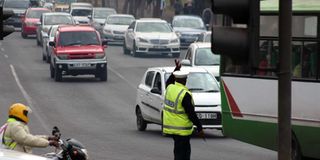
Although these statutory provisions and traffic control devices are designed to promote order, harmony, and mutual respect among road users, the law also recognises circumstances in which human judgment, particularly that of a trained officer must intervene. This is especially relevant during emergencies, severe traffic congestion, or when presidential and VIP motorcades require unobstructed passage. To address such situations, Section 69(a) of the Traffic Act grants traffic police officers the explicit duty and authority to regulate traffic, maintain order, and prevent obstruction. It provides:
“Without prejudice to any powers or duties of the police under this Act or any other Act, it shall be the duty of the police to regulate all traffic and to keep order and prevent obstruction in all roads…”
Through this provision, the Act confers operational discretion on police officers to modify normal traffic flows such as creating temporary additional lanes or permitting double‑lanes on a single‑lane road to alleviate gridlock. Motorists who respond to these hand signals are legally obligated to comply under Section 52 of the Traffic Act, which requires obedience to any lawful direction issued by a police officer regulating traffic.
Kenya’s Highway Code reinforces this hierarchy by affirming that police signals and directions take precedence over traffic lights, signs, and road markings. Motorists must therefore act sensibly and attentively when following an officer’s instructions. Rule 76 of the Highway Code further states that where double lines exist and the line nearest to the driver is solid, one must not cross or straddle it except in unavoidable circumstances, including avoiding a stationary obstruction, complying with a police officer’s order, or accessing premises or the roadside.
Legally, a traffic jam does not suspend the Traffic Act. However, the simultaneous grant of broad discretionary powers to police officers to manage congestion creates what many road users perceive as a legal paradox. This tension challenges the principle of legal consistency, which requires that the law be interpreted uniformly and produce similar outcomes whenever applied.
Vehicles that were caught overlapping were redirected by traffic police.
Photo credit: File | Nation Media Group
The legal analysis therefore turns on situational context: where traffic officers actively instruct motorists to form three lanes, including the use of overtaking lanes, such instruction is lawful and temporarily supersedes the continuous yellow line rule through operational discretion. Conversely, in the absence of an officer actively directing traffic, the standard law applies immediately, and overtaking on a continuous yellow line constitutes an offense.
Ultimately, one principle of law that must remain inviolate is predictability. This principle is anchored in Article 47 of the Constitution, which requires that all administrative actions be lawful, reasonable, and procedurally fair. It aligns with the High Court’s decision in Republic v Commissioner of Traffic & another Ex‑parte Brian Asin & 3 Others (2017), which held that traffic enforcement cannot be arbitrary, unpredictable, or abusive. The police remain bound by the Fair Administrative Action Act and Article 47 of the Constitution.