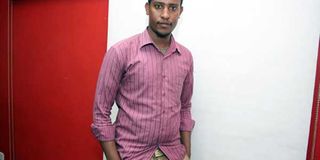
When Samson Dibo Sahado scored 388 out of a possible 500 marks in the Kenya Certificate of Primary Education (KCPE) exams in 2010, it was an enormous achievement for him. This was not an everyday accomplishment, at least not in his home area.
For someone who had attended Tirrim Primary School in Korr, an outpost flung roughly 508 kilometres North East of Nairobi in the southern fringes of Chalbi Desert in Marsabit County, a local school with hardly any facilities worth writing home about, Dibo had defied and powered through infinite odds to share the national stage of academic excellence with other top performers that year.
As a befitting reward, the fifth born in a family of 10 children shot to national glory, and was praised by many.
Back at home in Laisamis Sub-County, an immediate hero status was bestowed upon him.
Dibo’s long-held dream would materialise when Alliance High School offered him a Form One place. When Equity Bank awarded him a four-year sponsorship under their Wings to Fly scholarship programme, it was the onset of better prospects in his suddenly changed fortunes.
When he finally joined Alliance High School, he was already known.
“Most members of the school community and even some of my fellow Form One students could pick me out in a crowd. They had heard about me and even seen me on television. It was a humbling experience, a mixture of exhilaration and conquest for me.”
All this while, never in Dibo’s remotest imagination had it occurred to him that his popularity would turn his life in school into a nightmare. His troubles began with a group he refers to as the “chamber of prefects”, a clique made up of senior school captains at Alliance High School, at the time.
“I was immediately a marked man after setting foot in the school. Prefects were on my case, and followed every move I made. They provoked me, hoping that I would disrespect them.” Dibo recounts.
Dibo’s big frame always betrayed him, so however much he hid from the prefects, he was always an easy spot among his fellow Form One students. Prefects would find fault with him in the meanest of ways, and punish him forthwith.
He says: “Form One students were not allowed to walk while in the school premises they were supposed to run. Sometimes I would be accused of dragging myself or having badly done my tie. I had never had a tie before, so naturally, I had some difficulty doing it properly.”
“I wrote tens of apology letters, cleaned dormitories and was made to run petty errands for the prefects. Many days I would go without meals and miss lessons as I attended to punishments given out arbitrarily by prefects. They hated me for reasons I could not quite grasp,” he says.
Having begun as the champion of hope and redemption for his family and even community, Dibo’s flame began losing its vitality. His concentration in school work slumped, and his dream dwindled. The teen’s sanity was also threatened.
During his first year in school, Dibo’s grades moved from poor to wanting, raising alarm among his teachers.
“There was a rumour among students that I had cheated in exams to win a place in Alliance, which not only hurt me, but made me the laughing stock among the school community,” he recollects.
Dibo’s forbearance had been overstretched, even worn. Desire for vengeance was creeping in. By then, Dibo says he felt he no longer had anything to lose. His ruin was imminent, only he swore to take down with him those that had led him here, in whatever thinkable way. He made clear his intent to confront the prefects, but by the time he realised his costly blunder, he had roiled poisonous waters.
“Nothing was as offensive as engaging in a confrontation with the prefects. They operated as a gang, and a dispute with one was treated as an insult to the entire body of prefects. Punishment was meted out by mob.”
While Dibo reported to the teachers every incident of abuse he suffered in the hands of prefects, his assaulters always managed to manipulate the plot of the incident to cast him as the offender. Teachers would dismiss the case, consigning the defenceless student to face charged and retaliatory victimisation. Dibo resorted to suffer in silence.
Soon his aggravation became unbearable. Dibo, now fully awake to the damning reality of harassment in high school, slid first into depression, then withdrawal.
By April 2012, then in Form Two, his silent anguish had reached a crunch. He decided to involve his sponsors. A panel was immediately constituted, comprising representatives of the scholarship programme and a number of teachers. These were going to assess the gravity of Dibo’s grievances and recommend action thereafter.
“When I was asked what I thought was best for me, I stated to them that I wanted a transfer from the school. The school however was unwilling to release me. The panel asked me to go for a two-week break to think the matter over.”
Even as Dibo went home, he knew there was nothing to think about. He had already made up his mind, he says.
“After a fortnight, I called the foundation and told them that I could not go back to Alliance.”
Two more weeks expired. Dibo was out of class for a whole month. While he understood the cost of his absence from class, he stuck to his guns with tenacity.
Meanwhile, family and friends back at home felt that he was gambling with a golden chance, his only chance. Pressure was mounting on him, yet going back to the school was out of the question.
“After a month, the sponsors asked me to propose two schools of my liking. I settled for two national schools: Starehe and Mang’u.”
Although the sponsors had yielded to Dibo’s resilience, he faced one more snag.
“I had to seek for admission to either of these schools myself. I had thought that invoking the sponsor would automatically earn me admission to any of these schools. My bid was unsuccessful.”
Panic set in. Dibo had been away from school for too long already. At the intervention of a family friend, he secured a place in Utumishi Academy in Gilgil, Nakuru County.
“I was admitted to Utumishi Academy in Form Two, second term.”
Dibo would never settle in his new school. From teachers to his fellow students, everyone failed to comprehend why someone would quit a prestigious national school, the fancy of many students the country over. From the symbol of industry and resilience that he had been only slightly over two years earlier, Dibo was now regarded as the epitome of folly, and the subject of all manner of ridicule from fellow students.
When the school closed for a short break during the 2013 General Elections, Dibo, now in Form Three, met a local parliamentary aspirant to whom he opened up his academic woes. To Dibo’s delight, the politician promised to help transfer him from the school as soon as the election period was over.
“He enjoyed popularity in the area. There was no doubt he would be our next Member of Parliament. With him in parliament, I was assured of a transfer,” Dibo says.
The politician used Dibo’s case to gather political mileage, promising to disentangle him and other constituents from their miseries once elected to office. This only whetted the boy’s reassurance, and made him feel more secure as elections approached.
The man was indeed elected to parliament. When other students returned to school, Dibo stayed put. To him, it was only a matter of time before the newly-elected MP honoured his word and sponsored him in another school. Only that this gamble was about to go horribly wrong.
April went past, and it was now deep into May. No word had come from the Member of Parliament. Dibo’s attempts to reach him on his mobile phone were fruitless. He had been away from class for more than a month. He was trailing in his studies, but even more gravely, his absence from school put his scholarship in utter jeopardy.
“After nearly a month, I gave up. It was very hard, but I had to accept the sad fact.”
The boy had been deceived. His only option was to dust himself, and head back to Gilgil.
“The principal summoned me to his office the day I reported back. He was furious with me. He wanted to know what I had been doing at home while other students had reported back to school nearly a month earlier.”
Dibo’s explanation of his circumstances all but sealed his fate. Dibo was expelled. Upon learning of his expulsion, his benefactors terminated his scholarship. Dibo was now on his own, with neither a school nor sponsorship. His pie had crumbled.
The sudden collapse of fortunes thrust him into the streets of Nairobi. “I feared backlash from my family and community. I had failed them, and the last thing I wanted to do was to go back to Korr. I had to fend for myself as I sought for a school. I had rather languish in Nairobi than face them,” recollects Dibo.
He observes: “The publicity I had got after my performance in the KCSE exams, well-intended as it had been, had become my downfall. In this state, I was willing to go to any school.”
From the vile of starving to rue, depression and contracting an awful bout of pneumonia for sleeping in alleys and junkyards, Dibo saw it all. While his initial intention was to remain in the city to look for a school to finish his studies, he was dismayed by how fast his stay in Nairobi was turning into a battle for his very survival.
It took a whole year of malevolence of street life to neutralise Dibo’s grit. His perseverance could not stretch any further.
“It was in June 2014 when I decided I could not die in the streets yet I had a home and a family. It was a hard decision to make, but the wisest. I pulled myself together, and hitchhiked home.”
Dibo did not expect to get a reception befitting a missed returnee, but his people received him nonetheless. He joined Form Three at Tirrim Secondary Secondary, a school in his home location. His case was a legendary fall from glory to disgrace, and the jeers he got from all who knew him confirmed the height of his skid.
“I ignored it all, determined to focus on my studies and to recover the lost time. It was demoralising to return to the village from a national school and to sit in the same class with students who had scored as low as 100 marks in their KCPE exams. While this haunted me, I resolved to turn the shame into triumph by studying with renewed energy,” Dibo says.
It was until 2015, then in Form Four, that Dibo was able to put all his past woes behind him and fully focus on his studies.
“In the KCSE registration exam, I scored a B minus and earned index number two. The score gave me a big boost. I knew I could improve the score before the national exams.”
In the remaining five months, Dibo studied with relentless purpose and verve, hoping to get a grade that could propel him to university on government sponsorship, and to redeem himself.
“I scored a B of sixty points and qualified to join university. Maybe I would have performed better had I studied at Tirrim from Form One,” he posits.
Whereas Dibo was thrilled by his conquest, a victory that had also revamped his ambition of getting university education, it was relief that was more evident in him. The happy ending had spared him blushes.
Locals’ trust and belief in him were renewed. Dibo was offered a job as a teacher at Tirrim Primary in 2016, where he taught as he awaited his admission letter to university. In the flourish of this triumph, he also got into voluntary community work in Korr.
“Moi University invited me to study a Bachelor of Arts degree in social work. A few weeks later, a US mission awarded me a scholarship to study Bachelor of Commerce in Finance at the University of Nairobi. My life was finally changing for better.”
Dibo had to put on hold his admission to the main campus of Moi University in Eldoret, to focus on his dream course in Finance.
“I am starting my second year later this month. Later this year I will start attending evening classes for my social work course at Moi University’s Nairobi Campus, where I transferred to. It is a lot of work, but again, both opportunities are worth going after.”
For someone upon whom family and community have placed an enormous responsibility to succeed, Dibo says he cannot afford to fail again. He has taken this responsibility in his stride, and hopes to excel in every way.
“I wish to study for an MBA in Finance and go as far as my strength will allow. Thereafter I want to go back to Korr to serve my community.”