At one play area, Gloria Karanja watched her autistic son move from one quiet corner to another, each time seeking a space away from the crowd. When someone came into the corner he was using, he moved again. Eventually, no quiet spaces were left, and they had to leave. This experience stayed with her.
At another play area, she found the toilet in poor condition. For children who may be in diapers or unable to use standard toilets, something as basic as going to the bathroom can become another challenge.
This January, Ms Gloria launched Neuronest Play Centre, a facility that serves both neurodivergent and neurotypical children between two and 12 years. The idea to establish the centre came from her own experience raising an autistic son.
Her son was diagnosed with autism when he was four years old. One December holiday in the countryside, she found herself thinking about families who may not have access to proper information or services.
“I looked at my son and saw how privileged he was. I wondered, what about another child in the village whose parents don’t know what’s going on with their child?”
As a mother of two, Ms Gloria says the difficulty is not only what the child experiences but also what the family has to carry, especially the stigma.
A suspended bucket swing with a soft toy attached in the sensory play and therapy area at NeuroNest in Westlands, Nairobi, on September 2, 2026.
Photo credit: Wilfred Nyangaresi | Nation Media Group
“I've heard other parents say that their child would get a meltdown by the side of the road, and people would walk by them saying, 'This is not your child, or you don't know how to discipline your child.’ I felt there is need for a place where children can just be,” says Gloria, a mother of two.
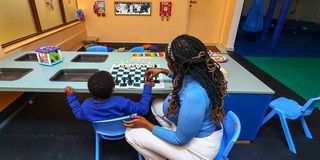
That idea eventually became Neuronest. It began with basic play activities, including a trampoline, swings and zip lines. It has since expanded to include chess, IT and robotics, alongside occupational and speech therapy sessions.
The play centre accommodates at least 20 children at a time. Its staff includes child minders trained in early childhood development and special needs, as well as occupational and speech therapists.
It serves children with autism, ADHD, dyspraxia, dyslexia and sensory processing disorder. Additionally, it also accepts children with cerebral palsy and Down syndrome, as well as neurotypical children.
At its core is the opportunity for children to play, interact and form relationships in their own way.
“I have already seen changes among the children who return regularly. Some arrive reserved but later begin asking where their friends are. They may not necessarily speak to one another, but they interact in other ways.”
The goal, she says, is not simply for a child to reach a particular milestone. “It is also about helping them feel that they belong somewhere and that they are not alone.”
NeuroNest CEO and Co-founder Gloria Karanja at the organization’s facility in Westlands, Nairobi, on September 2, 2026.
Photo credit: Wilfred Nyangaresi | Nation Media Group
The centre charges Sh1,000 for up to five hours on weekdays and Sh1,500 for up to three hours on weekends.
She notes some parents avoid taking their children to church because of the stigma and the expectation that a child should sit quietly and listen.
“The idea is to give parents an option. They can leave their child here to play while they attend to other things,” Ms Gloria says.
The centre does not diagnose or treat children, nor does it require medical reports for children who come simply to play.
“If a child is receiving occupational or speech therapy, the diagnosis is shared with the relevant therapist. We guide parents and give the child room to play freely.”
Baby Milestones Founder & Director Esther Muthee at her office on September 1, 2026.
Photo credit: Francis Nderitu | Nation Media Group
That sense of belonging is important to Esther Muthee, an early childhood consultant. She started the Baby Milestones centre after her son was born prematurely. At about two to three years, he had shown some difficulty with speech development.
His paediatrician explained that the attention she had given him through talking, reading books, singing and engaging with him had helped him avoid more severe delays in comprehension and learning.
“I realised that I saved my son,” she recalls. That experience eventually led her to start Baby Milestones, where she works with children between birth and 12 years. She also coaches mothers, nannies and, in some cases, entire families on ways of engaging children more deliberately.
Her concern is particularly with children growing up in urban households where daily life can become increasingly sedentary.
“Some children spend long periods on screens, play by themselves or are left with busy adults who may not have the time to engage with them consistently,” she says. “This means that opportunities for children to talk, play, move and develop their social skills are lost in the routines of everyday life.”
Speech delay is one of the main concerns she encounters. But she also works around other milestones, including walking, self-expression, emotional adjustment and interpersonal skills.
When a mother comes to her concerned about a child's speech, she enquires first whether the milestone has been missed or whether the child is simply delayed.
“If there are signs that the problem may be medical or neurological, I refer the child to a paediatrician or neurological specialist. If it is a delay, I look at how delayed the child is and what the family's routine looks like.”
She works with families to create a routine that gives the child more opportunities to communicate throughout the day. “The idea is to make the home itself part of the child's learning environment. One word can become another, then a short sentence and eventually a longer one.”
Children aged two years and below, she says, should not be on screens because they need time to interact with their natural environment. Where nutrition is a concern, she works with a paediatric nutritionist. If there is a physical issue, a physiotherapist may be involved.
“Once a child has been diagnosed, the focus shifts to helping improve the child's quality of life while continuing with the necessary medical care,” Ms Esther says. For children with some neurodivergent conditions, she says, the choice of toys and the way they are introduced can matter. “For some autistic children, soft blocks that can simply be piled on top of each other may work better than the interlocking ones. Most of childhood development can actually be sorted by engaging the child.”
A sensory play and therapy area at NeuroNest in Westlands, Nairobi on September 2, 2026.
Photo credit: Wilfred Nyangaresi | Nation Media Group
Virtual coaching sessions cost Sh1,500, while physical coaching sessions cost Sh2,500. Families can also opt for a training package session at Sh3,000 per session, with each session lasting one hour.
She notes that this is particularly relevant among middle-class urban families, where parents can afford televisions, phones and other gadgets for their children but struggle to provide one-on-one interaction.
“A child may struggle to interact with others, express themselves or negotiate. They may appear socially withdrawn when what they have lacked is regular interaction with other people.”
Some children are brought to her after parents notice that they have passed age two without talking. Others struggle to play with other children because they become overstimulated. Some do not maintain eye contact or appear reluctant to mingle.
“Many parents recognise these signs early. Others, particularly when neurodivergence is involved, may spend some time in denial before seeking help. The earlier a concern is identified, the greater the chance of improving a child's life,” she says.
Ms Esther says a child with delayed speech, for example, may grab something from another child because they do not have enough words to ask for it. They may defend themselves physically instead of explaining themselves and consequently end up in fights.
A range of colourful therapeutic play and climbing equipment at NeuroNest in Westlands, Nairobi, on September 2, 2026.
Photo credit: Wilfred Nyangaresi | Nation Media Group
“An autistic child may become intensely attached to another child and stay close for longer than the other child is comfortable with. Without understanding, such behaviour can easily be interpreted as pushiness, bad behaviour or overstepping.”
She believes that better engagement and socialisation can help children navigate these situations, while also helping the adults around them understand what they are seeing.
“In the past, some families hid children because of fear and stigma. Today, more parents are willing to talk about what their children are experiencing and seek help,” she says, adding that it is a part of a wider conversation about the increasing attention paid to children with developmental and neurodivergent conditions.