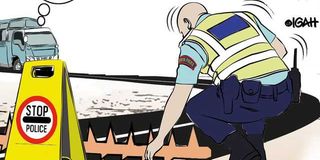
On several occasions, I have witnessed traffic police officers deflating the tyres of matatus while they are still carrying passengers, apparently as a means of immobilising the vehicles.
Is this practice lawful, even where the drivers have committed traffic offences? Does the law authorise traffic police officers to deflate the tyres of a vehicle as a form of enforcement, particularly when passengers are on board?
More importantly, does this practice not expose innocent passengers to unnecessary danger? What does Kenyan law say about the powers of traffic police officers in such circumstances?
Human rights and basic relationship decorum must remain central to the standard operating procedures of all professions in Kenya. For police officers, the expectation is even higher: their operations must reflect professionalism and respect for the law, regardless of the situation they are addressing. The institution of policing exists to create safe environments and relationships that enhance peace and advance the principles of the Bill of Rights. Before examining the conduct of some of the traffic police officers, it is important to outline the legal character of the National Police Service (NPS).
243 of the Constitution. Its mandate is anchored in constitutional morals, particularly Articles 1, 2, 3, and 10. The significance and the imperatives of these provisions cannot be made any lighter nor derogated by anyone: first, all powers, including policing, belong to the Kenyan people; secondly, the Constitution is supreme, and no person can claim to exercise power outside it; thirdly, every person, especially the police, must respect, uphold and defend the Constitution; and fourthly, national values and principle of good governance have commanded particularly the rule of Law, dignity, social justice, accountability amongst others. Police are no exception.
These provisions require the Service to uphold professionalism and discipline, prevent corruption, promote transparency, and respect fundamental freedoms. Police officers are expected to be trained to the highest standards of competence and integrity, with a clear obligation to respect human rights and dignity. They are also required to foster positive relationships with the wider society.
Against this backdrop, certain practices by traffic police officers raise concern. Among these are the deflation of vehicle tyres, confiscation of car keys, and striking of vehicle doors or windows. While these actions may immobilise a vehicle, detain a driver, or facilitate arrest, they are fundamentally flawed. Deflating tyres of a passenger‑laden vehicle is not only roguish but also dangerous. Removing car keys from the ignition points resembles arbitrary conduct rather than lawful enforcement. Striking or damaging vehicle doors and windows is unreasonable and devoid of common decency.
Vehicles found in contravention of traffic rules must be dealt with within the framework of the Constitution, the Traffic Act, the National Transport and Safety Authority Act, judicial decisions, and the principles of human rights. The Traffic Act (Cap 403) provides the legal basis for regulating vehicles and road use. It empowers police to stop, inspect, and detain vehicles that are defective or being driven recklessly. Sections 55 and 58 allow detention of vehicles with mechanical faults, while sections 47 and 49 criminalise reckless or dangerous driving. However, the Act does not authorise police to deflate tyres of a vehicle carrying passengers. Such conduct lies outside lawful enforcement powers and creates immediate safety risks.
The Constitution of Kenya reinforces this position. Article 28 requires protection of human dignity. Article 26 guarantees the right to life, while Article 29(c) protects individuals from cruel, inhuman, or degrading treatment. Deflating tyres while passengers are inside exposes them to danger, increases the risk of accidents, and may cause emotional or physical harm. Such actions violate constitutional rights and disregard due process. Enforcement of traffic laws must therefore respect both legality and human dignity.
Policy guidance from the National Transport and Safety Authority (NTSA) also emphasises safe enforcement. NTSA regulations provide for impounding defective vehicles, suspending licences, or prosecuting offenders. These are administrative and judicial measures, not physical acts that endanger commuters. Kenyan courts have affirmed these principles. In the appeal case Murungi v Republic being criminal case filed in 2019, the Court in 2023 quashed the decision of the High Court, arguing that any process involving accusation of unroadworthy vehicle must be done within the tenets of the law. It stated that inspection and subsequent prosecution must not deviate from the principle of natural justice and fair hearing.
In Osur v Attorney General (2026), the court criticised police for damaging a citizen’s vehicle during enforcement, holding that reckless handling of property and abuse of authority are unlawful and compensable. These decisions illustrate that enforcement must follow lawful channels and respect proportionality.
From a practical perspective, deflating tyres is both unsafe and unnecessary. Police have lawful alternatives: they may stop and charge the driver, detain the vehicle at a police station or designated yard, or refer the matter to NTSA for regulatory sanctions. Crucially, they must ensure passengers are protected, including arranging alternative transport if a vehicle is impounded.
Therefore, traffic police officers are not justified in deflating the tyres of a matatu, even when the vehicle is in breach of traffic laws. The law requires enforcement through arrest, prosecution, or regulatory action—not through acts that endanger lives. Case law confirms that damaging vehicles or exposing passengers to risk is unlawful and can attract liability. The proper course is safe detention, inspection, and prosecution under the Traffic Act and NTSA regulations.