When the controversial gay-themed film Rafiki came out, its biggest bulwark of support against a predictably irascible moral police came from young Kenyans on social media.
They shouted themselves hoarse on the need to have the movie shown locally not only as a statement of creative freedom in the country, but also, and perhaps more importantly, as a show of support for sexual minorities in Kenya who have been pushed to the margins of mainstream society by harsh anti-gay laws and a largely conservative culture.
Among the loudest voices were Kenyans whose sexual and gender identities fall under the expansive rainbow that is the LGBTQIA (Lesbian, Gay, Bisexual, Transgender, Queer, Intersex, Asexual) community.
You have probably spotted them — small rainbow flags attached to their social media accounts, their candidness when speaking about the realities of being queer in a country where majority of people neither recognise nor tolerate their identities and sexual orientations strikingly brave. A few of them spoke to DN2 about their lives.
Mark, a 27-year-old social media manager, told his mother that he is gay early this year. He was in the midst of a crushing clinical depression that, he says, had made life a living hell for him.
"Her response surprised me. She said something like, ‘that's OK’ and we moved on to speak about other things. She is staunchly religious so I expected a bit of opposition," said Mark.
That was months ago. And, although his mother does try to preach to him about his sexuality sometimes—saying things like if he found God he could change—she knows not to step on his toes too much lest she strains their relationship.
"I came out to my mother and my friends because I did not care about hiding my true identity anymore. It was too exhausting to live life with two identities; a public-facing one that conformed to societal expectations, and a private one that I only revealed to close friends and other gay people. I don't want to live like that anymore," he said.
Mark is out, but only to an extent. He openly identifies as queer on twitter, but he insisted that, for this interview, only his first name be used, and definitely not his picture. He is afraid about what revealing his full identity might mean for his safety, given the homophobic society that he lives in.
In Kenya, being gay is not illegal, but there are sections of the law that criminalise aspects of gay life, such as gay sex and the rights of gay men to adopt children.
Section 162 (a) of the penal code reads "Any person who has carnal knowledge of any person against the order of nature is guilty of a felony and is liable to imprisonment for fourteen years" while Section 165 states: "Any male person who, whether in public or private, commits any act of gross indecency with another male person, or procures another male person to commit any act of gross indecency with him, or attempts to procure the commission of any such act by any male person with himself or with another male person, whether in public or private, is guilty of a felony and is liable to imprisonment for five years."
Kenne Mwikya, a human rights lawyer at the Kenya Human Rights Commission, explains that "carnal knowledge against the order of nature" is a loaded statement that could cover any form of sexual activity that does not involve the penetration of a vagina by a penis.
"A heterosexual couple engaging in anal sex, masturbation, or oral sex could also be considered to be violating the law," he said.
Kenya's anti-gay laws are a legacy of colonialism when puritanical British administrators made it punishable to be caught having sex that does not lead to procreation.
In 1967, Britain repealed this law from its penal code and then went a step further to legalise gay marriage in 2013. Decades after this penal code was penned, Kenya, like other countries in the commonwealth, is still hanging onto this old law, and using it to systematically discriminate against queer people.
In 2015, under the auspices of this law, two men, Caleb Omar Idris and George Maina Njeri, were arrested in Kwale County on suspicion of engaging in sexual intercourse with each other. As part of evidence collection, the police forced them to undergo anal examinations.
Then in March this year, the National Gay and Lesbian Human Rights Commission challenged the legality of forced anal examinations on behalf of Idris and Njeri in the high court and won.
"The right to privacy, particularly not to have one's privacy invaded by unlawful search of the person, is closely linked to the right to dignity. Those rights in our view extend to a person not being compelled to undergo a medical examination," the judges ruled.
This is only one of a few wins for the NGO, which is pushing for the entire removal of the clauses in the penal code that criminalise gay sex. The case is ongoing.
These realities, that one could be arrested and their lives upended over who they choose to have sex with, and that society could use that law as a basis to ostracise sexual minorities, is what keeps gay men like Mark in the shadows, too afraid to take liberties that have been extended to straight people.
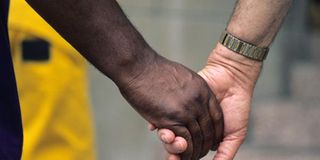
For example, he would not hold hands with his partner on the streets, nor would he want to be identified as a gay man outside of his circle of friends and family where he feels safe.
"Inasmuch as I am out on my twitter account, I have protected it to give access only to the people that I know. I have been harassed on twitter, by for example, being called "faggot" so I have learnt to be careful," he said.
Maria, who is 29 years old and a librarian, is even more closeted than Mark. Identifying as a non-binary person, Maria goes by the pronouns "they/their" and dates both men and women, with a bias towards women.
Non-binary people, or ‘enbies’, as they call themselves online, don't identify either as male or female. They do not conform to any gender and they set their own rules; they might present as feminine one day (wearing dresses or make up), and then as masculine the next (barefaced and in boyish clothes), depending on how they feel.
According to Maria, people tend to be kinder to them when they present as feminine.
"I have been referred to as "shoga" for walking with a girl, especially at bus stops. I am lucky that this has never escalated to physical violence," they said.
Like Mark, Maria identifies as queer on twitter, but very few people outside of their twitter friends know about their queer identity. They are not yet out to their family or offline friends. And to protect themselves even further, they have "non-queer" twitter account which has their real name and details about their jobs.
"I had access to the Internet from the time I was about 12, so I honed in on people like me from quite a young age. On Internet chat rooms, I could be myself, and this has spilt over to how I use twitter. I find it very easy to find other queer people on twitter and form communities with them opposed to any other social media. It provides a false anonymity that allows me to be myself, but then I am always aware of how easy it would be for somebody to link my twitter account to me and use it to harm me," Maria said.
Maria is currently not in a relationship with anybody and says that it can sometimes be very lonely because people tend to reduce the lives of queer people to whom they are dating at the time.
"This is why I do not like that "love is love" narrative that people bandy around to campaign for the acceptance of queer people in the community. Because the underlying message is, if you are not loving somebody, are you even queer?" they posed.
Maria speaks to the too-common narrative that reduces queer people to their sex lives while ignoring other aspects of their lives.
For example, when Kenya Film and Classification Board chairman Ezekiel Mutua took to twitter to justify banning the Rafiki movie, he asked: "What pleasure, pray, does a person of a sane mind find in watching girls having sex with other girls?"
This tweet would have led one to believe that it is a highly sexualised featuring barely dressed characters having gay sex in every conceivable place.
In reality, it is a sweet PG16 film which boasts of only two scenes where the main characters (Ziki and Kena) kiss, and one implied sexual encounter. The most shocking thing in Rafiki, what drew gasps of disbelief from the audience, is the gratuitous violence suffered by the characters once their lesbian love is discovered.
Director Wanuri Kahiu and actresses Samantha Mugatsia and Sheila Munyiva pose on May 9, 2018 during a photocall for the film Rafiki at the 71st edition of the Cannes Film Festival in Cannes, southern France. PHOTO| AFP
A rowdy crowd of agitated neighbours led by a busybody cafe owner fall on Ziki and Kena, beating them to a pulp and leaving them with ghastly bruises on their faces.
For a lot of queer people, that scene was not an improbable exaggeration by the movie makers to elicit emotional reactions from the audience. It was a harrowing reminder of the everyday violence that they must live through.
For Lily, a 24-year-old lesbian living in Nairobi, watching Rafiki was to see herself reflected on screen in a way that no other local film had been able to do.
"The film is a candid snapshot of queer life in Nairobi, which means to be an outlier. I am unable to capture the full extent of joy I had when I heard that the movie was made. I first heard about it a few weeks before it was banned and was so happy to finally be able to see myself represented in local art and film, a moment of affirmation after a long drought," said Lily, who works in fashion.
Like Kena and Ziki in the film, she, too, has experienced harsh treatment by a society that refuses to accept her for who she is.
"I have been denied admission into establishments, heckled publicly and insulted because of my sexuality but I consider myself lucky as compared to others," said Lily.
Her friends know that she is a lesbian and she is out on twitter but she has not come out to her family, although she thinks that her mother might have suspicions about her sexual identity.
"I am deliberately out on Twitter mostly because it is my own form of activism, disrupting and resistance. I rarely get harassed overtly because of my sexuality online but the micro-aggressions and erasure sting just as much. I do have a substantial following so I am sometimes worried about my online persona spilling over into my real life but I refuse to be silenced," she said.
As things stand now, although much of the millennial queer community has found a home of sorts on twitter, they are counting on a change in law to expand safe spaces for them and make it that much more easy to come out as gay in real life, not just when they have the protection offered by online anonymity.
According to Mwikya, who specialises in equality and non-discrimination, repealing the sections of the law that ban gay sex might just be the much needed first step towards creating a truly inclusive society for queer people in Kenya.
"Decriminalising safe sex conduct is very important for consolidating LGBTI rights in the country. The criminalisation of same sex is the source of rights violation from discrimination to violence, as it creates conditions for biases against people who engage in such sexual conduct," he said.
"Just because these laws are not implemented very often doesn't mean that LGBTI Kenyans haven't internalised them and don't live in constant fear. As happened with the two men in Kwale, if police have probable cause, for example in the form of a tweet where you declare your sexual orientation, they can pick you off the streets and arrest you pending investigations into your private life," he said.