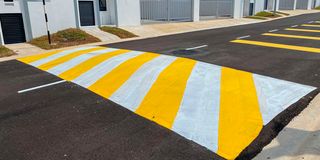
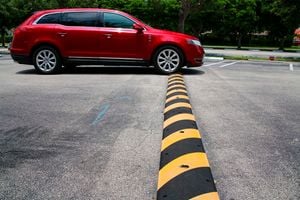
Question: Why do some drivers come to a virtual standstill when they cross the rumble strips that warn of an approaching speed bump or other hazard? Many readers
Answer: Rumble strips are a hazard warning and are not intended to be hazards in themselves. They are supposed to be designed and placed so they can be crossed with zero ill-effect on the comfort or control of the vehicles that cross them - at any speed!
Other road markings and signposts (for speed bumps or anything else) are purely visual warnings. You have to see them to take the advised action. But there are circumstances when they might not be visible, in heavy rain or when blocked by other traffic, or when the driver is not concentrating, or when the signs have been obliterated or are missing altogether.
So if the hazard is dangerous enough, or possibly invisible and unexpected (and speed bumps certainly qualify on those counts) a signal that is not dependent on eyesight is warranted. Rumble strips step in with signals to two other senses – your ears, the seat of your pants and your hands on the steering wheel. You can feel and hear the mild vibration they cause. They should be positioned so they do not require or recommend any action “before” you cross them, and leave plenty of time for reaction even if the vibration is your first clue to a looming hazard.
Photo credit: Shutterstock
If rumble strips interfere with the car’s handling in any way, either the strips are not properly designed or your suspension is faulty or your steering joints are excessively worn or your tyres are severely over-inflated.
In Kenya, rumble strips should be legally compulsory adjuncts to every speed bump (because their shapes and sizes are so much more severe than international practice or the stipulated Kenya Standard), but it is equally important that the warning strips are properly designed and built in accordance with the foregoing principles and intended purpose. Few hazards (especially bumps) even have the visual warning signs and locator posts which the law already specifies.
There are three probable reasons why some drivers brake suddenly when they see the new rumble strips.
Photo credit: Shutterstock
And to the greatest extent possible, rumble strips should always be positioned at a regular and regulated distance from any hazard, so the driver who feels their buzz can estimate exactly where the hazard is, even if he still cannot see it.
He knows where to look and he knows how hard to brake. If there are simple and logical ingredients as far away as possible from rocket science, these specifications would be among them.