In many spaces, walls and floors often fade into the background, reducing themselves to simplistic functional features, despite their prominence and towering presence. But Kamunya Wanjuki’s work commands walls to speak.
Wanjuki is a fine artist whose diverse portfolio spans paintings on canvas, exotic wood sculptures, driftwood sculptures, concrete reliefs, rustic metal installations, life-size mosaic murals, and delicate watercolours. He has spent three decades bridging storytelling, art, design and architecture.
His creations, whether an exotic carved wooden wall panel in a luxury hotel, a mixed media mural in a school reception or a sculpture at the Jomo Kenyatta International Airport, are designed to complement and elevate architectural and design vision.
Today, his pieces occupy public and private spaces across the country and beyond, quietly telling stories. In this edition, we explore the role artists play in breathing life into buildings. But first, let us dive into Wanjuki’s journey:
I realised that I was an artist very early on. In the 70s when I was a young boy, I drew sketches and moulded animals using clay. There were very few materials to work with.
Over time, my work improved, and I participated in shows. We had a congress that featured different types of projects, including sciences and arts. Selected projects were displayed at a show at the district level. My work featured well in these types of events.
By the time I was in high school, I knew I was an artist. I had travelled outside my home and I would see curio shops with artwork. I was also getting commissioned by my peers to produce artwork for them. I pursued art as a subject throughout high school. By the end of my secondary school studies, I knew I was going to pursue art as a career, and it is what I studied thereafter at the university.
Your work is very diverse. You paint, draw, sculpt and work with all sorts of materials. Were you always this versatile?
I started off with painting, drawing and sculpting with clay, which was readily available. There were limited tools when I started out, leaving little room for exploration. Wooden sculptures, for instance, had to be made using manual carpentry tools like chisels, which are not specifically designed for artwork. If I wanted a special chisel to bring out specific details, I had to fashion one out of a nail.
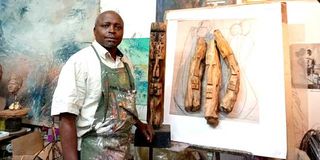
Kamunya Wanjuki, a Fine Artist whose art works have featured prominently in many public and private spaces
Photo credit: Pool
Of course, now, tools have advanced. I can import power tools to work on wooden sculptures, which allow me to use my mind freely without relying too much on my muscles. The material choices have also increased greatly. I can make rubber moulds, use plaster, metals, driftwood, plasticine, concrete and many others.
The manual tools are not all that bad, however. Although they are slow to work with, they give an artist time to re-invent their concept while building patience.
My work has been displayed in galleries, homes and commercial buildings. But how I transitioned into the design landscape was through interactions with interior designers and architects. In mid-2000s, I began receiving briefs from architects, designers and developers to help them accomplish their visions for different spaces.
Take us through your process, whether you are working on commissioned pieces or passion projects?
Most of my personal projects stem from a vision or even a dream. I can toy with an idea for a while – could be weeks, months or a year, depending on how clear my vision is. When I start working on it, I first make a sketch or doodle it on paper. Ideas fade away if you don’t capture them on paper. If it’s a sculpture, I like creating a study in clay or plastic. In art, a study is a practice piece used by artists to plan or refine details before producing the final piece.
After creating the study, I’ll take time to critique it and improve the vision. Depending on the vision, I will then decide what scale is good for the idea. There are some ideas that come out well in animations, or they are suited for desktop consumption. Others are great for big spaces, such as life-size sculptures, which tend to be two or three metres tall.
Fine Artist Kamunya Wanjuki.
Photo credit: Pool
Some ideas are picturesque and, in such a case, I have to decide the type of sculpture to create. There are mainly two types: relief sculptures and sculptures in the round. Relief sculptures are viewed from one dimension. These can be mounted on a wall or placed against a wall background, and they can be enjoyed from one dimension. The round pieces can be viewed from all directions, and they cannot be placed on a wall. People will need to go around it to see all its details.
Normally, when someone comes to me, they already have an idea of what they want. We start with the dimensions of the space where they want to install the art. This is important in establishing the right scale for the artwork. We don’t want it to be too big or too small. Balance is important in both art and design. They can also share more details about the space, such as the design theme.
From there, we brainstorm, create mood boards and out of that we develop a refined concept and work within a specified timeframe to deliver the piece.
Relief wall sculptures in wood are very popular. I also create them in materials like plaster, metal and concrete. I’ve also created mosaic pieces on building walls, which can be used both outdoors and indoors. Murals are also popular, but for outdoor walls. I prefer to create a mural with materials like tiles or coloured glass, instead of painting on the walls. Tiles and glass are designed to withstand the outdoor environment. With paint, some colours tend to lose the intensity of their hues over time.
Individuals who appreciate art tend to commission unique pieces. Learning institutions and hotels also form a big percentage of art consumers and commissioners. Corporates are commissioning portraits a lot, as corporate gifts. I’ve created countless pieces for accomplished individuals in Kenya as gifts from organisations they have served.
Do you have a particularly challenging piece you have worked on recently, and are proud of?
For an artist, that is a shifting goal post because we are constantly growing, and there is always a new piece that pushes our limits.
In the recent past, however, I would say the sculptural work I worked on for a school really pushed my creativity. The pieces were statues that had to resemble two special people, and so the details had to come out clearly. The pieces took about two years to complete and deliver.
How would you gauge knowledge and understanding of Kenyan art by general masses and professionals within the design space?
With technology and the information age, there is tremendous growth in the understanding and appreciation of Kenyan art. We also have a number of art centres around the country. Art has also been a part of the school curriculum for some time now — going all the way back to the 8-4-4 system.
Contrary to the popular sentiment that Kenyans don’t appreciate art, I have a very different opinion. Kenyans have always appreciated art and all other good things in different ways. You have to look at our art history to understand this.
For instance, we do not have a history of paintings on canvas in Kenya, but we have been decorating walls, work tools, weapons, vessels, pots, our hair and many of the daily tools we use. For instance, in the Meru culture, when a man goes through a certain ritual, he makes carvings on his walking stick. When you look at that walking stick you understand his life journey. Most of the art we’ve applied in Kenya and in East Africa has always been functional and not art placed on a wall. Wall art is an alien idea and it is mostly decorative.
You have taught art to architecture students, art students and also collaborated with architects and designers, when is the best time to loop in fine artists to a building project?
In many cases, artwork in buildings comes at the last stage in design. It is considered a soft element in design.
While that might be okay for some decorative pieces, when art is supposed to be part of the wall or the floor, then the artist should come in at a very early stage in the design process, so that certain elements are factored in.
For instance, if it is a relief sculpture that needs to be fixed on the wall, we need to make plans for how the work is going to be fixed on the wall. Perhaps the top concrete finish is part of the sculpture.
Some artworks require collaboration with electricians or plumbers because their vision relies on electricity or water.
Some pieces may not fit through the door. We have to create them in parts and reassemble them on site.
Lighting gives life to sculptures, and sometimes we are forced to create power sources where they were not installed or not supposed to be.
Having the artist participate in the early stages also helps in harmonising the art with the space or the entire design.
Artists first need to work on their skillset. Everyone has levels of growth, and they should aim to continuously become better versions of themselves. They also have to look for visibility and opportunities to show people their work.
Most importantly, as an artist, you have to grow into your prices. Art is not a quick money-making machine. We see artworks being commissioned or auctioned for millions sometimes, but that can be misleading to younger artists. You have to grow your trade to that level. With time, you will learn where to showcase your work to earn these high prices.
Speaking of prices, what goes into pricing art work?
First, it’s the concept and the space where the work is going —for commissioned work. For example, if it is a sculpture, it is intended for public spaces. People will want to touch it, sit on it or even write on it. And so, the artist has to use durable and resilient materials that withstand these interactions. Choice of materials informs costing.
The main determinant in pricing, however, is the value an artist gives the piece. When an artist is selling a piece, they are paid a percentage of the value to compensate for how much of themselves they gave to the piece. That value grows with experience and time.
Art gains value over time and in some countries, people collect art, as assets in the same way people invest in real estate speculatively. Is this a practice that could grow in Kenya?
The speculative art collection is growing in Kenya. This is common in auctions. We’ve started seeing art auctions growing. People are collecting work from artists who are recognised as brands, and I think we can open up these spaces to grow art as an investment.