The irritating thing about clichés is not so much the tastelessness that comes with their overuse. Rather, it is unavailability, at times, of an alternative to that well worn word or phrase.
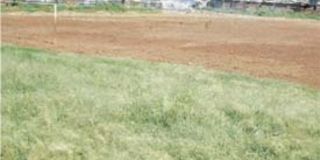
The Kihumbuini ground in Nairobi: Uneven surface, dusty when dry and a mud trap in the rainy season.
Take the expression “level playing field” for example. The phrase has been bandied around so frequently in the drone of local political debates that having to use it again can feel like chewing on a flat piece of chewing gum picked up from the pavement.
But how can anyone possibly avoid this phrasal tedium when discussing the state of public football grounds in Nairobi?
A single visit to Baba Dogo Sports Ground or Calvary Ground in Kayole among others is all one needs to understand just what it means not to have a level playing field, literally, that is.
Last week, Football Monda y visited Dandora, Huruma, Jericho, Baba Dogo and Kibera to see some of the spaces still available for a game of football in these neighbourhoods which are considered the cradle of Kenyan football.
This is a report not only of an acute shortage of football grounds in Nairobi and gross neglect and wastage of the few existing ones. It is also an account of the efforts of some committed Kenyans whose largely unrecognised but vital input at the base is perhaps the only thing saving the game from extinction.
It is also an indictment of Kenya Football Federation (KFF) whose successive management teams have failed to offer any direction and ideas on how to develop the game at the foundation.
Instead, all Kenyans have seen from the KFF men is endless bickering, vain posturing and an appalling lack of commitment to the good of the game.
Even to the casual observer, it’s apparent that failure to provide grounds has contributed immensely to the lack of growth in Kenyan football.
The few available grounds are not only a hindrance to the full development of talent but also extremely dangerous to the well being of the players, who risk terrible injuries in case of falls.
Although many quality players emerge from the countryside, it is usually the capital’s working class districts, which are the breeding grounds for football talent anywhere in the world.
However, lack of playgrounds has denied many Kenya youths an opportunity to develop their talent and improve their living standards through football like their contemporaries in other countries.
Communities in these areas not only have to suffer the indignity and misery and poverty, they also have, through sheer negligence by relevant authorities, been denied the chance to be entertained and improve their lot through the world’s most popular game.
Such is the crisis that the evenness of the grounds is not an issue for now. The desperation is for any empty space on which to play in.
The net effect of this failure to provide easily accessible football grounds in residential areas is that Kenya has been unable to foster the establishment and growth of neighbourhood teams, rivalries, and football traditions, which have been the backbone of club football in countries like England for over a century.
It is largely due to this that city football clubs with strong neighbourhood ties like Bedjos (Jericho), Black Mamba (Kaloleni) Hakati (Makadara), Umeme (Ziwani), Shauri Moyo Sportif (Shauri Moyo) among others, have remained stunted in the obscurity of their deprived precincts.
The football world is awash with stories of football stars risen from dusty bumpy pitches in shanty towns to the top of the game. Kenya is still nowhere near being a part of these fables.
So Join us on this tour of some of Nairobi’s public football grounds, or what is left of them.
We all know the story of garbage in Dandora but the extent of this problem only becomes clear when you take the final turn on the road to the offices of Dandora Youth Football Club in Phase IV of this neighbourhood also known simply as “D”.
The area behind Dandora Secondary School and the former Dandora Cinema, once reserved for residential development with roads, street lighting and sewer lines all provided, is now all under garbage.
Reports of violent crime have added to Dandora’s notoriety as one of Nairobi’s unsafest districts but the area councillor, Mogabe Were, is intent on bringing relief to the residents through football.
According to Godfrey Okoti, the Dandora Youth FC secretary, Were is spending his own money to fulfill a pre-election promise he made to Dandora residents to secure them a football ground.
“This is a community project. Dandora is known for many other negative things but I would like it to become famous for football and other sports. This ground will be able to hold over 20,000 people when completed.
"I believe it can make a small change in the economy of Dandora,” he says.
The grassless field situated between the Holy Cross Catholic Church and Tom Mboya Primary School is the only one available to Dondora residents, from Phase I to Phase V.
It has been secured with a perimeter wall all round and now, there are terraces coming up due to the efforts of the councillor. Floodlights and changing rooms are all part of the development plans.
People love to gather around the ground whenever there is a match. It is therefore not difficult to imagine the facility, complete with a well laid and green playing surface, mustering a big crowd when Dandora Youth take on rivals Dandora All Stars in a Dandora Derby.
Okoti talks of this rivalry with a quiver in his voice. “Initially, Dandora All Stars was the only team here. Then the young players, who felt they did not stand a chance in the first team, broke away to form Dandora Youth. So when these two sides meet, it is a match many Dandora residents want to watch,”
Do not be fooled by the ostentatious City Council of Nairobi signboard some 200 metres from Juja Road loudly proclaiming the existence of a Huruma Stadium somewhere in this deprived haunt. There is none.
Instead, the only ground the youth of Huruma have for a football field is a completely bare patch tucked in between tin structures, rickety kiosks and open sewers.
Apart from being home to several football clubs, this is the only playground available to the numerous primary and secondary schools in the area.
It was baked dry by the mid January sun when Football Monday dropped by but it’s not hard to imagine the mud bath it becomes when it rains. In one corner is a public toilet part of which is used as a changing room. We visit at the end of training for Huruma Youth.
Their coach, Milton Obote, is one of those who have refused to be put down by the difficult times. “When it rains, this stops being a football field.
It turns into a water pool but we don’t stop playing. We never even think of grass because none can grow here. It would mean the ground being closed for at least a year which is unthinkable. This is the only public field in this area and it is in use every day from morning to evening,” he says.
But Obote wishes there was grass and acknowledges that playing on such a rough surface does not bring out the best from his players. “The players try to adapt to the situation but it is difficult, they can’t tackle properly because they are more concerned about avoiding injury on the rough surface,” says Obote.
He also believes the Huruma ground can attract many people and generate revenue for the clubs if it is fenced and the surface rehabilitated. Work on a perimeter wall is in progress.
This is another illustration of the neglect of sports facilities in Nairobi. No grass, no fence no management. Just lonely goal posts sticking out on this desolate bare surface.
Across the valley from here, 13-year old Simon Thiong’o and his mates can see the magnificent Moi Sports Centre Kasarani, Kenya’s biggest stadium.
They have never played on grass on their Baba Dogo home pitch. As the only public ground in this area, it is home to several Nairobi Super League clubs like Baba Dogo United, Lucky Summer and Ruaraka FC.
From over yonder, players from Kariobangi Sports, Kariobangi All Stars and Kariobangi Sharks come to this murky section of the Nairobi River to train and play. This ground has produced, among other players, former Kenya Under-17 international Geoffrey Kokoyo, now with Ulinzi Stars.
An abandoned foundation excavation attests to the fight by Baba Dogo Sports Association, and the local residents to preserve this space from encroachment by a local manufacturing firm.
The land appears safe for now, according to Erasto Omondi, the Baba Dogo Sports Association secretary.
“We haven’t seen any moves lately so we hope they have seen the need to leave it to the young people as it was intended by the donor. It’s an asset for us and all we need is any well wisher to help develop it,” says Omondi.
Hidden away behind the rows of grocery and cereal vendors off the Nairobi-Nakuru highway next to the Kangemi flyover, is the Kihumbuini ground.
It fits perfectly the profile of a Nairobi football ground: uneven surface, dusty when its dry and a mud trap in the rainy season. This is the only available ground in a densely populated area.
However, according to the Kangemi United FC chairman Simon Mugo, good times are coming to this ground, the only one available to the people of Kangemi.
The ground has been closed since early December. The planting of grass is underway on a section of the pitch.
A benevolent Kenyan, whom Mugo declines to name, is behind all these developments. He says by the time the work is done, Kihumbuini will be the home to Kangemi United, complete with perimeter fence, a lush green playing surface, terraced stands for spectators, floodlights and drainage for the pitch.
The money, which Kenyan football needs to grow, is in the estates.
If we can attract 5,000-10,000 people to this ground on every match day, we can make enough money to sustain the local clubs and grow the economy of this area. A Kangemi United fan needs more than Sh100 to go and watch the team play at its present home at Nyayo Stadium.
If he lives in Kangemi, he will need only to buy a ticket. That little money is what we want,” says Mugo.
One of the oldest grounds in Nairobi, Woodley is the property of the Nairobi City Council and the venue of the annual Kiko Cup.
It is another case study in official neglect and wastage of city public sports grounds. It is now a rehabilitation centre for former street boys, a noble contribution to society but still a gross underutilisation of a facility with plenty of potential.
Mugo is of the opinion that if properly rehabilitated, Woodley would be an ideal home ground for a club like Gor Mahia, which has a huge support base in the adjacent Kibera slums.
“Being a smaller ground than their current home at the City Stadium, there would be more fans walking to and from the game and the atmosphere would be fantastic. The Gor Mahia management should seriously consider that,” says Mugo.
But the ground is not only without a perimeter fence, the pitch and the main stand are in dire need of attention.
Will Nairobi Town Clerk John Gakuo, whose energy has brought a sparkle to Nairobi, please include Woodley and other council football grounds in his future plans?
Nestled between Kayole I and Komarock Sector I, this ground, or what is left of it, was not meant to be a football ground. It has just not been grabbed yet.
It is hemmed in by a church on one side, a couple of nightclubs behind one goal and several structures in different stages of development on the remaining two sides.
Save for a small patch of green on one corner, there is no grass. In the corresponding corner is a puddle from the previous nights drizzle. In the middle are the remains of a protruding rock that has now been smashed flat.
A footpath runs diagonally across this field and often some pedestrians, unaware that a football match is progress, saunter casually across to their destinations only to suddenly find themselves dead in the middle of a mad scramble for the ball somewhere within the bounds of this unmarked field.
This is a busy venue. It is the only one within this vicinity and so players from Kayole, Soweto and parts of Komarock converge on the ground for matches from as early in the day as 10 am and the action does not stop until sundown, or the rains come. It is the only public football ground available for residents of Kayole and Komarock both very densely populated areas.
There are grounds inside Kayole but they belong to primary schools and are therefore not available to the public.