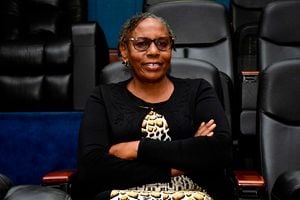
A legal dispute is brewing between Safaricom and Peter Oyier, a former television and radio news anchor, who is demanding over Sh69 million in compensation from the telecoms giant for the alleged unauthorised use of his voice in multiple projects over the past six years.
Mr Oyier has filed a copyright infringement suit in the Commercial Division of the High Court, accusing the company of continuing to exploit his voice, which is used in the Safaricom Voice Menu for platinum clients — high-value customers.
Mr Oyier claims that whenever a Safaricom client dials USSD codes — a system that allows a mobile phone user to interact directly with a service provider’s network without an internet connection — to access platinum services, it is his voice that guides them through the menu options, referred to as the Interactive Voice Response System (IVR).
However, he alleges that Safaricom has continued to use his voice on its IVR system long after the licensing agreements had expired. This has effectively locked him out of potential voiceover opportunities with competing brands and caused him severe financial harm.
“I am a vocal artist who has previously been a news anchor, a radio and events host. I also create voice-over content for different entities, including and not limited to movies, documentaries, advertisements, and interactive voice services,” Mr Oyier says in his affidavit.
“Over the six years of the defendant’s (Safaricom) use of my voice-over works, the voice has become synonymous with the defendant’s brand, negating my ability to get other jobs from competing or other brands because the public now associates the voice with the defendant.”
The dispute stems from a licensing agreement that Mr Oyier entered into with Safaricom through the telecom’s agent, MGM Studios, between 2018 and 2022.
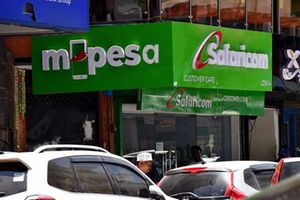
A Safaricom Shop. Peter Oyier, a former television and radio news anchor, has sued Safaricom, demanding Sh69 million in compensation.
Photo credit: File| Nation Media Group
These agreements covered five projects, including Safaricom Platinum Audio , Neo Home , and the Line 400 Revamp .
“The defendant and I, through their agents, entered into a licence agreement for voicing of interactive voice response (IVR) contents for use in their projects named Line 400 Revamp, commencing in June 2020 to June 2022. Safaricom Platinum Audio commencing in November 2018 to November 2020, Safaricom Neo home commencing in December 2019 to December 2021, Safaricom Neo scripts for line 400 and platinum respectively commencing November 2019 to November 2021.”
According to a Model Release Agreement (licence agreement) between Oyier and MGM Studios signed on November 6, 2018, each licence was valid for two years only, after which any further use of the voice recordings was to be renegotiated.
“I understand that the said material may, at the agency’s option, represent an imaginary or a real person. The copyright in the said material shall belong to the agency and or its client and shall have no rights to it or any of it for two years, renewable on agreement. I also agree that any person authorised or acting for the agency may also use the said material or any reproduction or adaptation for advertising. The agency and its licence, assignee, or client shall have unrestricted use of the said material for the two years, for whatever purpose they may think fit,” the Model Release Agreement states.
However, Oyier claims that, despite this licence agreement having expired, Safaricom has continued to use the voice recordings without a new agreement in place and, more critically, without his consent or further payment.
“The use of the IVRs was specifically for two years in each of the contracts, and any subsequent use after the lapse of the contracts was supposed to be renegotiated. The agreement lapsed in 2020, 2021, and 2022, respectively, but despite the lapse of this licence agreement, the defendant has continued to use the works to the date of this suit without renewal of the licence, consultation, permission and compensation.”
Oyier is seeking Sh69,281,729 in damages for conversion, which he says is based on his professional rate card.
'Deprived him of income, brand identity'
He argues that the continued use of his voice has deprived him not only of income, but also of his brand identity in the voice-over industry, to the extent that competitors do not want to associate with him as he is viewed as the 'Safaricom voice'.
However, Safaricom has denied Oyier’s allegations of copyright infringement and conversion.
In intellectual property law, conversion refers to the civil wrong of using someone else’s property for profit as if it were one's own.
The company has also challenged the basis of Mr Oyier's claims, stating that there is no binding agreement between the two parties.
“The defendant puts the plaintiff to strict proof regarding the allegations made. The defendant denies that it had a contract with the plaintiff on interactive voice response (IVR) content(s) or at all,” Safaricom says in its defence statement.
In this regard, Safaricom asserts that Mr Oyier cannot claim any payment from the company or hold it liable, as there is no contract between the two parties.
“The defendant denies the allegation of the plaintiff and maintains that there is no privity of contract between the plaintiff and itself. The defendant puts the plaintiff to strict proof of the allegations on the contrary.”
Mr Oyier maintains that Safaricom owes him the money and claims that he made several attempts to resolve the matter amicably, but his efforts did not bear fruit.
“I continuously sought the defendant out to renegotiate the contract and agree on payment of dues when work is used, without success. I even wrote a letter through my advocate and emails urging the defendant to make arrangements for settlement of the matter without going through litigation, but the same is yet to be acted upon,” says Mr Oyier.
The voice-over artist further argues that the dispute with Safaricom continues to hurt his livelihood while the company continues to generate profit from using his voice.
“My compensation by the defendant should not be a matter of back and forth, as it has been, because the continuous use of my voice over works in the IVR continues to injure my brand and the ability to work for other entities, rendering me jobless and incomeless. This, even notwithstanding other factors, like during the making of the IVRs, there were intensive scripts, which required long studio hours. Even further, the IVRs were also done in two languages (English and Kiswahili), which has continually offered greater benefit to the defendant’s diverse clients, increasing their profits substantially, as I languish in poverty for lack of jobs.”