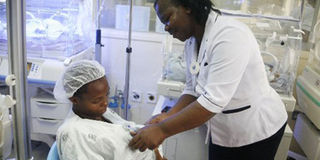
'Kangaroo care' trumps incubators for pre-term babies
Kenyatta National Hospital senior nursing officer, Florence Ogongo (right) shows a new mom how to hold her pre-term baby boy using the kangaroo mother care method. This simple practice of skin-to-skin contact is known as "kangaroo care" has gained traction and has quite a following globally. PHOTO/FILE
This simple practice of skin-to-skin contact is known as "kangaroo care" -- in a nod to the marsupials who carry their young in a pouch after birth to complete their development -- and started in Colombia more than 30 years ago due to a shortage of incubators.
After an initial bout of scepticism, it has become common practice in this South American country -- and has spread around the world.
Initially considered an "alternative for the poor," the practice was given a boost by the World Health Organization in 2004 when it recognized it as a way of promoting breast feeding and stimulating a child's cognitive development.
BOGOTA,
At Bogota's San Ignacio hospital, Cesar Algeciras often spends five hours straight in the neonatal intensive care unit, lovingly clutching his premature son to his bare chest.