When 44-year-old Ann Wambui walked into Fertility Kenya seven years ago, she was clutching hope like a lifeline. She and her husband had tried conceiving for 10 years. Every failed pregnancy test had chipped away at her faith — both in God and in herself.
“It felt like I was under constant judgement,” she says. “People said I must have done something wrong to be barren. It wasn’t an easy decision—IVF felt like my last hope. The journey was full of ups and downs: anxiety, hope, fear of failure and financial strain. But the support I received made all the difference, and I was blessed with twins. It was worth every tear and prayer,” she says.
The blessings of the children aside, it is the mixed reactions from her social and religious circles that she remembers most. “Some friends told me that IVF was unnatural, while others discouraged me from ‘playing God’,” she recalls. “But the birth of my twins changed everything—those who once doubted me now celebrate with me.”
Ann Wambui..
Photo credit: Pool
Faith, she says, sustained her. “I prayed every day for strength and guidance. There were moments I questioned God, but I also believe He works through science and medicine,” she tells Nation Lifestyle .
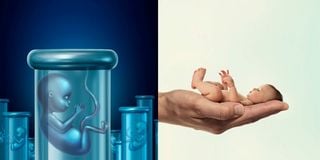
In an age where science offers new hope to couples struggling with infertility, the intersection of faith and fertility is more relevant than ever. Assisted reproductive technologies— from IVF [In vitro fertilisation], surrogacy, and sperm/egg donation—are transforming what it means to build a family. But while medical innovations are becoming increasingly common in Kenya, deeply rooted religious beliefs continue to shape how some people perceive these options. Does conceiving without intercourse raise religious concerns? What about the use of donor eggs or sperms, does this violate the aspect of marriage?
Dr Jane Nyambura, a fertility specialist at Nairobi Fertility Centre, breaks it down simply. “In IVF, we retrieve eggs from a woman, fertilise them with sperm in a lab, and implant the resulting embryo into her uterus. In surrogacy, another woman carries the child—either using her own egg (traditional) or a fertilised embryo from the intended parents (gestational).”
She notes that infertility affects one in six couples globally, and Kenya is no exception. “Some of our patients are in their 30s or 40s; others have faced unexplained infertility for years. Many turn to IVF as a last resort.” But it’s not just a medical journey. It’s emotional, ethical—andfor many—spiritual.
Sarah [who spoke to Nation Lifestyle on condition of anonymity] says her decision to try IVF brought a different kind of judgement —one from her own church. “I couldn’t tell my pastor. I knew he wouldn’t understand,” she says.
It was a dilemma that many Kenyan religious people face. In April 2024, the Vatican released a document, Dignitas Infinita (Infinite Dignity) , which drew a firm line in the sand. According to the Catholic Church, IVF and surrogacy are “gravely immoral practices” that distort the meaning of human dignity and family.
“The desire to have a child cannot be transformed into a ‘right to a child,’” the document states. Cardinal Víctor Manuel Fernández, Prefect of the Dicastery for the Doctrine of the Faith, went further: “The elimination of embryos, whether for selection or experimentation, is a crime against human life.”
In IVF procedures, multiple embryos are often created to increase the chances of a successful pregnancy. However, not all embryos are viable—some may be genetically abnormal, fail to develop properly, or simply not be needed after a couple achieves pregnancy. These embryos are then either discarded, donated for research, or kept in frozen storage indefinitely.
And on surrogacy, it says: “A woman’s body should never be rented. Surrogacy treats the child as an object of a contract, not a subject of dignity.”
The Catholic Church maintains a firm stance on reproductive technologies like IVF and surrogacy. According to the Vatican document Dignitas Infinita, procreation must arise from the conjugal act within marriage, not through scientific intervention.
“Children must always be recognised as a gift,” the document states, cautioning against transforming the desire for a child into a “right to a child.”
However, the Church urges compassion for couples facing infertility but adds that “suffering can have spiritual value,” suggesting that not all problems require a scientific solution.
While the Bible may not give explicit instructions on assisted reproductive technologies like IVF or surrogacy, Jane Opar Okello, a pastor of CLC Family Church, Nairobi, says scripture offers a guiding spirit.
Pastor Jane Opar-Okello, senior pastor at Christ Life Chapel poses for a picture after the interview on May 23, 2025.
Photo credit: Francis Nderitu | Nation
“The Bible does not expressly instruct on this matter,” she explains, “but the spirit of the letter offers us a guideline on pro-life and pro-happiness choices. Just as medical interventions like organ transplants save lives, IVF and surrogacy offer solutions to infertility and bring joy to families.”
Ms Okello encourages Christian couples facing infertility to proceed with prayer, wisdom and agreement. “They should prayerfully and soberly consider the options available and affordable to them, then consult widely within the medical fraternity. Involving their spiritual authority is necessary for the much-needed psycho-social support.”
On using donor eggs, sperm or a surrogate, she challenges rigid interpretations of God’s design for family. “God’s design is simple — a father, mother and children. Whether the children are adopted, fostered or from surrogacy, they are legitimately family. We ourselves were adopted into God’s family,” she says.
She also counsels compassion for couples devastated by failed IVF or multiple losses. “These are man-made interventions and they can fail — and they are costly. But faith in God, not just the process, must guide the couple,” she adds.
She notes that while stigma still lingers in many churches, there’s an ongoing shift. “Some churches still believe these interventions are anti-God. But as we understand God as a loving Father, we will embrace scientific interventions. In many instances, science has offered more practical solutions to mankind than faith without action.”
No third-party involvement
Sheikh Abdullatif Sheikh, of the Family Resource Centre at Nairobi’s Jamia Mosque, offers a more permissive—but structured—Islamic view.
Sheikh Abdullatif Sheikh, of the Family Resource Centre at Nairobi’s Jamia Mosque.
Photo credit: Pool
“In Islam, IVF is allowed under strict conditions,” he explains. “The sperm must come from the husband and the egg from the wife, and the embryo must be implanted in the wife’s womb. No third-party involvement.”
In other words, no donor sperm, donor eggs, or surrogates. But couples are increasingly buying donor eggs or donor eggs where the woman or man are unable to produce their own to create a baby. They pay from Sh30,000 to Sh100,000 per donation cycle, depending on many factors.
Surrogacy, also, though still a contentious issue in many religious and legal circles, is increasingly becoming a sought-after option for Kenyan couples facing infertility. The woman who agrees to rent out her womb is paid anything from Sh800,000 to Sh3 million, depending on the agreement with the commissioning parents and the number of foetus she is carrying.
“You can’t borrow a womb,” the Sheikh says. “Surrogacy is not allowed in Islam. It introduces confusion—who is the mother, the egg donor or the carrier? In matters of inheritance and lineage, clarity is essential.”
He adds that even within polygamous marriages, it is impermissible to take the egg from one wife and implant it into another.
What about unmarried women using sperm banks, as has been a trend among financially independent and career-driven Kenyans choosing to embrace motherhood without waiting for marriage? “That’s haram,” he says. “Islam strongly upholds family structure. A woman cannot bypass marriage just to fulfil the urge for a child.”
Infertility has over time proved to be a silent grief, often carried behind closed doors. For Cecelia Karanja, it became a defining part of her life—and later, her mission. The counsellor and founder of Fertility Kenya recounts a deeply personal journey that spans 11 years, marked by stigma, rejection, and healing.
Cecelia Karanja is the counsellor and founder of Fertility Kenya.
Photo credit: Pool
“I was married and divorced twice—all because I couldn’t have children,” she says. In her first marriage, doctors diagnosed her husband with a low sperm count, but he refused treatment and pinned the blame on her. “The emotional abuse and pressure from his family became unbearable,” she recalls.
They eventually parted ways. Her second marriage wasn’t kinder. Tests revealed Cecelia had blocked fallopian tubes and she needed Sh300,000 for laparoscopy surgery to unblock them. “My then-husband refused to support the procedure. He left and married someone else,” she says. But that betrayal became her turning point. She saved up, had the surgery, and later remarried. Today, she is a proud mother of three.
Out of her pain, Fertility Kenya was born in 2016. “There’s so much ignorance and silence around infertility in Kenya,” she says. “I wanted to create a space where people felt seen and supported.” Since its founding, the organisation has helped over 6,000 members access information, treatment options, and emotional support.
Among those who have found refuge in Fertility Kenya is Agnes, who spent nearly a decade trying to conceive. After multiple ectopic pregnancies, her marriage crumbled. Though doctors recommended IVF, Agnes and her devout Catholic family dismissed it as ungodly until her husband couldn’t hold it any longer. He relocated to the US and remarried.
“Even my sisters told me to just take their children and call them mine,” she says. But five years of gentle counselling, changed her outlook. She gave IVF a chance and through a donor sperm, became a mother to a four-year-old boy. “The same people who once judged me now celebrate my son,” Agnes says with pride.
Fatima, a Muslim, also tried IVF for six years using her own eggs—unsuccessfully. When advised to use donor eggs, she declined firmly, citing her religious beliefs. “It’s unholy to accept another woman’s egg,” she told her doctors. Cecelia and her team respected her decision and continued to offer support. “We walk with our members, whatever their choices,” Cecelia says.
Theological clarity, however, doesn’t always ease personal pain. “We tried IVF twice,” says Peter and Lydia (not their real names),
They stopped attending church for six months. “It hurt. We were already vulnerable, and instead of love, we got judgment.” Their IVF attempt failed, but they’re considering adoption next. “We’ve made peace with what we can’t control. But the stigma still lingers.”
In contrast, Amina (not her real name), a Muslim woman who recently underwent IVF within the boundaries of Islamic law, speaks with relief. “Our Imam guided us. We ensured it was my husband’s sperm and my egg, and the embryo was placed in me. No shortcuts. Alhamdulillah, we’re expecting twins,” she adds joyfully.
Dr Nyambura, the fertility specialist, says the biggest challenge isn’t science—it’s the emotional and spiritual dilemmas couples face.
She adds that some fertility clinics in Kenya also avoid involving third-party donors due to both religious opposition and legal ambiguity. “We always ask—what is the intention behind this? Is it ethical? Is it transparent? We don’t want to become a black market for desperate hope.” She believes that collaboration between clergy and clinics could ease tensions. “We need open dialogue. When faith and science sit on opposite sides of the room, the ones who suffer are the patients.”
Back to the Vatican’s position: Dignitas Infinita makes a crucial distinction—it’s not against the desire for children, but against turning that desire into a demand that justifies any means. “It’s not compassion to promise people a child at any cost,” said
“God gave us minds, doctors, and discoveries for a reason,” says Lydia. “Science isn’t anti-faith. Sometimes, it’s the miracle.” As Kenya modernises and globalises, more couples will face these ethical crossroads. IVF clinics are expanding, laws are still lagging and
Sarah, who’s still holding onto hope, captures this tension well. “We don’t want to go against God. But we also don’t want to live
For now, she and her husband are doing what most people of faith do when science and religion don’t quite align: they wait, they pray and they hope. Ann Wambui’s message to others: “Don’t let stigma or religion steal your chance at motherhood. IVF is not shameful—it’s courageous.”