What does a Kenyan town look like in the year 2125? San'aa Njeeri's 'Area Nyaga' is a virtual world where ancient tradition meets high-tech innovation.

Eight years ago, the digital art world paused and watched as images of Maasai elders and warriors drifted across galaxies. The series, titled MaaSci — a fusion of the words Maasai and sci-fi — reimagined tradition not as relic, but as future.
For creator Jackie Njeri, who now goes by the name San’aa Njeeri, the project became more than a visual experiment. It altered the course of her life.
“MaaSci was so precious it fundamentally reordered my life’s trajectory,” she says. “Everything happening around MaaSci was beyond anything I had planned for myself.”
But MaaSci was never just about outstanding aesthetics. It was an act of radical imagination, placing a Maasai woman at the helm of a spaceship and inviting audiences to do something powerful – to visualise that possibility as real.
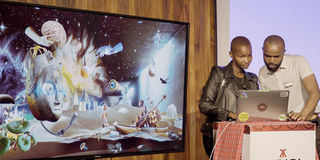
Visual artist Jackie Njeri a.k.a San’aa Njeeri launches "Area Nyaga," a VR-designed reimagining of Kirinyaga set in 2125, where Maasai space explorers return to earth as custodians of a tech-hub called "ScrapVanna".
Now, Njeeri is building on that legacy.
Recently, at Baraza Media Lab during an event dubbed Storytelling for the Future: A New Format Community and Worldbuilding Salon, she unveiled her latest vision: Area Nyaga — a futuristic reimagining of present-day Kirinyaga set in the year 2125.
A town built from memory
On her blog, Njeeri describes Area Nyaga as a world where "innovation thrives on the forgotten, and the boundaries between art, technology, and culture blend into a spectacle of possibility". It is a landscape inhabited by the MaaSci, who have returned from their space expeditions to become "the custodians of ScrapVanna," a tech-hub housing relics like vintage code scripts and defunct AI prototypes.
Njeeri writes that for these inhabitants, "innovation doesn't begin in a lab, it starts with curiosity, reverence for history, and a desire to build sustainably".
Njeeri’s vision is not a solitary one. She plans to have the virtual land of Area Nyagah co-designed with other African visionaries using Virtual Reality (VR).
“I created a collaboration manual for anybody who is in this room that feels inspired to work together towards a shared goal,” she announced.

Building African worlds in VR
To bring this to life, Njeeri is partnering with Brian Afande, CEO and co-founder of Black Rhino VR, a Kenyan-based Extended Reality agency. Together, they aim to create a space where Africans can build their own worlds.
Afande’s journey into VR began in 2013, sparked by Facebook’s landmark $2.3 billion (Sh296 billion) acquisition of Oculus. "We started a VR studio just by buying a developer's kit and a 360 camera," Afande says.
Today, his core focus is building tools that allow young people to access technology without code.
"Reality doesn't have to be tangible," Afande explains. "If I create a space, let's say an alien planet, and you go to that planet using the headset, it’s a different reality. When you go to the metaverse, it’s actually real people. If you see an avatar, it’s a real person with emotions and feelings."
He likened it to a popular game, Ready Player One: OASIS beta, a free-to-play VR experience that allows players to explore, compete, and battle in a somewhat early-stage virtual universe.
As part of the preservation of history, Afande’s company is working on a project, Echoes of the Ancestors, that uses LiDAR (Light Detection and Ranging) technology to document material culture. LiDAR uses laser pulses to calculate distances, enabling the creation of precise, real-time 3D mappings of physical objects.

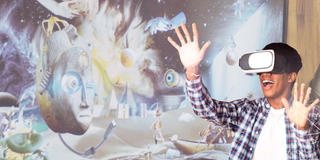
Gaming fans sample Samsung's Gear VR powered by Oculus at the Los Angeles Convention Center.
By scanning cultural artefacts, they create digital replicas in "point cloud data." However, Afande insists that technology alone is not enough.
"If you take these artefacts and put them on a website without information from the community they come from, then they're useless," he says.
Partnering with researchers and the historic record label Tamasha, they are ensuring these "cultural reference points"—from musical instruments to aesthetic designs—are preserved with their stories intact.
"When colonisers came, they took cultural items they called ‘artefacts.’ These are cultural reference points," Afande notes. "How do you go forward if you don't know what was behind?"
Central to this new world is the philosophy of Sankofa, the Akan symbol of a bird with its head turned backward. For Njeeri, this represents a vital instruction to "go back and fetch" what has been lost or forgotten.
"Area Nyaga is one of the philosophies called Sankofa," Njeeri explains. "Through that cycle, [we] create someone who has a big understanding of their roots."
She views this as a reclamation of identity, arguing that “decolonisation begins with remembering who we are."
“We do not believe we can do the things that we say we can do because we forgot.”
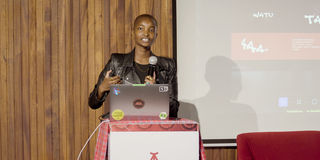
Visual artist Jackie Njeri a.k.a San’aa Njeeri launches "Area Nyaga," a VR-designed reimagining of Kirinyaga set in 2125, where Maasai space explorers return to earth as custodians of a tech-hub called "ScrapVanna".
This cultural remembrance is now being pitted against the "vicious" digital landscape of Artificial Intelligence. Njeeri is vocal about the risks of Africans merely "onboarding" to technologies inherited from the West without finding their own place in the ecosystem.
"Right now the fight is to fix Africa in the AI ecosystem," she warned at the Baraza event. She pointed to the stark reality that while AI is built on "collective information," its benefits are often concentrated, leaving "the rich getting richer" while others feel "hopeless."
"If I, as a tech-savvy person, cannot harness the full power and potential of AI, what does that mean for the person with the image?" she asked, highlighting the urgent need for digital literacy to ensure these ideas become "executable" rather than just concepts.
For Njeeri, the solution lies in Ancestral Intelligence—merging cosmic systems with ancient philosophies and human intelligence. "I believe human intelligence is sacred," she says. "Nothing will ever come against human intelligence."
Area Nyaga is ultimately a "brave call to action" for a new generation of progressive Africans to build their own narratives. By looking back through the lens of Sankofa, Njeeri wants to ensure that when the children of 2125 look at the skyline, they see buildings inspired not by London or Dubai, but by their own architectural philosophies.
"The future is not mystical," she concludes. "The future is what we're doing now to change what is coming."
Follow our WhatsApp channel for breaking news updates and more stories like this.