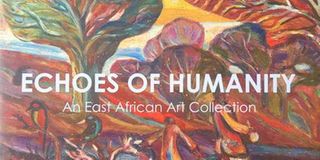
For anyone interested in East African art – whether living here or visiting – an important book has just been published. Its title is ‘Echoes of Humanity: An East African Art Collection’.
It features a private collection, some of which is now on show at the Red Hill Art Gallery in Tigoni. The authors are Hellmuth Rossler, his wife, Erica Musch-Rossler, and their co-writer, Zihan Kassam Herr. The collection belongs to Hellmuth and Erica, and it is normally housed in their home.
In his Foreword to their book. Michael Armitage, the artist and founder of the Nairobi Contemporary Art Institute, writes the following tribute.
‘This book offers an opportunity to engage with the extraordinary collection assembled by Hellmuth and Erica – an endeavour that reflects not only their passion for the visual arts but also a deep and sustained commitment to supporting artists across the region. Over the years, Hellmuth and Erica have demonstrated an exceptional sensitivity to artistic practice, nurturing both established and emerging voices, and creating space for their work to be seen, discussed and celebrated.’
The story of how they acquired their many paintings and sculptures began in 1992 when they were both working for Save the Children in Somaliland. On a ‘rest and recuperation’ leave in Nairobi, they visited the Gallery Watatu in Standard Street, and they met Ruth Schaffner, the gallery Director.
She introduced them to several artists whose work had been on display at her gallery – many of them unschooled in their art but creating with what Ruth Schaffner called ‘authentic and genuine talent’.
And, so, Hellmuth and Erica discovered a vibrant art scene that was the beginning of their own journey through East African art – and their beginning to collect many items of it. Their own work with Save the Children took them through Tanzania, Uganda and Sudan, as well as Somalia and Kenya. They also visited Namibia and Zimbabwe.
When Hellmuth and Erica retired in 2010 they stayed in Kenya, and they decided to showcase their art collection in a gallery they built in their lush Tigoni garden. As they wanted, they made it light and airy, and it has a curved glass mosaic across its floor – one made by Nani Croze, whose stained-glass works can be seen in many buildings in Nairobi, as well as at Kitengela Glass near Ongata Rongai.
Over the years, the Red Hill Art Gallery has hosted exhibitions from the private collection, as well as many solo and group shows. As the gallery website says, its mission is to ‘provide a platform to support and promote our local creative talent, and to contribute to the national and international recognition of contemporary art in Africa’.
‘Echoes of Humanity’ has a comprehensive and excellent section describing the changing art landscape in Kenya since Independence. For me, it has triggered many memories. It has taken me back to 1969 when, at the end of my two years’ secondment here, I bought at Gallery Watatu one of Robin Anderson’s hand-printed silk batiks to take back to the UK. That was soon after the gallery had been founded by the artist Yoni Waites, together with Robin Anderson. In those days, I suppose the main clientele of the gallery were expatiates like me!
In those early years, Elimo Njau’s Paa ya Paa Arts Centre became an important focal point for young artists and not-so-young art lovers. It was in the middle of the city before it moved to Ridgeways along the Kiambu Road. I will never forget the discussions I had there with Elimo, Okot p’Bitek and other friends.
And my sons have fond memories of the Mother Christmas children’s parties at Ridgeways organised by Elimo’s wife, Philda, who brought her music to Paa ya Paa along with all the paintings and sculptures. It must have been a splendid moment for them at the book’s launch at the Red Hill Art Gallery when Elimo and Philda arrived to find a huge chocolate cake for celebrating Elimo’s 93rd birthday.
Finally, I will just mention two contrasting art galleries that are open now. First, the Banana Hill Art Gallery, founded in 1992 by the artists Shine Tani and his wife Rahab. It is located in a busy road in the township in the outskirts of Nairobi with its motley collection of kiosks, shops, bars and churches. But, inside, there is quiet and a surprising display of works by local artists. The second is in a very different setting.
It is the One Off Contemporary Art Gallery in the leafy upmarket Rosslyn Lone Tree Estate off the Limuru Road. It was registered in 1994, and it represents some of the leading names from East Africa. Apart from a regular schedule of exhibitions each month, it has a very extensive collection of works for sale, a shop selling artistic merchandise and a sculpture garden.
‘Echoes of Humanity’ features the work of 47 artists from Kenya, 10 from Sudan, 16 from Tanzania, eight from Uganda, seven from Zimbabwe, three from Namibia, one from Egypt and one from Zambia. It is a heavy book – but not in its writing or presentation.
The many paintings have been beautifully photographed and presented. There are also photos of sculptures. Having collected a few Makonde sculptures in my own travels in Tanzania, I particularly enjoy those on display in the book.
I don’t think there is any other book on East African art that is as comprehensive as this one. Hellmuth and Erica have made a most significant invitation to those who would like to share something of what they found on their journeys across Africa. Right now, ‘Echoes of Humanity’ can only be purchased from the Red Hill Art Gallery, but it will soon be on sale in the bookshops.