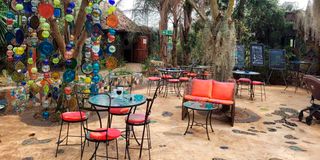
Kitengela Glass is near Ongata Rongai, out on the Athi-Kapiti Plains and overlooking Nairobi National Park. I hadn’t been there for years, and I had heard that there have been changes. Changes? It’s a transformation, as Lut and I found when we went there a couple of weeks ago.
‘Where should we start?’ Lut asked as we arrived.
It’s at the entrance, and it looked so attractive with its old-man’s-beard on trees, hanging balls of coloured glass and mosaic glass tables and chairs. They call it the Glasstronomique Café – just one of the witticisms that you see in notices all around the place. On the Kitengela Glass website, the café promises plant-based fare, good coffee, teas, sodas, milkshakes, beer and wine.
So I quickly ordered a glass of house red wine. I should have been more patient, because when I read through the menu I saw that they also have the award-winning Procera gin and tonic, at a very reasonable price. It’s the very special gin produced in Kenya and earning itself a great reputation around the world. But that’s another story.
As for food, the café has a small but imaginative menu. Here are two examples: breakfast sandwich of two eggs on fresh croissant, layered with halloumi, crisp tomatoes and rocoto warm red pepper; pizza zucchini with goat’s cheese and sun-dried tomatoes. There are also home-made ice cream and sorbets, milk shakes and smoothies – all of many different flavours.
The sun was shining for our lunch; then we moved to the nearby darker, hotter and fascinating place – the glass blowing studio. This is where discarded glass is made molten in the furnace, blown into bubbles and shaped into amazing and artistic objects – many kinds of drinking glasses, bottles, vases, wind chimes and even chandeliers.
This is how the website defines the mission of the place: ‘We recycle and reimagine waste into objects and experiences that have a future, serve a function, and spark joy. We’re here to embed glassmaking as a living African craft — rooted in this place, speaking a global language of beauty, resilience, and innovation’.
It goes on to say ‘We run a working studio, open to the public, where visitors experience the heat, rhythm, and magic of glass in motion.’ That is where we were, and that is what we experienced – the magic of glass in motion. But we were just spectators.
You can actually participate: for three minutes blowing a giant bubble; for 15 minutes at a glassblowing bench, shaping a paperweight; for 30 minutes, blowing a glass from start to finish. For further details on these opportunities – the charges and how to apply – go to the website.
It is an excellent website. As well as a presentation on what the place is and does, and a graphic description of its various products, it tells the story of the owner, Anselm Croze, and his mother, Nani. As a youngster, Anselm went to Holland to learn the skill of glassblowing and the technique for building a furnace.
From a distance, it is the tall, cone-shaped, brick furnace that stands out. It took about four years to build in the early 1990s. There was no mains electricity, so Anselm used recycled engine oil to heat the furnaces and melt the glass. The local masons who were involved in the construction became his first apprentices.
As for having an artist’s sensibility, this was inbuilt, so to speak – his mother, herself the child of an artistic mother, has decorated many places in Nairobi with her paintings, concrete relief murals and stained glass. Nani Croze made Kitengela Glass a magical fairyland of zany cottages and whimsical sculptures. Whenever I visited her, I always shared her company with her tame Egyptian vulture, a crested crane, and many dogs. It seems she has a Pied Piper effect on animals; but, in a way, she was trained for it.
After studying English literature at Exeter University in the UK, she went to work at the Max Planck Institute in Germany, the country where she grew up. She was one of the ‘goose girls’ for the famous Konrad Lorenz, who was carrying out research on bonding and imprinting. After marrying Harvey Croze, an animal behaviourist researcher, the couple move to the Serengeti.
After four years, in 1970, Nani, Harvey and their three children moved to Kenya. For a time, they lived in Tigoni – until they had a picnic on the Athi-Kapiti Plains. They were struck by the beauty of the place, with its riverine gorges. They decided to build a house and a workshop there. And that was the beginning of Kitengela Glass.
For a time, Nani’s stained glass and bead-making was separate from her son’s glassblowing enterprise. But now Nani has retired, Anselm has taken over both businesses. He has upgraded Nani’s house – the house where he grew up. He has created Nani’s Wonderland – a garden that preserves much of her art works, glass walkways and her fairyland sculptures.
He has established the delightful Glasstronomique Café. The shop is much bigger than before, and it has an amazing variety of products for sale. In addition, the zany but rickety cottages have been seriously and cleverly upgraded. So there are now five cottages that can be rented for short or long-term stays. If you do stay, there will be plenty to amuse, impress and inspire you. Go to the website for more details of the cottages.
There are two ways of getting to Kitengela Glass after the turn-off from the Magadi Road just before Ongata Rongai: by driving on a winding, mainly murram, road or walking across a ‘scary’ hanging bridge from near Maasai Lodge. Again, check the website for its very clear directions.