It wasn’t altogether the kind of holiday at the Coast we had intended. With one of our party admitted to Mombasa Hospital, we spent more time in the city than at the beach. It was a chance to get to know the city a little better.
You see much more when you walk on the pavements than when you drive along the streets, don’t you? And if you have an eye for the history of a place, then Mombasa – founded hundreds of years before Nairobi, visited long ago by Chinese and Indian traders, fought over by the Portuguese, the Arabs and the Swahilis, taken over by the British – Mombasa has plenty of history to keep you interested, and even entertained.
For instance, I have driven past the bell tower at the Nyali Junction so many times. I must have seen it – but never really noticed it. Do you know what it is and why it is there?
The bell was erected in the 1880s, so I have learned, by the Society of Freed Slaves to warn the people of Freretown of an imminent attack by Arab slavers. And Freretown was named after a British diplomat, Sir Bartle Frere, who was very influential in the suppression of the slave trade.
The first Freretown community was set up in 1873 on the promontory just north of Mombasa Harbour. They were slaves from Nyasaland (now Malawi) rescued by a British Royal Navy ship when they were on their way to be sold at the big slave market of Zanzibar. Later, the settlement was moved further inland to 50 acres in Kisimani along the Mombasa-Malindi Road – where the Freretown name is still used.
As for the bell at the Nyali Junction, it is a plastic replica. In the 1920s the original was moved for safe-keeping to the nearby Emmanuel Church.
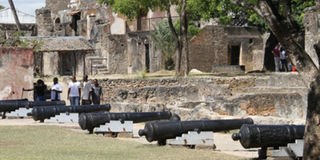
Of course, the National Museums of Kenya packages Kenya’s history very neatly and attractively and, as its Fort Jesus Museum is so close to the Mombasa Hospital, we took the opportunity to make an afternoon visit.
For a place with the most gentle and pacifist of names, Fort Jesus has had an incredibly turbulent and bloody history. You will know that the Portuguese sailor/explorer, Vasco da Gama, visited these parts in the late 15th century. He got a rather hostile reception at Mombasa, so he sailed on to the friendlier Malindi, where he established the first Portuguese base in East Africa.
But when the Turks made a fort at Mombasa in 1589, the Portuguese were afraid that their route back to Europe might be cut off, so in 1593 they began to build their own much stronger fort at the entrance to the harbour.
The Portuguese at that time regarded themselves as the representatives of Christendom; they sailed under the flag of the Order of Christ – and so they thought Fort Jesus would be an appropriate name.
I’ve picked up all this from the Museum’s small give-away leaflet. It goes on to summarise the Fort’s many changes of fortune over the next four centuries: takeovers by the Sultan of Oman; Portuguese recaptures; re-takings by the Sultan; mutinies against the Arabs and re-occupations by the Portuguese; declarations of independence by the Swahili Mazruis; protections and bombardments by the British; conversion to a prison; declaration as a National Monument.
Better, of course, to enter through the gates, saunter across the lawns, peer down the deep wells, climb the stairs, walk the ramparts, squint through the gun slits – feel the character, savour the atmosphere, and imagine the history of the place.
The main exhibitions are on the eastern side of the fort where the soldiers’ barracks used to be. The displays give you a good idea of Swahili and Mijikenda cultures – a good idea, too, of the trading that went on across the Indian Ocean. There is an excellent display of pottery; some of it over a thousand years old and a surprising amount of it from China. (There was a group from the new wave of Chinese visitors looking with obvious fascination at the display cases.)
In 1697 the Portuguese ship, the Santo Antonio de Tanna, sank in Mombasa Harbour while trying to break one of the many sieges of the Fort. Over a thousand objects – from armaments to jewellery – have been recovered and many are on display in the museum.
And when you have had enough of looking at pots, cannon balls and brooches, you can browse the gift shop, sit in the shade of a tree in the inner garden or, better still, sample a refreshing lime juice in Amina Loo’s kiosk on the high walls, with a view out to the Indian Ocean.