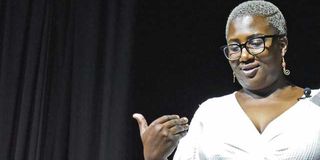
It was three Sundays ago. I had a ticket for Wakio Mzenge’s performance of “Elements” at the McMillan Memorial Library — a drama by John Sibi-Okumu and a production sponsored by the Italian Agency for Development Cooperation.
It was also the day Arsenal were away to Chelsea — a crucial match I didn’t want to miss. My ticket was for the afternoon showing of the play; the Arsenal match was in the evening — so I thought I would be able to see both.
John Sibi-Okumu calls his “Elements” a monologue; Wakio has made it something else. She has made it a solo drama, where her actions are as important — probably more important — than the words of the original script.
I will never forget her enactment of domestic violence. I have seen so many live theatrical performances, both in the UK and here in Kenya, as well as in cinemas and on TV — and I can’t recall anything as powerful as what Wakio did.
When she left the stage, the applause was loud and long. Then there was the opportunity to discuss the issues that the play had raised. I saw no one leave. There was no way I could go home to watch a football match.
As John Sib-Okumu says in his Collected Plays (available at Prestige Bookshop in Nairobi) the character, Dana, is a well-known writer. She is living in Atlanta in the USA. Her apartment is sparsely furnished, but the décor suggests that she is well travelled around the world.
A lion sculpture at the McMillan Memorial Library in Nairobi on July 17, 2019.
Photo credit: File | Nation Media Group
From the many books on the shelves, it is also clear that she is well read. And among the books are a number of novels she has written. Dana is alone. Her second husband, Philippe, is not yet home. She is clearly somewhat agitated, and she pours herself a drink. Sibi-Okumu says it is wine, but in the drama we watched it is whisky. (I wonder if there is any significance in the switch!) She turns on some music; it is a guitar solo by her musician son, Stéphane, who had committed suicide. It is the anniversary of his death. The phone rings, and she turns off the music to take the call
What follows — for the whole duration of the play — is Dana’s preparation for a presentation about her work as a writer that she will be making at a conference. In a call with her Aunt Eliza, she claims she is bearing up, but after the call she says that she is not bearing up at all.
She tries to concentrate on her preparation. She mouths her introduction; she anticipates the questions she might receive from the audience, and she composes her responses. She reflects on how people have been puzzled about where she comes from — whether from England, from Ethiopia, from India, of from Africa. Her father was Kenyan; her mother came from Jamaica; her paternal grandfather was Indian. ‘I came to the conclusion,’ she says, ‘that, based solely on the way I looked, I could claim to be coming from any of the five continents.’ Her childhood was in England and, before settling in the USA, she had been educated in Kenya and France. She had also travelled to Senegal. This multi-cultural identity, means that women from across the world who watch “Elements” can more readily identify with Dana as she shares her experiences and reveals her issues.
She reflects on the traumatic experiences in her own life – being sexually abused by her father; finding out that her first husband, Bienaimé, was cheating on her; mourning the death of her son and feeling a growing separation from her daughter, Sonia. At times, she reads aloud passages from her own novels; the most harrowing of which are about brutal domestic violence, the rough circumcision of a Somali girl, and a famous model who becomes a prey to depression and alcoholism.
A few days after the production, in the company of Manka, administrator of the newly-formed Nairobi Writers Club, we had meetings with both Wakio Mzenge and John Sibi-Okumu. Wakio talked about how, in preparation for her first performance as Dana, she had worked at understanding why this woman, feeling isolated and lonely, was so distraught. Wakio described a time in her own career when, though well-recognised for her success in acting, nevertheless had also felt isolated and lonely. ‘
Built in 1931 in memory of William Northrup McMillan, the Mac Millan Memorial library is arguably the oldest library in Kenya. It is located along Banda street in Nairobi. PHOTO| TOM MWIRARIA
“I began to recognise the different layers of that experience,” she said, “and I began to feel that I was in her shoes.” She also began to wonder if Dana was feeling guilty because she felt she had not been a good mother. That, perhaps, is why in the performance Dana’s son has committed suicide rather than being killed in a car accident, as is written in Sibi-Okumu’s script.
Wakio said that her being in the shoes of a character means that, on stage, she sometimes speaks what she feels rather than what is in the script — something that can upset a play’s director, who might think that she doesn’t know her lines.
But the writer, Sibi-Okumu, clearly appreciates how Wakio interprets his drama. He says that she is the reason why “Elements” has been performed more times than any of the other five plays in his Collection. I feel sure that there will be many more performances of this play in Kenya, as well as in other countries. In fact, when we met Wakio she had just returned from making two presentations in Bloemfontein in South Africa.
One significance of this solo drama being performed and discussed at the McMillan Memorial Library is that the Book Bunk organisation is achieving one important objective of its renovation work at the library — that it should be more than a repository of books and be a place for cultural events and exchanges. But when I looked up at the ceiling and saw the large brown stains of water damage, I realised that there is also a lot more physical renovation to be done.