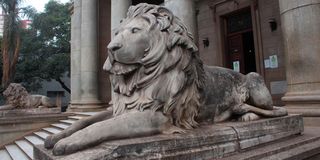
I have another ghost story for you. It was last Monday morning, as I was enjoying a coffee on the terrace, when it appeared. Come, to think of it, that’s where all my ghost guests have appeared. He was a big man, a massive man, dressed in a dark baggy suit and tie.
I knew who he was. I recognised him from photographs of someone I had recently looked up on the website of Book Dump, the organisation carrying out an extensive renovation of the McMillan Memorial Library.
‘Good morning,’ I said, ‘You must be Sir William Northrup McMillan.’
‘That’s right,’ he replied. ‘I know from my ghost friends, particularly Lord Delamere and Elspeth Huxley, that you enjoy talking with ghost characters from Kenya’s past. I saw you yesterday at the play, Elements, that was being performed at my library. An amazing theatrical story. So I thought I would pass by and tell you something of my own life – also quite amazing, I think. But I feel sure, as you will know, though ghosts have difficulty feeling anything, you will already know a few things about me.
‘Yes, I do. You were an American billionaire; you came to Kenya on a big game hunting safari in 1904; you liked the country, so you settled here, having bought 19,000 acres of land around Thika. You had a fine house in Nairobi called Chiromo, which you let to many celebrities, including the man who became the American President, Theodore Roosevelt, and his son.
You were buried high on the mountain Ol Donyo Sabuk. Your wife, Lucy, had the McMillan Library built as a memorial to you. Oh, another thing. It is said that you were seven feet tall and so wide that you had to pass through doors sideways.’
‘That’s all correct, though I think that bit about passing through doors sideways is something of an exaggeration! But would you like to hear more of my story? I think you will find it quite amusing. So, what follows is what he told me.
Before I came to Kenya, like Donald Trump (a man who must be often in your thoughts these days) I made my money, a lot of it, in real estate. Then I had that hunting safari in Kenya. I was so keen to shoot a lion. I managed that – as well as shooting many other animals. If I was alive these days, I guess, I would feel bad about that. But I would also think that people should be judged by the standards of their time. And, of course, we should really celebrate those who positively change those standards.
I bought my 19,000 acres here, my Juja Farm, at what must now seem a ridiculous price. But remember a British pound bought far more then than it does now. The name of the farm comes from two small statues, Ju and Ja, I brought over from West Africa. They were the subject of many superstitions, one of which was that I would die at sea.
Eventually, my wife had them buried somewhere in the Ndarugu Valley, and she never told anyone about the actual site.
I also had the Chiromo House in Nairobi. I loved entertaining, and I guess that is why I put on so much weight. I enjoyed letting Chiromo to visitors to East Africa. I guess I was the first person here to have what you now call an Airbnb. The most famous of the guests was Colonel Theodore Roosevelt – soon to become President of the United States – and his son, Kermit. One night, after a boozy session at the Norfolk Hotel, the two of them stole two stone idols at the gates of the Khoja Mosque. They placed them each side of the fireplace of Chiromo House.
Knowing the District Commissioner was going to arrive, as part of the investigations, it was thought safer to bury them. Clearly, money couldn’t buy your way out of trouble so easily in those days. When the two statues were eventually and accidentally dug up, it was first thought that they were the missing Ju and Ja.
Oh, the two massive stone lions outside my library – there are two similar ones outside a posh hotel in the middle of Salisbury – sorry, Harare. It is said that they roar every time a virgin passes by. But they have never been heard to roar. I don’t think we have the same story here.
My knighthood – it was in recognition of my service in the First World War, also fought out in East Africa. I had joined the 25th Battalion of the Royal Fusiliers, known as the Frontiersmen. When I died, it was not in the war; it was actually at sea, off the coast of Nice in the French Riviera. So Ju and Ja had their way. But my body was brought back to Kenya. I had said I wanted to be buried on the top of Ol Donyo Sabuk. That proved to be a difficult task. The hearse was made with skis on the bottom, and a tractor pulled it up the hill, followed by the many mourners.
Some of the cars burned out their clutch plates, and the tractor eventually reached the shoulder of the hill and stopped. I believe my wife said, ‘That is far enough.’ So the burial took place there instead of on the summit.
You know, when I saw the play yesterday at the library, if I hadn’t been a ghost, I would have felt very guilty. The library had been a gift to the people of Nairobi.
But, in 1931, that meant Europeans only.
I saw all the Kenyans who were there, and the actress, Wakio Mzenge, was truly magnificent. How prejudiced, short-sighted, and wrong we white settlers were. Nairobi, whatever its problems right now, is a much better place than it was in my days.