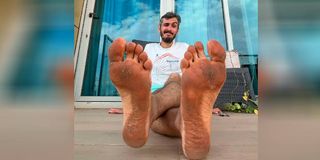
A photo of a barefoot man performing a headstand at the finish line of the 2025 edition of the Standard Chartered Nairobi Marathon went viral on social media.
He had just completed a full marathon in four hours and fifteen minutes. He had blisters and bled from some of the lacerations sustained during what he describes as a difficult run.
The sun-baked tarmac under his feet for each of those 42 kilometres did not help matters. He had started bleeding at just 10 kilometres and had to summon grit to carry through the remaining three-quarters of the journey.
“I had my sandals in my bag just in case,” says 33-year-old Patrick Scheel, who describes himself as an endurance athlete. “But I told myself, no, the challenge is to do the full marathon barefoot.”
Scheel is an environmentalist with the United Nations Environment Programme (Unep) in Nairobi. He is passionate about protecting the planet and pushing the limits of human endurance, a balance he strikes through endurance sports. It is a seesaw that has attained an equilibrium he is proud of.
Originally from Monterrey, Mexico, his hometown was a key influence on his love for mountains and peaks. “My parents’ house is in the mountains,” he says. “The backyard was a national park. It goes without saying, I started thinking about mountains as a home.”
Scheel supports ecosystem restoration projects by day and transforms into an endurance athlete by night and on weekends. “I’m not a runner or a mountaineer,” he adds. “I’m an endurance athlete. It’s about mental and physical endurance, being willing to spend hours doing something other people wouldn’t understand.”
Scheel’s minimalist approach to running started six years ago after reading Born to Run, a cult classic among distance runners. The book explores the biomechanics and philosophy of the Tarahumara, an Indigenous Mexican tribe known for running ultra distances in sandals made from tyre rubber.
“I started using Luna sandals, which are inspired by the Tarahumara,” he says. “Eventually, I started training barefoot. It felt like going back to the basics, trusting my body instead of gadgets or gear.”
His minimalism extends beyond running and mountaineering. “People have a pair for road running, another for trail, another for the gym. I wear sandals everywhere, even to work. I trust my feet more than I trust my shoes.”
Patrick Scheel.
Photo credit: Pool
“The sandals are zero-drop — no difference in height between the heel and the toe — so you land on your forefoot, which reduces impact on your knees, hips, and back. The problem started when companies like Nike added thick cushioning to shoes in the ’80s, making people land on their heels. That’s how runner’s knee became common.”
His run at the marathon was the truest test of his approach yet. “The tarmac was sharp and full of glass. I thought about quitting three times. But I told myself, just focus on the next step, not the finish line.”
The pain, he says, taught him much. “It was one of my top five most painful challenges ever. But I realised that most pain is temporary, it’s not real damage. The next day I woke up, and all my blisters had closed. No open wounds. My body healed overnight.”
He attributes this remarkable recovery to his sleep and diet. “If there’s a fountain of youth, it’s sleep,” Scheel says. “It’s the foundation of everything.”
He guards his nights with near-spiritual reverence. “I never take my phone into the bedroom. I charge it outside. My room is a sacred space. No screens, no distractions.”
He plans his nights around his body’s natural 90-minute sleep cycles. “I try to sleep either seven and a half or nine hours, so I don’t interrupt a cycle. That’s how your brain and muscles really recover.”
When he trains late into the night, he adjusts his schedule rather than sacrifice rest. “It’s always a trade-off between running and sleeping. But I’d rather run less and sleep more than train hard and recover poorly. Without good sleep, even perfect nutrition or training doesn’t work.”
Scheel maintains a plant-based diet and has had the same breakfast every day for the last six years. “I’m vegan,” he says, “but not in a complicated way. I just eat clean, mostly fruits, vegetables, grains, legumes, and nuts. I don’t count calories. I focus on how food makes me feel.”
His diet is as minimalist as his footwear. “ As long as all my nutrients are there, I’m fine. The body knows what it needs if you listen to it.”
He’s convinced that food, sleep, and mental calm form the triangle of endurance. “I always say we choose our diseases through our lifestyle. Every decision, what we eat, how we rest, how we manage stress, either heals or harms us.”
A week before the marathon, Scheel was in yet another endurance endeavour — a 36-hour odyssey that pushed him to his mental and physical limits. “I started from Twin Peaks in the north and ran all the way south to Elephant Hill — about 80 kilometres. I was following a map I’d pieced together from different sources, and I ended up getting lost for hours.”
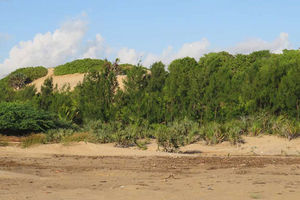
The route, he says, was overgrown and barely navigable. “Forty or fifty kilometres had no real trail. I was bushwalking through dense vegetation, pushing through thorns, stinging nettles, and knee-deep mud. Sometimes I moved only two kilometres an hour.”
“I always know where the sun is, where the compass points, and where the nearest civilisation lies. So, I was never scared, just exhausted. I followed elephant trails, saw buffaloes, and kept moving. It was painful, but beautiful.”
The solitude and silence were quite something. “I don’t listen to music out there. You have to be aware, elephants, buffaloes, anything can appear. Every sound matters.”
By the time he emerged from the forest, he had not only found his way back but also rediscovered his centre. “When you’re alone that long, stripped of comfort, you see who you really are. It’s the purest form of meditation.”
Scheel’s training is as unconventional as he doesn’t measure mileage in kilometres but in hours spent moving. “I run about 20 hours a week. On weekends, I might do six to eight hours each day — long mountain runs in Mount Kenya, Longonot, or the Aberdares. During weekdays, I run in the city or train for elevation.”
Sometimes that means running barefoot up and down the staircase of his 80-metre-tall building for two or three hours at night. “When the gym closes, I just go to the stairs,” he says matter-of-factly.
He’s currently training for his next big project — an audacious plan to run from Mombasa to Mount Kilimanjaro, tracing a 350 km route from the Indian Ocean to Africa’s rooftop, gaining elevation of more than 7,000 metres above sea level. The two-and-a-half-day continuous, non-stop running challenge, which he plans to complete barefoot and self-supported, will be a continuation of a personal journey after running from the Gulf of Mexico to Pico de Orizaba (Mexico’s highest point). “It’s a way to connect two great natural landmarks,” he says. “ It is also a way to raise awareness of the urgent need for conservation.”
He admits that these extreme experiences come with risks, but far much beyond, they teach him humility.
“Every time I go out, I know 99 per cent of the risks I can control through training, experience, or preparation. But there’s always one percent that’s beyond my hands, a falling rock, bad weather. I accept that. It makes you appreciate life more.”
Earlier this year, he nearly lost his fingertips to frostnip while doing a triple-route challenge on Mount Kenya ascending and descending Chogoria, Sirimon, and Naro Moru in one day.
“It was snowing and I didn’t have the right gloves,” he says. “I lost sensation for months. But I finished. Through breathing and focus, I could send warmth to my fingers. That’s the mental part of endurance, staying calm when things get extreme.”
Why, you’d ask, does he subject himself to all this? “That’s where I meet myself,” he says quietly. “When you’re out there, stripped of comfort, your mind has nowhere to hide. You see who you really are.”
He believes that too many people underestimate their strength. “People think they are weaker than they actually are,” he says. “They say, I can’t climb that mountain, I haven’t trained enough. But sometimes, you just need to start. Take a risk. You’ll surprise yourself.”