At the beginning of Alan Donovan’s book, My Journey through African Heritage , he quotes something Robert Redford says to Meryl Streep in the film version of Karen Blixen’s ‘Out of Africa’: ‘We’re not owners here, Karen, we’re only passing through’. Sadly, Alan passed through his life here on 5 December 2021. Of his time in Africa, this is what he says in the Prologue to the book: ‘Africa. For nearly 40 years, I searched for the continent’s beauty and creativity, passing through the glorious sunrises and the magnificent sunsets that encompass the splendour and the calamity of each new day.’
Perhaps no one has done more to discover, celebrate and preserve African art – in carvings, paintings, ornaments, tools, fabrics, from many countries across the continent. With his friend and business partner, Joseph Murumbi, Kenya’s second Vice President, he founded African Heritage, which a World Bank study called ‘the largest and most organized craft retail and wholesale operation in Africa’. And when Alan saw how calamitous and unjust it was that Joseph Murumbi’s dream of founding an African Studies Centre was being frustrated, he devoted so much of his time to ensuring that Murumbi’s legacy would be honoured as a politician of integrity and one of the foremost collectors of African art.
Alan fought for placing of the Joseph and Sheila Murumbi graves in a secluded corner of City Park, surrounded by sculptures. He set up the Murumbi Gallery of Art and Artefacts within the Kenya National Archives. He ensured that the wide range of Murumbi’s art collection is permanently on show in the Nairobi Gallery at the corner of Kenyatta Avenue and Uhuru Highway.
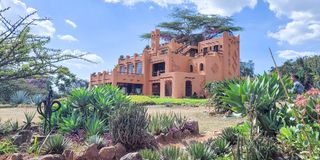
In a way, challenging what Robert Redford said to Meryl Streep, Alan did own a part of Africa – the African Heritage House overlooking the Nairobi National Park. It is a house designed by Alan himself, inspired by the ancient mud buildings he had seen in his travels, such as the Great Mosque of Djenne in Mali, the palaces of Morocco and the less ornate mud houses of Navrongo in Ghana. It is also strongly influenced by the Swahili architecture of the coast. It has been featured in many architectural magazines, and it really did become one of the most photographed houses in the world.
Back in early 2014, I remember sitting with Alan by the pool down the slope of his garden and with its view over the old railway line. He was very worried because the house was at great risk of being demolished to make way for the planned SGR line. But an online campaign petition was eventually successful and, in fact, the house was later gazetted as a national monument. Nevertheless, I am aware that, though a trust has been set up and tours of the house are still operating, some matters after Alan’s death have still not been settled.
Lut and I had never taken the tour of the African Heritage House, so we decided to do that last Saturday. The directions there from Nairobi are simple: you double back on the Mombasa Road at the end of the Express Way at Mlolongo, and almost immediately take a slip road on the left and then, after about two hundred metres, turn into a dirt track that is well-signposted.
In the car park we were welcomed by a young man, Hillary Kisini, who was our guide for the tour. First, he took us to seats near the pool for a coffee and a preliminary chat. He talked about Alan’s initial reason for leaving his native America and coming to Africa as a food relief officer in the breakaway Biafra, about his decision to stay on in Kenya, about the way in which a few months in Turkana reinforced his appreciation of traditional artefacts and triggered his travels across the continent. Hillary then walked us to Alan’s grave beyond the pool.
Before moving back up the slope to the house, we looked at how the story of African Heritage is told in many photographs displayed on poolside screens: dramatic photographs of the many art festivals and fashion spectaculars Alan promoted in Kenya and in other countries – and the models who had participated in them, wearing specially designed and flamboyant costumes made from traditional fabrics.
On the way back up the slope, we passed a thorn-less acacia tree that Alan called ‘the wedding tree’. The house itself is truly amazing – in the unique décor of its rooms and in the number and quality of artworks, jewellery and fabrics on display. But it is still a home as well as a gallery. Alan’s first-floor study is the most spacious and distinctive that I have ever seen. You could spend a whole day there, browsing the many books in cases along the walls. The huge desk has the light from a wide window with its view of the National Park. Given the clutter of items on the desk, it’s as if Alan could have been sitting there only an hour or so before. There are five bedrooms, all lavishly furnished; in four of them – all with en-suite bathrooms – you can stay the night.
Hillary was an excellent guide. He had something to say about any object on display. I asked him how he has managed to store all that information. He said it is from the many times he listened to Alan himself conducting a tour. But it must also be because of his own keen interest in all that is in the house – whether an intricate silver necklace from Ethiopia, a rare Benin bronze, or a brown hairball said to be vomited by a lion.
And so, as Alan Donovan said himself, African Heritage House is a showpiece of African culture and heritage and contains an invaluable collection of African art. For us, last week’s tour was a most enjoyable and eye-opening experience. The cost of such a tour is a little complicated: 4,000/- for up to four people; after that, the fee for each additional person is 1,000/-. We didn’t have it, but the elaborate lunch there is said to be quite special, costing 4,000/- per person. For staying at the house, the costs are given on the website www.africanheritagehouse. Guests can enjoy the libraries and African reading material found throughout the house, as well as relax in the second-story lounge or at the pool. And all the bedrooms and bathrooms have a view of the National Park. We are tempted to return for the overnight experience.