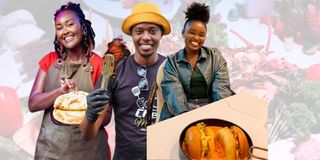
Christine 'Koku' Lwanga (left) Moses Kioko and Wanjira Kimani.
The festive season is here, and that means it is time to bring out all those recipes you swear by.
In fact, some of them have created their own, inspired by their life’s story. They speak about the art and science of cooking a delicious meal.
Eunice Nduta’s kitchen debut is a classic example of what happens in most Kenyan homes. As a firstborn girl, it went without saying that she was expected to know how to cook and take care of her siblings. After all, isn’t the ‘firstborn daughter’ code for assistant mum?
“When mum was making chapatis, she would ask me to sit nearby and watch every move. Then she would ask me to give it a try.”
She was barely 10 at the time, but the spark had been lit. Her experiments quickly progressed to real cooking, a passion that now earns her income as an online food content creator.
“One of my favourite recipes is egg curry because it reminds me of my mum. Her version was simple: eggs in simmered onions and tomatoes. I re-invented this, adding seasoning cubes, paprika, and turmeric, to make it more flavourful. It’s the dish I cook when I miss home,” she says.
Digital Content Creator and Brand Influencer Eunice Nduta Njuguna at Nation Centre for an interview on November 17, 2025.
Top of her signature recipes is her homemade ice-cream.
“I use condensed milk blended with whipped cream, frozen overnight, and later mix with bits of chocolate or strawberries for flavour and also to turn it into something playful and indulgent,” she explains.
Her inspiration comes from every day interactions, including online where she samples food from different cultures. This exposure has made her open to try out different dishes including those that she was not fond of growing up.
“I never liked fish. It was always served in a tomato-and-onion soup; I never enjoyed it! I tried cooking it myself with coconut milk, and I fell in love with it.”
Eunice also revamped a traditional delicacy called mukimo, making hers with green bananas pounded together with sweet potatoes, seasoned with green onions, salt, and a legume of choice (beans, cowpeas, lentils). She once cooked it for her mother’s friends, and they endorsed it heartily.
“I believe that food absorbs emotion. If I am not in the right mood, I don’t cook. For me, every recipe begins with love.”
Hunger prompted Stella Ajwang to discover her cooking prowess at the age of 8.
“My mum stepped out of the house around lunch hour, so I decided to make some ugali for my siblings.”
Digital Content Creator and Brand Influencer Stella Ajwang Ogutu at the Nation Centre for an interview on November 17, 2025.
They gobbled it up and left no crumbs. Since then, Stella has been cooking all kinds of dishes and is always exploring and curating recipes to create new dishes. “When I get an idea of what to cook, I head straight to the kitchen and try it. If it works, I cook it again, perfect it, then post it online for my followers.”
She grew up eating fish, but not baked ones, so when she discovered an easy way to make sumptuous baked fish, she never stopped making it.
“Start by stuffing the fish with chopped onions, garlic, paprika, seasoning cubes with oil, along with slices of lemon. Bake for 25 minutes until the fish is thoroughly cooked before serving it with fries or ugali and vegetables.”
There are ingredients she never cooks without. Garlic tops the list, along with seasoning cubes; the aroma and the way they tenderise meat make them her favourite.
You probably know HolyDave Muthengi for his gospel hits like Kelele Takatifu, but the man also cooks. He attributes his kitchen flair to his mum, a professional baker.
“Food, for me, is about lifestyle, fun, and entertainment. I started posting my food videos online during the Covid-19 pandemic when we were all stuck indoors.”
He laughs when he calls his kitchen a “lab,” but he means it. He is a firm believer in trying, tweaking, and tasting. HolyDave has held on to his mum’s cookbook and occasionally flips through it for inspiration.
Before he cooks anything new, he researches widely. He’ll sample a local version of a dish, check how people make it, flip through his mother’s cookbook, then combine all that with what he already knows. Part of his trademark is experimenting with sweet and savoury; adding sugar where it doesn’t traditionally go, or sneaking salt into a sweet dish.
Though he loves experimenting, he has also grown more intentional about ingredients. “Nowadays I lean towards natural options when I can, fresh garlic over powder, and simplicity over overly spiced dishes,” he says. “But garlic and onions, those are non-negotiable.”
Wanjira Kimani, a lifestyle and food content creator, shares that one of her meals she enjoyed preparing was roasted rabbit meat paired with kales and ugali.
Wanjira Kimani, a firstborn in a family of five, was raised by her grandmother. Her earliest memory of food was a plate of sukuma wiki and ugali.
“No spices, no bold flavours, just the taste of tomatoes and onions,” she recalls.
Evenings were spent gathered with cousins, talking about everything happening in the world as they passed plates of food around. It is in those moments that her curiosity took root. She began wondering what would happen if she mixed one thing with another, or cooked something in a slightly different way. “I started cooking for my siblings when I was left in charge at home. Along the way, I discovered that I was naturally drawn to it,” she says.
Her background in Nutrition and Dietetics eventually blended with this curiosity, shaping a culinary style that mostly revolves around homemade meals.
One of her favourites is roasted rabbit meat. “Clean the meat thoroughly. Make the marinade by mixing paprika, coriander powder, seasoning powder, cubes, rosemary, a little turmeric for colour and garlic paste. Coat the r meat with the paste and wrap it with aluminium foil before placing it on the grill to cook until tender and juicy,” she explains.
“I often use paprika as a substitute for tomatoes, because it gives both colour and flavour in one go.” She loves recreating those simple meals she grew up eating with her cousins. Some of her meals may sound like odd combos, but she promises they are finger-licking good.
“The mix of rice with githeri and nguja gutu, a blend of ugali and sukuma wiki, reminds me of childhood days with my siblings. It was also my grandmother’s favourite meal,” she recalls.
Chef Moses Kioko has a story too.
Chef Moses Kioko, a personal chef, describes his cooking style as a blend of curiosity and nostalgia.
“My earliest memory of food is standing on a stool next to my mother as she stirred a pot of pilau. The aroma of cloves and cinnamon felt like magic,” he says.
Today, his style mirrors both who he is and where he comes from. “I love creating food that feels familiar yet exciting. Oh, and I love my spices, always have.”
Most of his ideas are inspired by his travels. A lingering spice on the streets of Mombasa, a street snack in Nairobi, or even a story shared by a friend. Nostalgia sits at the centre of his creativity. “Reinventing my childhood favourite dishes is one of my greatest joys,” he says. He often gives Kenyan and African dishes a modern touch, but always with respect. He never strips away their core identity. “If I modernise a dish, I never remove the heart of it,” he says. So you’ll find his pilau enhanced with caramelised onions and smoked paprika, and his sukuma sautéed with coconut milk.
One of his most surprising experiments was pairing roasted sweet potato with a tangy tamarind glaze and crushed peanuts. “The harmony of that dish made it quite unforgettable.”
To him, food isn’t just about taste. Texture, aroma, and visual appeal are just as important. “Flavour is only half the experience,” he says. “A good dish must look inviting, smell enticing, and offer an interesting mouthfeel.”
One of the recipes closest to his heart is his coconut-garlic chicken stew. It is inspired by his grandmother from the coast, who cooked almost everything with coconut. “I recreated it years after she passed away, and with every simmer and stir, it felt like she was right there with me at the table.”
Christine “Koku” Lwanga, a mother of three, almost had a tragic launch into her cooking career.
Christine 'Koku' Lwanga describes her culinary style as African, warm, and homegrown.
As a small girl, barely tall enough to reach the kitchen countertop, she stood on a stool, “cooking” leaves in a plastic tin over a gas stove.
“I almost burnt down the house. I remember the smell of burning plastic and smoke from the curtains, which had caught fire. My mother was ready to burn me at the stake,” she laughs.
She has a rich heritage of Ugandan, Tanzanian, and Botswana roots, and she grew up watching different kinds of traditional dishes being prepared at home.
“One day I decided to make luwombo with a twist,” she recalls, referring to the traditional Ugandan stew prepared in smoked banana leaves. “Borrowing chapati techniques here, adjusting a flavour there, I realised I could create rather than merely follow.”
Koku describes herself as familiar but full of surprises, a personality mirrored in her food.
“I often return to the flavours my grandmother from Bukoba, Tanzania, used to make or the dishes shared across her Ugandan and Botswana ties,” she shares. And she is not afraid of bold experiments. “Njahi with chicken, for instance, turned out to be surprisingly sweet and unexpectedly delightful.”
Koku’s children are her first critics, and their verdict matters. If they love it, she knows the recipe can stand on its own.
“My cooking engages every sense, aroma that pulls you in, texture that keeps you interested, and visual appeal that makes the first bite inevitable,” Koku says.
Playing with traditional dishes can stir up strong reactions. Her comparison of Katogo, the Ugandan dish, with what Kenyans call matoke nearly set her social media accounts 'on fire.'
“Food is cultural, and culture is identity. People guard it closely. I respect the reactions, but also believe that evolution and authenticity can coexist,” she says.
If her recipes could tell a story about modern Kenyan taste, “I believe it would be one of boldness, evolution, and a willingness to mix tradition with creativity. Kenyan and African flavours today are colourful, warm, curious, and deeply rooted in the home. And that is precisely the story I hope every dish I create will continue to tell,” she says.
Follow our WhatsApp channel for breaking news updates and more stories like this.