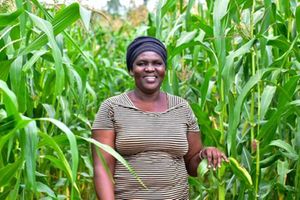
For nearly two decades, Ken Nyori has been growing African Indigenous Vegetables (AIVs). His passion for these nutrient-rich crops has now transformed not just his farm, but his family’s eating habits.
Nyori, a health worker at Githunguri Sub-County Hospital in Kiambu County, cultivates traditional vegetables on his quarter-acre plot in Kamburu, Lari, Kiambu County.
His crops include African nightshade (commonly known as managu or sucha ), amaranthus (terere ), and spider plant (saga ), alongside cabbage, spinach, and sukuma wiki to supplement his income.
However, according to the farmer, who grows the vegetables for commercial purposes, his family was not conversant with cooking them, and it is through his commitment to researching different recipes that they fell for them – as one of their favorite delicacies.
“Initially, my family was not a fan of the indigenous vegetables,” Nyori admits.
“But after researching different recipes and ways to prepare them, they have become my number one customers.”
It is through his commitment that Mr Nyori has earned himself recognition by his employer, where apart from his professional duties, he leads the Githunguri Sub-County Hospital kitchen garden.
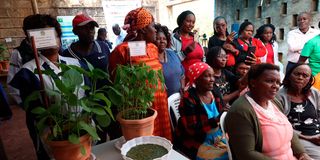
“The farm trains teen mothers, among other patients, on growing the vegetables and healthy eating,” he explains.
Additionally, they are taught how to cook indigenous vegetables and also how to grow them not only for consumption but also as a business venture.
A few kilometers from Nyori, a similar script replicates that of Wanjiku Waiganjo.
Ms Wanjiku grows Ethiopian kales (kansera), managu, and terere in her kitchen garden in Matuguta, Githiga, in Githunguri.
Being a mother and a grandmother, she says that she grew up in a family that practices agriculture, and cultivating indigenous vegetables is a unique venture that she values.
“The crops earn me money almost each and every day. For my children and grandchildren, traditional vegetables do not miss in their daily menu,” she informs.
Wanjiku grows the short-term crops as a side hustle. Hers is a circular economy, as she also rears cows and chickens, and she uses the cow dung and poultry droppings as manure.
Though her sale is farm gate, she affirms that of late, African indigenous vegetables are among the most sought-after horticultural produce.
Consumption of traditional vegetables is increasing over time as people become keen on healthy eating and lifestyle-related diseases.
Studies show that the African Indigenous Vegetables, including managu , murenda , mito , saga , terere , and kunde , are rich in Vitamin C and A, proteins, micro minerals such as Iron, phytochemicals – antioxidants which clean body systems, fiber, carbohydrates, among other nutritional vegetables.
“As a result of research and promotion about nutritional benefits, there is an increase in the intake of indigenous vegetables. The demand is so high to an extent that if you visit some markets and even supermarkets in the evening, the shelves are empty,” observes Dr Anne Aswani, a nutritionist from Masinde Muliro University of Science and Technology, working with the Department of Nutritional Sciences.
The expert says the demand is increasing for various reasons, including promotional campaigns, nutritional advantages, and managing lifestyle diseases.
Production, according to the Ministry of Agriculture’s consolidated validated annual report, has seen a significant increase between 2011 to 2019, where the average production to date stands at 300,000 tonnes per year.
About 95 per cent of the vegetables are consumed locally, with that implying that only 5 per cent is exported.
It is for that reason that Jomo Kenyatta University of Agriculture and Technology (JKUAT), in partnership with Masinde Muliro, and other private partners such as IREN Growthpad Limited and Local Research Development Institute, is undertaking a program to promote the cultivation and consumption of the traditional vegetables.
IREN Growthpad is a vegetable export company, with an established market in the United States. It exports dried African indigenous vegetables.
The project, dubbed National Research Fund (NRF) Upscale African Indigenous Vegetables (AIVs) Climate Smart Technologies for Food Nutrition Security in Kenya, seeks to upscale production, preservation, value addition, cooking using standardised recipes, and utilization of technologies to produce the vegetables locally.