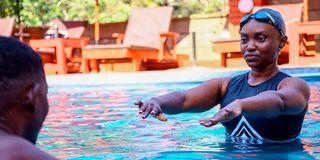
You-swim CEO and certified swimming coach, Roseline Maina, guides a learner during a session in Westlands, Nairobi, on September 17, 2025.
“Mummy, you know it would be nice if you also learned how to swim.”
That was the statement that transformed Marilyn Wanza from a 40-year-old who couldn’t float in a pool to a master of all swimming techniques.
Wanza, who runs a family-owned seafood business named Gropper Seafood, was 40 years old when her four-year-old daughter, who had just begun learning to swim, casually made the remark. Wanza began to imagine how nice it would be to swim with her children while on holiday.
“Until then, I had never looked at swimming like a necessary or even important skill,” she says. “I had never seen my parents swimming, so it never occurred to me to do it.”
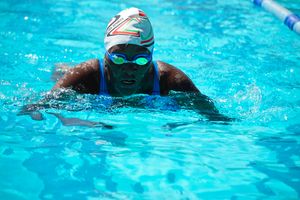
Marylyn Wanza, 47, learnt to swim in her forties so she could join her children in the pool. Here she displays a medal she won in a swimming competition.
But once the idea was planted, it didn’t take long for her to put it into motion. She reached out to Swim Africa, the team that managed the swimming pool at her children’s school. They included her in a swimming package, assigned her a certified coach, and gave her the encouragement she needed to begin her swimming journey. Although she felt scared and anxious at first, Wanza is glad she took that step. Her first 10 classes blended both group and one-on-one sessions.
“I learnt together with my friends who happened to be fellow parents at my child’s school. We would drop off our children, go and swim, then have catch-up sessions after class. It was always something to look forward to and it helped build my social connections. I particularly liked the one-on-one sessions because they allowed me to meet my personal goals.”
Another key milestone was when she completed a full lap across the length of the pool.
“I could coordinate my breaths and movements, but for a long time, I was only able to swim across the width of the pool. This was until my swim coach challenged me to do lengths. I wasn’t prepared, and of course, my first reaction was fear, but once you’re in the water, you don’t have a choice. You just start moving.”
As far as benefits go, Wanza can't stop praising her new hobby.
“It made me understand my children’s swimming journeys. When I started learning and experiencing it myself, I was able to empathise with the fears they have to overcome, the days they wake up and don’t feel like going to the pool, the bursts of energy after swim sessions, the differences in learning speeds, and even the ability of the body to adapt when pushed to swim.”
You-swim CEO and certified swimming coach, Roseline Maina, guides a learner during a session in Westlands, Nairobi, on September 17, 2025.
As one who struggles to stay motivated and focused in the gym, Wanza finds that swimming is the perfect alternative for hitting her fitness goals. “In the water, you only have two choices – sink or swim and sinking is not an option.”
With consistent practice (three to four times a week), she boasts of results like increased lung capacity, bone density, stronger muscles, improved flexibility, higher energy levels, and better sleep quality. An advocate of clean beauty such as natural, plant-based skincare solutions, Wanaza says swimming has also helped tone her skin since it aids blood circulation.
Then there is the element of personal growth. She has overcome many of her fears, including the fear of diving into the deep end, which she conquered when she mastered swimming underwater.
“Every day brings a new challenge. You’ll think you’ve learned everything, but there is always something else to look forward to,” she says. “So I wake up and show up, and every time I reach a goal that I didn’t believe I could, I realise that there is nothing out here that I cannot do.”
It started as just another way to bond with her children, but now, swimming is her ‘me-time’. It’s time to relax, clear her mind, and be free. “It’s never too late to learn. It can save your life or someone else’s, and it helps you stay youthful and fit.”
For Brenda Alung’at, 37, it was about checking off a recurrent New Year’s resolution. For more than five years, learning how to swim sat stubbornly on her vision board, even as other skills like cycling and walking more often got done. But when 2025 rolled in and a friend encouraged her to take the leap, Brenda knew it was time she learned to do more than just wade and splash about the shallows.
“I didn’t wake up and say, ‘today is the day’, I just walked into a swimming academy one Saturday after finishing my errands and asked for information on how the classes work and how I could book sessions,” she says.
You-swim CEO and certified swimming coach, Roseline Maina, during a session in Westlands, Nairobi, on September 17, 2025.
Now months into her swimming journey, Brenda says that the hardest part has been overcoming the fear.
“It is a progressive journey. You start with floaters and slowly lose them as you get better, then you start going full lengths and doing more. But even though there’s always an instructor, I still have to face the fear of drowning every time. And because I still haven’t completed my classes, while I can go to the shallow end by myself, I still can’t be in the deep end without an instructor.”
Teaching adults to swim
But like Wanza, there have been highlights that keep her going. Topping that list, is the first time she managed to swim across the pool, doing backstrokes.
“It was a high moment,” she remembers. “Another was when I went for a holiday in May and was able to be in the pool without an instructor. It was shallow and my sister and friends kept giving me tips, but it still was a big win.”
Now, whenever things get hard and she feels like she can’t do something, Brenda reminds herself that she couldn’t float in January but can now do freestyle or backstroke across the shallow end. Beyond the endorphins that she gets to start her days with after a swim session, Brenda lost eight kilograms in four months. She engages in other activities to keep fit, so swimming can’t take all the credit, but it certainly played a part.
Brenda encourages all interested adults to learn how to swim.
“The brain is a funny thing, every time you do something you’ve not done before, you create new paths in your brain and that by itself, is enough to help you accomplish other things. We really are limitless. If we put our minds to it, anything is achievable.”
Roseline Maina, a certified swim coach and CEO of You-Swim, has had many adult clients. She has observed that most adults, especially those with children, seek swimming lessons for safety purposes.
“With the CBC curriculum, swimming is part of the extra-curricular activities. Naturally, parents want to learn the skill so that if anything happens while their children are in the water, they can jump in and save them,” she says.
Another common reason is fitness. This one is popular among those aged 40 and above.
“A number of them used to swim maybe 20 or 25 years ago when they were younger, but they dropped it, and now want to re-incorporate it into their lives as a way of keeping fit.”
Roseline explains that this group must be re-introduced to water so that they can overcome any fear or self-doubt that might have crept in during their inactive years. Those aged 30 and below are mostly looking to enjoy their vacations to the full, while others simply want to get over their phobias.
You-swim CEO and certified swimming coach, Roseline Maina, during a session in Westlands, Nairobi, on September 17, 2025.
With her academy catering to both children and adults, Roseline points out that there is a huge difference in teaching adults to swim, compared to teaching children.
“It’s very easy to teach children. They don’t overthink things. As long as it’s fun, they just jump in and grasp the concept quickly. Adults however tend to hesitate out of fear and overthink. Usually, they end up needing reassurance before they can feel comfortable.”
And speaking of fears that adults frequently bring to the pool, Roseline mentions the fear of falling in the water, putting one’s head under water, breathing in or swallowing water, keeping the eyes open under water, and the fear of water getting into one’s ears. Roseline suggests using goggles and earplugs to cover the eyes and ears, but also encourages swimmers to go all in and embrace the water fully, with no aids.
She believes that a positive attitude backed by mental preparedness, a willingness to trust the process, and the ability to be patient with yourself are qualities that can help adults learn the skill faster.
You-swim CEO and certified swimming coach, Roseline Maina, dives into the pool during a session in Westlands, Nairobi, on September 17, 2025.
As a coach, she has come across some passive forms of stigma surrounding swimming adults, where people make snide comments like, “You’re too old to learn”. Also, some communities make it difficult for their women to learn how to swim.
“Some people are very specific when deciding whether or not to join a swimming session. One may say the pool area has to be in an enclosed location, and the session can only have women in it.”
But since there are no women-only pools in Kenya yet, or ones with specific hours allocated to women, this challenge persists. Still, she encourages everyone to swim.
“It’s one of those things you really don’t think you need, but once you’ve done it, it becomes part of you and you can’t stop. It is also a way of showing yourself love.”