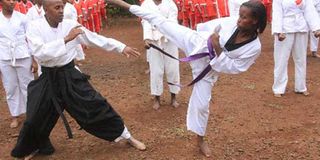
At 4pm on a chilly Friday evening in Murang’a, students from the little known Sagana All Saints Academy start trooping from their classrooms, signalling the end of a grueling eight hours of study.
They walk in groups, cracking jokes, whispering to one another and giggling like young girls do.
They look like any other normal teenage girls – carefree, and probably looking forward to a relaxed evening where they will perhaps oil each other’s scalps, file their nails, and with trepidation, search their faces for a pimple that may have surfaced during the day.
Maybe they will do all these things later, right now though, there is something more important that needs to be done. One by one, the same unassuming girls confidently walk into the open space outside their classrooms.
Their red, white and gray uniform, together with the school girl persona that were conspicuous moments ago are gone. They are now wearing spotless white tunics, majority of them with white belts around their high waists, their feet bare.
The giggling is gone, instead, there is a purposeful look on their faces, their backs ramrod straight.
They start assembling in straight lines, after taking a respectful bow in the direction of an unsmiling man, who is wearing a white tunic as well, but with a black belt strapped around his waist.
They stand waiting in pin drop silence, their hands clasped on their backs. No sound is tolerated at this point, and breaking this rule can earn you an expulsion from the field. If you are wondering, the girls are about to begin a martial arts class.
The sensei, (martial arts teacher) Joseph Murimi, then takes them through a short warm up session before the deafening silence gives way to loud tough yells and a series of neatly choreographed punches and kicks, coupled with occasional turns, side steps and graceful jumps. Karate is mandatory in this school – the girls train three times a week after class for an hour, as well as on weekends.
“Our girls are trained to defend themselves from any form of aggression directed at them – a girl who has been in this school for four years can take down an adult man in seconds,” Murimi, assures us, as the 200 plus girls yell even louder, as they continue to perform energetic manoeuvres, their concentration absolute, unbothered by the red dust swirling around them.
For the last five years, this assembly ground has doubled up as a Karate training ground.
The school principal, Waithera Karanja, says that they introduced the sport as a way to promote discipline, build self-esteem among the students, and teach them self-defense skills.
“It is not a common sport in our schools, and critics who do not understand this sport may accuse us of promoting a culture of aggression, but karate teaches respect, discipline, self-control, perseverance and responsibility, important characteristics that we need to succeed in life,” she says.
Most importantly though, the school wanted to teach its students some form of self-defense in the face of rising crime in Murang’a County for the last few years.
Just last month, Murang’a Resident Magistrate Joseph Masiga, jailed a 35-year-old man for defiling a Class One pupil at Makuyu area.
Last year in July, four people were rescued by police from an angry mob for allegedly engaging in bestiality with a donkey. Still in the same month, a man from Gatumbo village slashed his father to death after he walked in on him raping his mother.
In a most recent incident that occurred two weeks ago, a man, who was in a group of four that had impersonated policemen, was shot dead outside Kirwarwa Police Station, where they had dared to erect a road block.
“As a school, we looked at the challenges facing the girl child and women in general in Murang’a and insecurity was among the biggest challenges,” says Murimi, who, besides being the school’s karate coach, is also the deputy head teacher and discipline master.
A karate instructor and holder of a 3rd Dan Black belt, Murimi started practicing this sport when he joined Egerton University in 1989, to study Sociology.
“As a young boy, I developed an interest in karate from watching movies. If you can remember, action movies were a hit those days, so when I realised that Egerton had a Karate club, I immediately joined,” he says, and adds,
“If you look at crime trends anywhere in the world, girls and women are the most vulnerable, and since education is a process of learning that is supposed to instil various skills, including survival skills, karate was one way that we could impart these skills to our girls,” he explains.
Three times a week, the students have a one hour practice session in the evening after class, and another two hours during the weekend.
The weekend sessions are usually facilitated by guest senseis, sought locally and internationally through a partnership that the school has with the Kenya Karate Federation and Taikan Africa - a martial arts school in Nairobi that also teaches anti-rape and anti-mugging techniques. They train the girls for free.
The techniques are completed with various throws and joint locks. The focus is placed on defense, rather than attack, and trainees are taught skills on how to defend themselves from aggressors by focusing on their attackers’ wrists, which are a weak point.
“By exerting excruciating pain on the nerves around the wrists, one is able to dislodge a knife, a panga, pistol, or any other weapon from an assailant,” explains Caleb Atemi, the chairman of the Kenya Karate Federation.
He adds that the sport promotes mental fitness. Those who practice it therefore think faster when faced with a challenge, compared to the average person.
“When you mention martial arts, what immediately comes to the minds of many is fighting; however, what people don’t know is that this is the only sport in the world where you get to learn life-saving skills and self-discipline,” he says, pointing out that in areas where the discipline is popular, there are fewer incidences of crime.
He gives an example of Cairo, a city that had about 2 million black belt holders in 2007 - the crime rate here is low.
Practicing martial arts among the youth was adopted as one of the strategies of reducing crime in cities at the 12th UN Congress on Crime Prevention and Criminal Justice, in Brazil in 2011.
The congress reckoned that, “martial arts classes aim to offer an alternative adrenaline rush, sense of belonging and self-worth if combined with discipline, responsibility, positive behavioural development, teamwork and leadership.”
Karate is based on five maxims. These are perfection of character, faithfulness, spirit of effort, respect and avoiding violent behaviour.
Since the art was introduced in this school in 2010, there have been no serious indiscipline cases, also, no student has been suspended or expelled during this period.
Before, the deputy head teacher says, an average of three students would be suspended for indiscipline every term. He adds that there has also been a significant improvement in the academic performance of the students since the sport improved their concentration with time.
“We are one of the few schools in Murang’a that doesn’t emphasis on KCPE performance when admitting Form Ones’, yet our KCSE performance has improved from a mean of 3.0 in 2010 to 5.2 last year,” says Murimi.
“This is a game of intellect, and since it demands a lot of thinking and concentration, as well as energy, the girls get an opportunity to let out all the negative energy from their system that may lead to indiscipline.”
Kaloki Kawira, a 15-year-old Form Two student, says that karate has not only boosted her self-confidence, but also helped her perform better in Maths.
“The art involves a lot of calculations because you need to estimate when to hit and where to hit. I believe we are all capable of doing even what we consider impossible, all we need to do is make a habit of exercising the mind – karate stretches your mind to the limit,” she explains.
She adds that thanks to the sport, she is able to handle situations she once considered difficult.
Apart from field practicals, the students also have oral and written examinations every three months. Such examinations test their accumulation of skills and knowledge, which determine their ranks.
Florence Kandesa and Scovia Achieng, who were the school’s top students in KCSE in 2012 and last year respectively, were also top performers in Karate.
Florence, who is studying for a degree in Commerce at the University of Nairobi, took part in the Kenya National Karate Championships in 2012, and has even tried out for the International Karate Federation World Championships. She holds a blue belt, awarded to one who has mastered eight levels of training in a particular sport in martial arts.
To qualify for a 3rd Dan black belt like the one Murimi holds, one has to be trained through 12 stages and take an exam administered by the International Karate Federation. Apart from skills, the federation has to prove that you are using your skills for the benefit of society, like he does.
The school has hosted a number of martial arts experts, some of whom have offered to train the enthusiastic girls.
In 2011 for instance, Jody Young, a former South African Karate team captain, and later coach, spent two days at the institution training the girls on self-defense.
Karate is not recognised as a sport by the Kenya Secondary Schools Sports Association (KSSA), and as a result, the students only get to take part in internal competitions.
Though many of these girls may never get a chance to show their prowess in a national or international arena, there is no doubt that they are in a much better position than millions of Kenyans, who are completely defenseless in the face of rising crime in the country.