On May 13, four-time Afrimma award winner Nikita Kering took the Kenyan artistes’ fight for better pay to the African Union (AU) in Addis Ababa, Ethiopia.
Addressing the AU as a Kenyan artistes representative, Nikita, like most musicians who came before her, called out Collective Management Organisations (CMOs) for mismanagement of artistes' royalties collection and distribution, which runs into millions of Shillings. The 23-year-old urged AU to intervene.
Nikita Kering performs during the relaunch of Showmax in Kenya on May 8, 2024, at Sankara, Nairobi.
Photo credit: Wilfred Nyangaresi | Nation Media Group
In recent years, Kenyan musicians have repeatedly voiced concerns over inadequate royalty payments, with some receiving as little as Sh1,215 for their musical work.
Having returned home, Nikita reiterated her sentiment on a phone call. "It was such an honour (to speak at AU) and the best response was to go and speak from the heart for a lot of Kenyan artists who feel their voices can never be heard. A lot of artistes can earn a good living and feed their families with the impact their music has had on the Kenyan music industry, but that is not the case. Their songs have millions of streams."
The fight for artistes’ royalties has been going on for the last three decades. The situation has gotten worse within the last decade, with the rot within the CMOs beingt beyond comprehension.
For things to get better, Nikita believes an overhaul of the CMOs' system is what is needed. However, she doesn't see that happening.
"These agencies have been around for a while. I think it's a difficult ask. I don't have high hopes, but that is what I would wish to see happen. That's why I took the AU opportunity, to give this topic a voice and hopefully start a conversation. Restructuring of these agencies will be amazing, but if that does not come through, we can form other private institutions, or someone can pitch a good idea to artistes on how we can be able to collect royalties directly without needing them," she adds.
In recent years, a series of events involving the CMOs— the Music Copyright Society of Kenya (MCSK) founded in 1983, the Kenya Association of Music Producers (KAMP), and the Performing and Audio Visual Rights Society of Kenya (PAVRISK)— indicate Nikita's plight might need more than the AU intervention if things are to ever get better.
In an interview with Daily Nation last year, embattled MCSK CEO Dr Ezekiel attempted to explain why CMOs have not been distributing satisfying amounts.
“Averagely, all three CMOs collect Sh200 million jointly in a year, which is little money for our members. Considering that we don’t have police officers (having been withdrawn by the government) to help us with enforcing compliance, we can collect more,” claimed Dr Mutua.
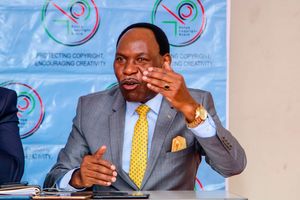
Music Copyright Society of Kenya CEO Ezekiel Mutua addressing participants during distribution of royalties to their members at Safari Park Hotel in Nairobi on January 25, 2024.
Photo credit: Bonface Bogita | Nation
Mutua's claim is backed by one of the MCSK Directors, who spoke to Buzz on condition of anonymity. "The truth is, we are still not collecting money that we can handsomely distribute. Since the government withdrew police escort from us in 2022, enforcing collection has been a problem. We are yet to regain the police escort. The main challenge is that a majority of what we collect, a bigger percentage goes into operations. We are aware that artistes are not happy, but even then we have been trying our best to distribute the much as we collect."
Police escort was withdrawn from CMOs in 2020 by the then Interior Cabinet Secretary Kithure Kindiki, due to concerns about the police service's reputation and public complaints.
Attempts by the CMOs' honchos to have the police escort reinstated fell on deaf ears, with Mr Kindiki insisting the micheviousness by MCSK, KAMP, and PAVRISK was too loud. When summoned by the Parliamentary Committee on Sports and Culture to explain the move following an outcry by the CMOs, Mr Kindiki told MPs that his ministry would not approve the reinstatement of the escort services until a memorandum stipulating their specific roles is presented.
“There were numerous complaints of extortion from the public, and it was not clear who was responsible for this. Until a time when an agreement and memorandum stipulating well-defined roles of each team, the status quo remains,” explained Kindiki.
MCSK’s last royalty distribution, which has the largest membership (16,000), was in January 2024, when it disbursed Sh20 million. The highest earner took home Sh757,092 and the lowest receiving Sh5,000. KAMP's last distribution was in June 2024, distributing Sh17,126,454, with the highest earner taking home Sh1.2 million, while the second and third-highest received Sh734,700 and Sh697,000, respectively.
PAVRISK hasn't distributed any royalties in more than five years. As of 2015, MCSK, KAMP, and PAVRISK had been collecting an average of Sh650 million a year when they had police officers escort them. In 2016, Safaricom Limited released Sh152 million to CMOs and Premium Rate Service Providers (PRSPs), for payment to artistes whose music was sold through the company’s music platform – Skiza Tunes.
Ms Angela Ndambuki. She was been appointed the first female chairperson of the Kenya Association of Music Producers (KAMP); the collective management organisation (CMO) mandated to license commercial users of recorded music in the broadcast and public performance sectors.
Photo credit: Pool
Although Angela Ndambuki, KAMP chairperson, also points out that the lack of police escort has dented the CMOs' collection, she insists that since coming to office in 2023, they have been streamlining the agency systems.
"There have been problems with CMOs, we can’t deny that. Since I took over, it's my firm belief that KAMP is best suited to be the one CMO that can effectively do the job properly, mainly because of how we have restructured our system. We now have more operational efficiency, transparency, accountability, and good governance. Our members haven't been complaining, as we have heard from the other CMOs. Things can get better if we can have police back to enhance compliance," says Ms Ndambuki.
Forensic Audit exposes rot among CMOs
A forensic audit of 2020-2022, commissioned by the Kenya Copyright Board (KECOBO), exposed the looting of tens of millions by the CMOs.
Auditors uncovered Sh158 million owed to the artistes (as of then) after reviewing license fees collected by KAMP and PRISK (which rebranded to PAVRISK) against the distributed royalties for the three-year audit period.
Music Copyright Society of Kenya (MCSK) chairman Lazarus Muli (seated).
Photo credit: File | Nation Media Group
Between January 2020 to December 2022, KAMP owed its artist members Sh75 million in withheld royalties. There was a suspicious award of a tender inflated by Sh69 million to a firm that had failed at the evaluation stage. The audit also noticed hefty allowances for the CMO's board members that far exceeded the royalties paid to artistes.
At PRISK, there was a misappropriation of Sh28 million. However, the full extent of the scandal of ripping off artistes had yet to be established, as MCSK declined to allow auditors to inspect their books. In the last decade, MCSK has faced significant issues: fund misappropriation, a board clinging to power, power wrangles, and a dysfunctional corporate culture, all detrimental to its 16,000 members.
CMOs claim 70:30 ratio for funds distribution not possible
According to the audit, the three CMOs had routinely violated the 70:30 rule, which requires that at least 70 percent of the collections be disbursed to artistes. Instead, most of the cash is squandered on lavish staff allowances, office operations, and suspect procurement dealings.
Former Cherangany MP Joshua Kutuny.
Photo credit: File | Nation Media Group
In 2023, a year after he was appointed MCSK CEO, in a forum convened by then new Kenya Copyright Board (KECOBO) chairman, Joshua Kutuny, Dr Mutua claimed that CMOS couldn't distribute 70 percent of the total royalties collected, citing operational bills as a significant hindrance.
This violates CMO regulations 2020, which stipulate that administrative costs should not exceed 30 percent of royalties collected, and royalties should be regularly and properly distributed using approved distribution rules.
For the period under audit review (2020-2022), the auditors found out that both KAMP and PRISK board allowances and staff salaries constituted up to 69 percent, way above the total administration cost cap.
Rehema Lugose (left) receives a cheque from Kirinyaga County woman representative Njeri Maina and MCSK Chairman Lazarus Muli (right) during the Music Copyright Society of Kenya (MCSK) royalties distribution for Quarter One of 2024 at Safari Park Hotel.
Photo credit: Bonface Bogita| Nation Media Group
An appetite for siphoning artiste royalties has over the years led to an appetite of board members clinging to power. This has led to frequent falling out and power struggles. Currently, MCSK is at the centre of nasty boardroom wrangles with two factions, one led by Dr Ezekiel Mutua and another by the chairman, Lazarus Muli, each claiming to be in charge of the society.
On May 9, 2025 the Muli-led faction published a public notice that Mutua's contract had been terminated by the board and he was no longer the MCSK CEO. But in a rejoinder on X, Mutua refuted having been fired, alleging it was part of a smear campaign he blamed on former directors.
The old MCSK website (mcsk.or.ke) no longer existing and has seems to have been replaced with a new website (mcsk.org). No information on Dr Mutua appears on the new website except the public notice dismissing him. Muli also claimed they had engaged the services of auctioneers to repossess the Prado TX that the public noticed had stated Dr Mutua had refused to surrender.