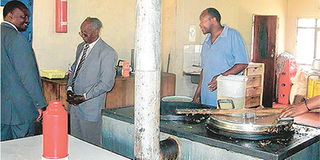
When Mr Nelson Muguku invested his savings from a teaching job in three chicken, he had no idea that he would become a leading poultry farmer in the country.
And when he invested the cash he got from poultry in a nondescript building society, little did he know that Equity Building Society would years later, grow into Equity Bank and make him the largest individual shareholder of the bank.
Today, the man with a penchant for risking his money in what apparently seems unrewarding ventures, has since diversified his portfolio; he has bought a former international school in Limuru at Sh150 million.
“It is not so much about diversifying my investments. I want to play a small role in growing education in Kiambu, and in particular Kikuyu,” he told Money at his latest investment, the former Greenacres School at Red Hill off Limuru Road. He has since renamed it Tumaini , Kiswahili for ‘hope.’
And fiddling with the leaves of a young tree Equity Bank CEO James Mwangi planted outside the school’s administration block, Mr Muguku says he hopes the institution would grown, just like the bank, and start offering scholarships to bright needy students from the area.
“Nothing comes easy in life. And nothing is impossible with hope and determination. My hope is to see the school grow and open opportunities to as many bright and needy children from Kikuyu as possible. Education is life. I hope Tumaini will give children hope to get quality education and make it to universities, so they can in turn help the community.
“I do not expect the school to repay the money in the near future. I don’t even dream of creating wealth through it. But I expect it will start sending students to universities in four years.
That would be my greatest happiness and investment. I am always ready to help bright and needy students,” he says. Mr Muguku, a former carpentry teacher at colonial Kabianga Teachers College, now Kabianga High School, is credited with having helped found two leading local public primary schools; Kikuyu Township, and Kidfarmaco.
A former Makini School principal John Mbunde heads the year-old institution while a University of Nairobi education lecturer Rugendo Chandi is the manager.
Mr Muguku aged 76, says that until 2004 following frustrations in his efforts to help improve local education standards in Kikuyu, he had no interest in risking his money in building a school.
“I hate confrontation. I hate controversy because I wasn’t doing it for personal gains. I had no interest in investing in a school. I found myself wasting a lot of energy talking to people including our leaders on how to arrest the situation.
“I decided to invest in my own school and do my best and see as many students as possible from Kikuyu make it to universities. I know there are many parents who are ready and willing to spend an extra shilling and ensure their children get quality education,” he says.
Greenacres had been on sale for three years before Mr Muguku’s first-born child Muthanji saw an advertisement in a local newspaper and interested his father in the institution that sits on a 53-acre plot.
It was around that time that Mr Muguku had shelved the idea of building a school on his six-acre plot at Nderi in Kikuyu, after he was told the first phase would cost Sh140 million.
“I decided to buy the school because it offered a better deal. The price was justified,” he says of the school which has a swimming pool, 20 staff houses as well as six dairy cows.
The institution had been closed and its buildings, some timber structures, used to serve as an ideal venue for the shooting of a local television programme Makutano Junction . It now has Forms one and two, 60 students and 11 teachers.
But a humble Mr Muguku, would not want to claim he is a great planner to have invested successfully in poultry farming, Equity Bank as well as real estate. “I had no idea my investments would grown to this level. I attribute this to three things: God’s blessings, planning and a bit of luck,” he says.
His journey to the top of Equity shareholders’ chart started over a decade ago when he walked from his mainstream banker into the then Equity Building Society headquarters in Four Way Towers, Nairobi, “to find out what their services were.” He has never regretted.
“I was impressed and opened an account. I wanted to be associated with an indigenous African bank. At that time, not many people would have risked their money in the society.
In fact, many of my friends laughed at my decision to join Equity. Some said I had never made such a business gamble,” he recalls.
“When I was buying shares, I had no idea the bank would grow this way. It was not a plan. I was just investing. Investing in shares and stocks is like gambling.
It is not something you invest to get rich. For instance, I bought some Safaricom shares but I burnt my money. “Nobody would have thought it (Equity) would grow. It had no chance of growing in the past regime. It has been a phenomenon growth. Putting my money in Equity turned out to be my best investment,” he says.