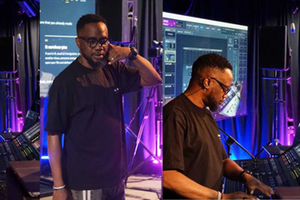
For a moment, Mark Maina wanted to be the man behind the next great Kenyan app. He was enrolled in Computer Science at the University of Nairobi, eyes on code, fingers busy building digital futures. But all that changed one afternoon when he paused The Bourne Ultimatum and started asking questions that had nothing to do with Java.
“There’s this scene where the guy jumps from one building to another, straight through a window,” he recalls. “And I remember wondering, is this guy paid enough to do that? Is that actual glass he’s crashing through?”
Turns out, there was no glass at all. The shattering was an illusion, a trick done in post-production.
“That’s when I got hooked,” Mark says. “I wanted to know what software they used to make that happen. I discovered After Effects. That was the first tool I ever taught myself.”
That curiosity, and a laptop running pirated software, opened a portal. His background in computer science didn’t just make him comfortable spending hours tweaking frames and pushing pixels; it gave him the technical foundation to experiment in ways most film students couldn’t.
“It was all connected,” he says. “Graphic design, visual effects, editing, it felt like the same language, just translated through a different interface. I loved being on the computer. And that became my entry point into film.”
At the time, storytelling wasn’t the goal. It was all about the visuals, making something eye-catching and cool. But visuals beg for context. And so Mark, alongside his late brother, who acted in the early sketches, began writing rough narratives to give the effects a reason to exist.
“We made short films and showed them to our family first, then a few friends. The response pushed us to make more films. At some point, I realised I wasn’t just trying to impress with visuals anymore. I wanted to tell a story.
To go to film school or not
By the time Neophobia, his first major short — screened at Cannes in 2017, Mark had a few festival laurels under his belt. Neophobia was the only African film showing that year. It also got picked up by the Zanzibar International Film Festival, where something else happened that would alter his course again.
He met veteran filmmaker Judy Kibinge.
“I asked her, whether it is necessary to get a film degree.”
At that point, Mark’s qualifications were strictly in IT: Java, HTML, BSc in Computer Science. What he lacked was formal knowledge in filmmaking.
Kibinge introduced him to Mark Schleicher, the administrator of the international class at the Film Akademie Baden-Württemberg in Germany, one of the most prestigious film institutions in Europe.
“We met in July. By September, I was getting ready to go to Germany,” Mark recalls.
Film school in Germany was huge. Directors, editors, animators, writers, and photography directors all worked as a team.
“I was in class with people who had done big things, people from Game of Thrones, Oscar award winners…and suddenly they are critiquing your work and giving feedback.”
There was no hierarchy. If your idea was strong, you were heard. And if your film had already been to Cannes, like his, you were taken seriously.
“I realised you don’t have to dream about the Oscars. In Europe, there are so many festivals that matter just as much — Berlin, Cannes, Rotterdam.
He noticed that films that weren’t produced in Hollywood had more depth.
“You watch a good Polish or Iranian film and it is so relatable. They don’t need explosions to move you.”
While at the Akademie, Mark made a sci-fi short called Harriet, about a man in a futuristic institution designed to increase IQ levels using machine learning and AI systems.
“In the story, the man starts learning from an AI system and eventually, the AI falls in love with him. Now, years later, we’re seeing exactly that happen in real life, people falling for their digital assistants. It’s wild.”
The project was a creative gamble, sci-fi isn’t a genre he could easily tackle in Kenya due to budget and infrastructural constraints. But at the Akademie, students were given all the necessary support – budgets, equipment, studio time. The only tradeoff was human labour.
“You had to find your crew,” he laughs. “The number of times I literally pitched my idea to people in bars, or begged a cinematographer to shoot for me or convinced a sound technician to show up on Sunday…”
Despite those challenges, Harriet ended up being the best film in Mark’s class. It taught him what it really meant to lead a production from start to finish.
“I realised that just being good isn’t enough. The global stage is massive. And you need to be ready.”
“You Feed the Audience Breadcrumbs”
If you ask Mark what draws him to nonlinear storytelling, he’ll say, “Christopher Nolan.” He even named his son Nolan.”
Nolan’s mastery of non-linear timelines, intricate plotting, and layered meaning offered Mark a new cinematic vocabulary. One where audience participation wasn’t optional but essential.
“There is joy in watching films that journey with the audience. Where the character discovers things at the same time as the viewer. That shared unraveling makes the experience more intimate.”
“And when you watch it again, you catch the things you missed. That’s when the film really lives.”
It’s also why visual metaphors feature heavily in his work.
“I try to make every frame like a painting. If you paused it anywhere, it should still tell a story. That’s how I teach, too. I ask my students: ‘Tell a story in five pictures.’ If you can do that, you understand cinema.”
Mark avoids exposition where possible, preferring to show, not tell.
“I enjoy films that I have to watch twice. You should want to go back — not because you didn’t understand, but because there’s more to discover.”
The idea for A Pause for Reflection, a short film that weaves together three interlocking narratives about parenting, loss and memory, came from a shoe shop.
“I was in Lagos for my boss’s birthday,” he recalls, the boss being Mo Abudu, CEO of EbonyLife Group. “The theme was Asian attire. I had nothing close to that in my wardrobe.”
So he headed to China Square, a popular shopping complex in Lagos.
“I saw a shoe and tried to ask for the price. A woman finally shouted across several stalls, ‘What do you want?’ It sounded aggressive.”
The price? About Sh10,000 (118,789 NGN), a bit steep, so he tried to haggle.
“She was very rigid, but eventually dropped the price slightly. I told her I still couldn’t afford it, and she said I couldn’t leave after negotiating that much.”
At that point, the woman clocked his accent: “You’re not from here, are you?” and the ice broke.
The woman shared how she was struggling with the news that her teenage son had impregnated a girl his age.
“It hit me,” Mark says. “If I had judged her by that first interaction, I would have left thinking Nigerians are rude. But beneath that aggression was a whole story.”
“I wanted to look at our judgmental nature, but through the lens of parenthood. Because parenthood isn’t just about raising children.”
The film follows three narratives: A woman in a park debating whether to have a child, wrestling with societal pressure versus personal truth. A young girl learning to ride a bike as chaos swirls around her, a metaphor for innocence in the middle of adult dysfunction. A father asked to identify the body of his estranged son, their last interaction shaped by anger, silence, and unresolved tension.
The writing took months. “I wanted the stories to feel emotionally dense and relatable.”
The result is a quiet 15-minute epic about ordinary people, told with elegance, restraint, and deep emotional insight.
“Yeah, for sure,” he says, nodding thoughtfully when asked if any of the themes stemmed from his own life. “Because I’m a parent as well.” At the time of filming in Nigeria, Mark had left behind his son in Kenya, then just under two years old.
But it wasn’t just physical absence that shaped his storytelling. Emotional scars did too.
“I lost my brother when he was 22. That also contributed to the feeling of loss and grief. You keep praying, crossing your fingers that they’re okay. It’s really hard.”
Both experiences, parenthood and profound loss, fed directly into the emotional fabric of the film.
In post-production, his background in editing became his secret weapon.
The film was essentially written three times—during the scriptwriting phase, reshaped during production, and then again in post-production. The biggest challenge? Integrating animation.
“The movie was very serious, so including animation helped balance the emotions of seriousness and tenderness.” That constant push and pull between vision and execution is what ultimately gives A Pause for Reflection its unmistakable texture.
Mark knows the dangers of working in isolation. “You can be lost in your own world. It helps to hear other people’s perspectives. I usually invite other directors to come in and bounce ideas.”
That humility, that openness, is part of what makes his storytelling so resonant.
While A Pause for Reflection is a deeply personal project, Mark has worked on MTV Shuga, and more prominently, a new series titled The People Shall, which aired during prime time on NTV Kenya in June.
But as he explains, there’s a stark difference between client work and creating for oneself.
“Most of those are client’s projects,” he says. “When worked on my own projects, the only challenge was time. Because you find yourself with so much control when it's your own work. With clients, there are budgets, deadlines, branding concerns. You can push something creatively, but ultimately, they control how far it can go.”
Mark admits to putting more effort into client’s work than his own.
Mark’s film career has taken him across borders, and working in Nigeria’s Nollywood industry left an indelible mark.
“Working on projects at EbonyLife really helped. It taught me how to control big set pieces. How to talk to an actor even when there’s a huge element in the scene. How to push projects.”
He saw firsthand how “blockbusters are made and should feel like”—a valuable contrast to the indie-centered East African ecosystem. Nollywood’s efficiency and scale taught him not to be intimidated by size, but to focus and execute.”
He also wears many hats – filmmaker, editor, director and sometimes, tutor.
He urges aspiring film makers to watch more global films. “If you want your story to reach the highest level, you have to see what others are doing.”
His golden rule? Show, don’t tell. “The first few minutes matter. Impressions matter. You have to hook your audience immediately. Shorter is better if it’s authentic and cultural,” he says.
That belief in story and structure extends to how he views the Kenyan film curriculum. “There’s a lot of theory and that’s creating a mismatch in our film production.”
He advocates for a more practical approach—one grounded in watching, critiquing, and understanding the business of film. “Creativity and business,” he says. “You have to create something people want to buy.”
Still, he’s optimistic. “Recent partnerships and grants are helping people come up with better films. When I started, you had to grind your teeth and hope someone would come and participate, then maybe share the profits later.”
Mark isn’t slowing down; he is already shaping four ambitious feature film scripts.
The first is a sports drama inspired by Samuel Wanjiru, the Kenyan Olympic marathoner who won gold in Beijing. “We do a lot of drama stories,” he says, “but what is Kenya known for out there? We rarely tell those stories. It’s time someone does something that will transcend boundaries.”
The second is gritty and timely, centered around the infamous “mchele babes,” women who drug men in nightclubs to rob them. “It’s an authentic story. Many have been through the mchele ordeal and survived. I want it to go through Kenya and Nigeria.”
Then there’s a psychological thriller inspired by Memento, told in two timelines, one moving forward, the other backward. “A lot of nonlinear storytelling,” he promises.
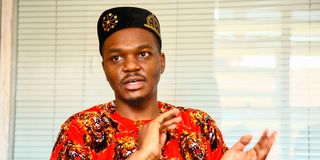
And finally, a Mau Mau story. A tribute to the freedom fighters who helped liberate Kenya. “Something authentic to Kenyans,” he says.
His message to fellow filmmakers?
“Always see the story from both sides. Make sure audiences enjoy your films. Let’s continue making films.”