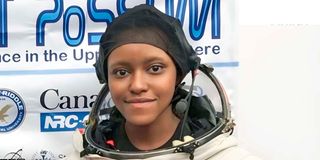
As a young girl, Wanjiku Chebet Kanjumba,29, would press her forehead against the windowpane of her Nairobi home, eyes fixed on the slow drift of stars overhead. While the city below bustled with noise and light, she was drawn to the silence, wondering what lay beyond the moon, behind the blinking satellites, and within the velvet dark that cradled it all.
“I sketched the curvature of planets, dreaming of escaping gravity. Inspired by my parents and brothers, one in medicine, the other in aeronautical engineering, my fascination with space felt like a calling, not mere childhood wonder,” she says.
She completed her A-levels with exceptional grades, earning her a place at one of the world’s leading aviation institutions—Embry-Riddle Aeronautical University in Florida, USA. She pursued a Bachelor of Science degree in Aerospace, Aeronautical, and Astronautical Space Engineering, disciplines that form the backbone of the global space industry.
Her coursework delved into complex subjects such as orbital mechanics, rocket propulsion, and spacecraft design, complemented by a minor in space operations.
“The minor exposed me to the intricacies of both commercial and private spaceflight operations—from safety protocols and space policy to life support systems, risk assessment, and the human factors that define mission success,” she says, adding that the multidisciplinary training gave her a clear understanding of what it takes to innovate and lead in the aerospace sector.
But Wanjiku’s ambition went far beyond traditional academia. She became the first Kenyan to graduate from the Project Polar Suborbital Science in the Upper Mesosphere (PoSSUM) Academy, an elite citizen-scientist initiative dedicated to studying Earth’s upper atmosphere.
This certification placed her among a select group of scientist-astronaut candidates worldwide. She went on to earn a Master of Science degree in Aerospace Engineering with distinction, specialising in the dynamics and control of various aerospace vehicles. This advanced expertise equipped her with the skills to engineer complex systems integrating robotics, artificial intelligence, thermal control and autonomy.
While completing her Master’s, she co-founded Vicillion with two colleagues. The company quickly grew from a technology research and development lab into a global infrastructure firm with a vision to build and operate the world’s first equatorial, commercially operated spaceport—the Omega Spaceport—in Kenya.
Launches from the equator, she explains, benefit from the Earth’s rotational speed, offering a fuel-efficient and weight advantage for geosynchronous and geostationary satellite missions.
“It is not just about my achievement, but about challenging societal conventions. Aerospace remains a male-dominated field globally, and even more so in countries where science and technology sectors are still developing,” she states.
She never saw it as a problem. She remembered her late father’s words: “Do not worry about what others are doing. Be yourself. As long as you have two working feet, two working hands, and a working brain, get it done.”
She understood that when people hear about aerospace or space engineering, they often think it is out of reach, especially for women.
She now channels that conviction into outreach initiatives, encouraging young girls, to pursue careers in science, technology, engineering, and mathematics (STEM), where role models are still scarce. Beyond Vicillion, Wanjiku serves as a Citizen Scientist at the European Space Agency (ESA), contributing her expertise to projects that advance space science, orbital sustainability, and environmental monitoring.
She has had a strategic role at Space Partnerships and Research Company (SPARC) as Director, Aerospace Engineer, and Assistant Head of Strategy and Communications.
She is currently pursuing her PhD in Aerospace Engineering (and certifications in Engineering Project Management, Engineering Innovation, and Engineering Leadership) at the University of Florida, where she is researching modular docking mechanics and autonomous in-situ construction for lunar and Martian surface habitats.
Her multi-faceted involvement in global aerospace initiatives highlights the interconnectedness of space exploration and Earth’s sustainable development, a perspective she passionately advocates.
She believes that Africa has the potential to become a prominent spacefaring continent, leveraging its equatorial geography, youthful and ambitious population, and innovation ecosystems.
“African countries can leapfrog traditional development stages by investing in space technology, satellite communications, and infrastructure. We can harness space tech for agriculture, climate monitoring, disaster management, and education,” she notes.
Wanjiku regards Vicillion’s spaceport project as the initial step towards developing a sustainable space ecosystem in Kenya and across the entire continent. The initiative will generate employment, promote technological innovation, and establish Kenya as a centre for space commerce.
Her long-term dream is to build an integrated space ecosystem linking Earth, the Moon, Mars, and the Asteroid.
Her influence extends far beyond Kenya. She is the lead author of the Integrated Network for Commercial Spaceports (INCS), a visionary framework presented at the International Astronautical Congress (IAC) 2025 in Australia, which proposes a globally interconnected network of commercial launch sites.
The INCS aims to standardise operations, harmonise regulations, and streamline launch scheduling across continents, creating a “Space Internet of Launchpads” that enhances global access, reduces congestion, and promotes equitable participation.
“Imagine a world where a satellite built in Ghana can book a launch from Australia, Kenya, or Alaska through a single digital platform. That is the future we are building,” she explains.
The INCS has gained traction with space agencies, private operators, and policymakers, positioning Wanjiku as a global thought leader in space infrastructure and governance.
Wanjiku is also a key contributor to the Unified Approach to Space Traffic Management (USTM) concept that proposes the formation of two entities: the Global Space Traffic Management Authority (GSTMA) and the Universal Space Traffic Coordination Centre (USTCC) to prevent orbital collisions and ensure long-term sustainability.
Recently, she was selected as one of 70 recruits worldwide to join Titans Space’s cutting-edge Research and Development (R&D) and Expedition and Development (E&D) Astronaut Program, where she will be trained as a Career Astronaut, as the first (and currently only) Kenyan in the program, focused primarily on orbital and Moon missions.
To aspiring scientists and leaders, she says. “The observable universe does not discriminate. It doesn't matter where you are from, what you have done, or who you are, and that means you get to define everything for yourself. The stars belong to you. Claim them.”