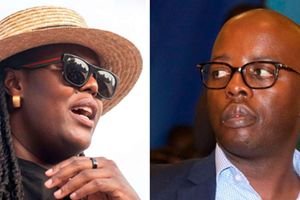
Nice Githinji is an immensely driven multiple award-winning performing artist. Her versatile portfolio includes TV series 'Nganya' (Showmax) which she co-created, 'Crime and Justice' (Showmax) and is soon releasing a short film she produced and starred in called 'Midnight Van'.
1. You say that you're not one to shy away from tackling challenges plaguing your industry. What challenges are these and how are you taking them on?
I'm not one to shy away from tackling challenges. Could be within the industry or without. As far as the industry is concerned, to make sure that we had performers who had an idea of working on the craft, I created a syllabus to train actors professionally when I sat on the board of the Kenya Actors Guild.
That was way back in 2010 or so, when ‘acting schools’ hadn't popped up all over the country. The plan didn't really pan out, and that's when I decided to start training on my own. I have in the past been part of committees that have challenged the CMOs in charge of collecting artists’ revenues as well.
More recently, there has been a surge in sexual abuse (physical & verbal) in the workplace within our industry, and I have been able to put out sensitisation podcasts with the help of Valentine Zikki.
We also had a great challenge as performers at the onset of the pandemic because we were used to physically being in front of the audience for our shows. Together with an actor called Nyokabi Macharia, I curated Shorts from Africa (SFA), a Kenyan collective that brought together artists from different disciplines to create works inspired by Africa and its literature.
Through SFA, we staged plays live on Instagram while collaborating with actors, writers, and directors from all over the world.
Aside from art, I am passionate about the safety; physical, mental, and financial, of women and the female form. My first active role with this has been in being at the forefront of the battle against period poverty.
I have been working closely with Scandicare, in the distribution of menstrual cups while having conversations around the stigma that comes with menstruation.
2. You're very excited about your upcoming movie. What made you change your director to Caroline Odongo? How did you raise funds for this movie, and when is it coming out? Where will Kenyans be able to watch it?
First of all I've always admired Caroline Odongo. Every time I've been in her hands, I've come out the other side a better actor. So let's just say that selfishness was one of the reasons. I haven't been sharpened lately by a director because I've been doing appearances as opposed to fully fledged roles that take time to study.
I needed this. Secondly, it was the need to work with a full female team. This wasn't the idea at inception. I just played around with the thought, then figured, why not try? I believe women have a way with things and around things. They are instinctive. They are empathetic.
They know how to work the tiniest of budgets (you'll find that most line producers are women) and run sets like the military (the best Assistant Directors we have are women).
However, GoFundMe stopped campaigns from certain countries from April 27 this year, and Kenya was one of them. This has put a little dent in the fundraising process. The film should be out by early August.
Ideally, if the funding works out and I manage to pay my cast and crew in full, the plan is free distribution across the country via all portals available. FTA, VOD, social media, Vimeo, and YouTube.
If I don't raise enough money, then it means I will have to re-sale the film in order to compensate my team and recuperate my expenditure. It's important to note that if I do end up selling the film, then anyone and everyone who donated will get to see the film first, amongst other goodies, once we release.
3. Crime and Justice hit the airwaves and the imaginations of Kenyans in a big way within the last few months. How was it to be on a show with such high standards of production? Did it give you hope for the industry, or simply confirm that we're going in the right direction?
I'll go with the latter because most of the shows I've been on with such standards are usually for international release and run by foreigners. C&J is pretty much ours. It gave me hope to see that if given the chance, we can pull off shows with big production budgets.
You can always tell when production quotes, for instance, USD 30 million for a show, then spend USD 25 million on cars and houses and side businesses, then shoot with just the 5 million left over. This wasn't the case on C&J.
Every coin was spent on making the show great and the actors comfortable. It was also a lot of fun. The set was uber professional and the compensation quite good. I think I made in five days what most are making in a month on recurring TV shows.
4. As you've done both, what do you prefer, stage or screen? What's your favourite role that you've ever played?
Obviously, the stage comes first. It's just not consistent enough. Hmm…maybe it's up to me to make it consistent, now that I think about it… Anyway, the stage wins. I'm an adrenaline junkie and nothing beats the rush I get while on stage.
Once the curtain goes up you have to dive in. I can only compare it to bungee jumping! My favourite role so far has to be Wangeci in Ngugi wa Thiong'os ‘I will marry when I want’ - Ngaahika Ndeenda.
She's strong willed yet subtle in her ways. It's easy to think her husband makes the decisions but if you listen closely you realise that almost every choice he makes has been pushed by her. She reminds me of my mother with her silent strength.
5. Take us through what it takes to produce a show or a film, in the same way you did your upcoming film, or even Nganya. Storyboarding? Casting? Scripting? How does it work?
It starts with a feeling in the heart, haha. ..This longing to create. Then your pocket puts you in check. Can you afford it or not?
However after the script is in hand, it's sent to a couple of trusted people for notes, to help develop the script further. In an ideal situation, there would be a budget for these people because after all, they are sharing their knowledge.
After script development comes casting, then the crew is picked as locations are being sorted. The line producer works on the budgets, lawyers prepare contracts, the producer runs after film licenses and ratings, etc.
At this point wardrobe would be busy shopping after discussing with the camera, art and lights departments on the colour scheme/temperature of the show. Most things happen concurrently during pre-production like recce, rehearsals, and safety training in case there are weapons on set, for example.
There is no one way of producing, I'll say. Some start with a script then cast, some have a cast as they write, some use storyboards (I've seen this more in music video production and advertising than film). There are many methods to our madness.