The Mountains of the Moon command the eye from the air, stretching until they fade into the horizon. Ptolemy, the great Greek scholar, had written of them as the source of the Nile as early as the 2nd AD, based on the accounts of early Arab traders.
From the 1850s onwards, central Africa became the magnet that drew explorers into its girth to solve the greatest geographical mystery of the time – what was the source of the Nile? Explorers like Speke and Burton, fuelled by Ptolmey’s map, cut across the middle of Africa unlike earlier explorers.
As we land in Kasese on the foothills of the Rwenzori Mountains straddling DRC and Uganda, the afternoon mist begins to settle on them. Modern-day Kasese is a busy mining town where cobalt is much sought after. Its copper mines are a thing of the past.
A few kilometres past the equator, we suddenly spot a family of elephants. We’re driving through Queen Elizabeth National Park which runs between Kasese and Kampala.
A side road turns onto higher ground to reach the park gate, passing by crater lakes encrusted with salty shores. A narrow road between two water bodies has us at Mweya Safari Lodge, welcomed by its gigantic elephant (of course a statue) and we’re perched on top of a peninsula between Lake Edward and Kazinga Channel, offering amazing views of the landscape. The 32-kilometre natural channel drains Edward’s waters into Lake George on the other side of the main road. In ancient times, the two lakes may have been a super-lake, but volcanic activity filled it, leaving the natural channel between the two lakes. The two then flow into Albert (that we saw from Murchsion Falls) and continue as the Nile thereon.
Henry Morton Stanley was the first to document Lake George in 1875, the same year he confirmed that Victoria was indeed the Nile’s source after sailing around it on his boat, Lady Alice. On his second visit in 1888, he discovered Lake Edward, naming both after the British monarchs.
Edward, however, was renamed Lake Idi Amin in 1973, until the dictator was overthrown in 1979.
The eventide arrives with a lion strolling through the lodge, announcing its presence with some growls.
In the first light of the day, the fiery sun lights the plains. A pride of lions has been spotted, but while we wait, a van-load of noisy tourists who have paid extra for the experiential permit in the excuse of helping researchers drive off-road in haste, and we never get to see the cats. Instead, we meet a lone leopard a few metres away, watching humans behave badly. The leopard is collared – part of a study to know how far they wander in an effort to protect their spaces.
Finally, we’re at Lake Katwe, a crater lake in the park. It’s busy with a curio market on the crater’s rim. Katwe is a major producer of salt in Uganda, with salt pans laid out by the salt miners, an activity that goes back to the 13th century, according to research.
While we see no long necks or stripes in the park, for none exist there, the Uganda specials are in plenty – the Uganda kob and oribi, including waterbuck and Jackson’s hartebeest.
The highlight
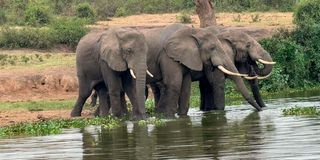
It’s the veritable Garden of Eden, the channel’s freshwater luring the animals – hippos, crocodiles, the antelopes and the most mesmerising – the elephants on the banks drinking their fill in and outside the channel.
The birds enchant. A handsome flock of African skimmers rise from the banks to skim the waters to snap the prey with their orange bills – the unmistakable shrill of the African fish eagle rent the air, pied kingfishers dotted like confetti on every bush, scores of waders like the Yellow-billed and Openbill storks stalk the shores for a fill of fish or water snails.
Children from the fishers’ village wave as we glide by, unperturbed by the hippos and elephants so close to them. The wide open expanse of water announces Lake Edward and the captain turns the ferry around.
In a spectacular twist, the storm has arrived unannounced. The sky suddenly turns grey and the wind whips the darkened waves, drenching some. It vanishes as suddenly as it came by the time we dock.
It’s time for our next destination. En route to Kasese to catch our flight for the gorilla trek, we stop at the Equator and drive up the shoulder of the Ruwenzori to enter the Democratic Republic of Congo. It is one of the most beautiful drives showing off the park in all its beauty. We don’t reach the DRC – even though the border is a few kilometres away. The aircraft has landed.
Queen Elizabeth National Park is famous for its lakes, tree-climbing lions, chimpanzees and the Kazinga Channel.